


A Vision Takes Root
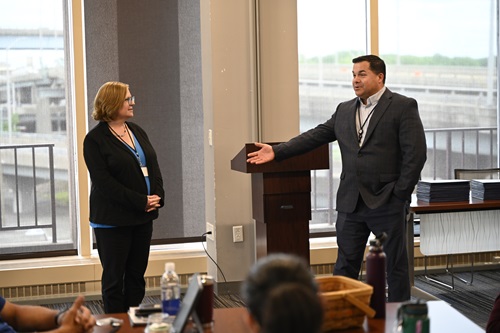
In late 2018, amidst a rapidly evolving workforce landscape and shrinking state resources, then-Governor-elect Ned Lamont gathered his transition team to reimagine the future of government operations. Among the top priorities: overhaul a fragmented human resources infrastructure that no longer served the needs of a modern, adaptive state workforce.
Governor Lamont’s direction was clear: “Agencies don’t require their own individual fiefdoms,” he told Nick Hermes, in New Haven. Hermes, now Deputy Commissioner of the Department of Administrative Services (DAS) and the State of Connecticut’s Chief Human Resources Officer, was charged with an ambitious task: design and deliver a centralized HR structure that could meet the moment.
What followed was a transformational journey. Over the next five years, Connecticut consolidated HR services across most executive branch agencies into a unified DAS-led model. This story celebrates the remarkable progress of that initiative.
"This effort to centralize human resources across our state agencies was about creating a government that works better and smarter for the people of Connecticut. I’m proud of what we’ve accomplished in just five years—this is a lasting success story for our state," Governor Lamont reflected.
Why Centralize? A System Under Strain
Before centralization, HR operations varied drastically across agencies. Staff shortages, inconsistent practices, outdated processes, and little to no technology led to duplication of effort, compliance risks, and service delays. HR had become decentralized to the point of dysfunction and instability.
The administration recognized the opportunity for scale, consistency, and expertise. By pooling resources, the state could:
- Address increasing complexity in employment laws and benefits;
- Improve compliance and reduce risk;
- Build scalable, adaptable systems;
- Strengthen workforce planning and service delivery.
Change in Action: Building a New HR Model
The centralization effort began in early 2019 and was formalized with Governor Lamont’s signing of Executive Order No. 2 later that year. DAS assembled and co-led an executive steering committee, launched a communications website, and maintained continuous dialogue with agency stakeholders.
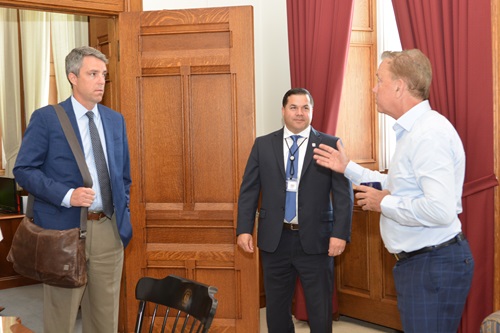
Despite the undertaking's complexity and major external events, such as the COVID-19 pandemic and mass retirements, DAS remained focused on people, processes, technology, and change management.
Leadership Continuity: Commissioner Gilman Carries the Work Forward
In 2022, Commissioner Michelle Gilman was appointed to lead the Department of Administrative Services, succeeding former Commissioner Josh Geballe. Under Geballe, the groundwork for HR centralization was laid with a bold vision and decisive momentum. Commissioner Gilman continued that work with unwavering commitment, helping the initiative mature from concept to practice.
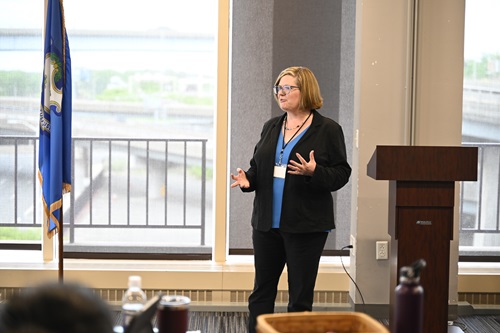
Gilman has championed a data-driven, people-focused approach by encouraging collaboration across agencies and deepening the state’s investment in talent development and innovation. Her leadership has ensured that centralization is not just sustained but continuously refined and expanded to meet the needs of Connecticut's workforce.
"HR centralization has helped us build a stronger, more agile state workforce,” Commissioner Gilman said. “It is about delivering services that are responsive, consistent, and grounded in excellence. Five years in, the progress has been significant, but it is a work in progress. I look forward to continuing these efforts over the next five years and beyond.”
Milestones & Metrics: What Centralization Has Delivered
Even in its early stages, HR centralization produced tangible results. Among the most significant:
- Over $7 million in personal services (PS) savings to the state’s FY22–23 budget.
- Elimination of backlogs in FMLA and military leave processing.
- Digitization of over 100,000 employee files through the UKG HR Service Delivery system.
- Policy consistency and standardized HR transactions across agencies.
- Development of new HR capabilities through dedicated, specialized teams.
These changes brought a new level of agility and consistency to HR delivery statewide.
Partner Perspectives: What Agencies Are Saying About Centralized HR
For agency leaders, the transition to centralized HR has been both a challenge and a source of new value. At the Department of Motor Vehicles (DMV), Communications Director Shaun Formica reflected:
“The transition to a centralized HR model has significantly enhanced our operations. It has provided us with valuable support from subject matter experts… and we look forward to further refining our collaborative approach to best serve the DMV.”
The DMV has benefited from more consistent policy interpretation, though Formica noted ongoing needs for clarity around roles and responsibilities. With continued support from DAS, agencies like the DMV are seeing faster turnaround times, more responsive service, and better alignment with statewide goals.
Empowering Growth: Learning & Development in the Centralized Era
Learning & Development (L&D), under the leadership of DAS’s Peg Hackett, has flourished in the centralized model. The team now delivers strategic, data-informed training programs aligned with agency needs, compliance requirements, and employee growth.
Key offerings include:
- The Aspiring Leaders Development Program, relaunched in 2023 after a several-year hiatus, supports leaders with developing skills to become effective managers. This program has trained 68 leaders from 21 agencies since 2023.
- Generative Artificial Intelligence (AI) in the Public Sector, a collaborative initiative between DAS and US Innovate.
- Statewide training for General Letter 115, impacting 11,000+ employees who operate DAS fleet vehicles.
- Programs for Workplace Violence Prevention, Diversity & Inclusion, Hiring for Managers, and more.
- Custom learning paths tailored to agency and HR team needs.
- Integration of LinkedIn Learning to provide over 19,000 expert-led online courses.
“Learning and growth are an economic imperative… Our mission is to help people challenge themselves through curiosity and continuous learning,” Hackett said.
The L&D team supports additional HR functions by partnering on training programs designed to enhance HR specialization, including current initiatives for Benefits & Leaves and HR Business Partner teams.
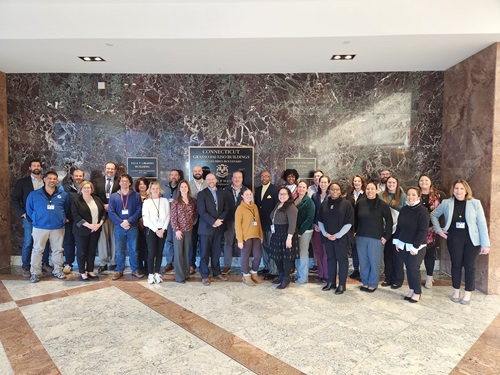
“With a seat at the strategy table in Centralized HR, Learning & Development improves performance through a consultative needs analysis to address business gaps and challenges,” Hackett said.
The L&D team uses tools such as dashboards and participant surveys to measure impact. Their most high-profile success stories include:
- General Letter 115 training, linked to DAS Fleet Operations telematics data, which is already demonstrating reductions in driver violations;
- Aspiring Leaders, where 100% of surveyed participants reported positive impacts on their growth and leadership performance.
Future goals include:
- Promoting a culture of continuous learning;
- Advancing digital fluency across the workforce;
- Equipping every employee to lead and innovate, regardless of title or role.
Reinventing Recruitment: Talent Solutions Leads the Way
Talent Solutions, led by Michael Cosgrove, has transformed recruitment from a decentralized, transactional function into a dynamic, proactive talent acquisition operation.
Key improvements include:
- Elimination of redundant approval steps in Core-CT.
- Enhanced job postings that tell a story and highlight career paths.
- Targeted sourcing using digital tools such as LinkedIn Recruiter, HBCU Connect, and Handshake.
- A strong presence on social media and job boards, with 3,200+ LinkedIn job posts and 700K+ views in FY24-25. State recruitment social media accounts are proudly some of the largest and most trafficked accounts in State government.
- Creation of impactful tools like the Vacant Position Request form and improved applicant self-service portals.
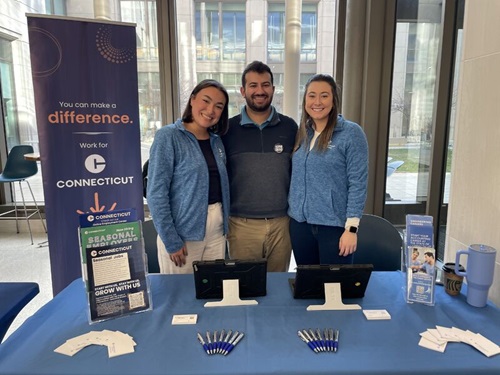
“We’ve found new ways to attract qualified candidates and spread the word that at the State of Connecticut, you can Start with us, Stay with us, and Grow with us,” said Cosgrove.
Championing EEO: Streamlining and Standardizing the Program for Increased Fairness, Transparency, and Compliance
The DAS Equal Employment Opportunity (EEO) Center of Excellence, led by Alicia Nunez, has standardized affirmative action, ADA accommodations, and investigations across participating agencies.
Achievements include:
- A shared complaint intake process and centralized training protocols.
- Standardized guidance on reasonable accommodations.
- Data-driven monitoring of complaint trends, timelines, and plan submissions.
“Centralization has eliminated disparate interpretations of policy across agencies… Agencies in our structure see lower complaint rates, faster plan approvals, and fewer technical issues,” said Nunez.
The EEO team is now working to onboard more agencies and enhance inclusion efforts across the executive branch.
Strengthening Agency Partnerships – The Role of HR Business Partners
Under Erica D’Angelo’s leadership, the Agency HR Business Partner (HRBP) role evolved from primarily transactional work to a more strategic, consultative position. “HR centralization truly modernized the way the Executive Branch administers human resources functions and matches what private sector companies have been doing for decades,” D’Angelo noted. Prior to 2020, on-site HR teams were often stretched thin, handling everything from retirements to leave administration—tasks that diverted time from workforce planning, recruitment, and relationship-building. With the creation of specialized Centers of Excellence to handle complex processes, HRBPs can now focus on strategic priorities like workforce planning, hiring, employee relations, and agency collaboration.
This transformation was not without challenges. “Because each agency's human resources department operated so separately and differently from the next, one of the most significant challenges we encountered was understanding and inventorying the way each team conducted then understanding how it would fit into the centralized model,” D’Angelo explained. The HRBP Project Team, under the lead of HR Statewide Program Manager Sandra Nigro, worked to standardize and digitize processes, create a central repository for guidance, and unify procedures across agencies. These changes have made hiring more efficient and reinforced the sense of the Executive Branch as a single employer.
One standout example of strategic impact comes from the Department of Transportation, where HRBP Brenda Abele led the creation of a formal apprenticeship program for Transportation Maintainer 2 positions—roles that had historically been hard to fill. Through more than a year of planning, negotiation, and design, the program launched its first cohort earlier this year, with graduates set to move into full positions by November 2025. A second class began in August 2025, helping the agency achieve record staffing levels.
Over the past five years, relationships between HRBPs and agency leadership have strengthened. While there was initial hesitation around centralization, trust has grown as HRBPs delivered consistent, compliant, and results-oriented service. Agency leaders now see their HRBPs as strategic partners who help drive priorities while ensuring HR best practices.
Customer service has also improved measurably. According to D’Angelo, “Our ability to scale teams based on needs has been our biggest key to success.” Centralization allows HRBPs to quickly deploy generalists between agencies to prevent service gaps, contributing to record vacancy fills, increased size of the workforce, and greater standardization of HR transactions statewide.
The Backbone of Consistency: HR Policy and Systems
Behind the scenes, Jeremy Kushin and the HR Policy & Information Systems team have built the infrastructure that powers HR consistency statewide.
“One agency might perform a standard transaction completely differently from another… our UKG system helps ensure accurate, consistent, and timely service,” Kushin said.
Major accomplishments include:
- Deployment of the UKG HR Service Delivery (HRSD) system for case and file management.
- Implementation of the Vacant Position Request (VPR) form to streamline job approvals.
- A self-service portal where employees can request leave or find information 24/7.
- Direct access to policy guidance, training, and timely communications via UKG.
Kushin’s team also supports the expansion of public-facing workforce data through the Open Data Portal, which provides transparency and insights on hiring, vacancies, and attrition. This assists legislators, policymakers, agency leaders, and others with key data to support decision-making.
“Centralization has been so beneficial to Statewide HR, and it could not have been achieved without strong leadership and guidance,” he reflected.
Streamlining Support: HR Shared Services in Action
From the beginning, HR Shared Services has been about getting employees and agencies the right answers when they need them most. Whether it’s a medical leave, a workplace accommodation, a military leave, or a workplace injury, these cases involve complex laws and time-sensitive decisions. That’s why the work is handled by subject matter experts—dedicated teams who ensure employees are supported and agencies stay compliant.
“Employees deserve accurate, consistent information—and agencies need the assurance that these complex processes are handled correctly,” said Lisa Annis, who has led the Benefits & Leaves division since 2022 and now leads the HR Shared Services division. “Having specialized staff on these cases protects both the employee and the employer.”
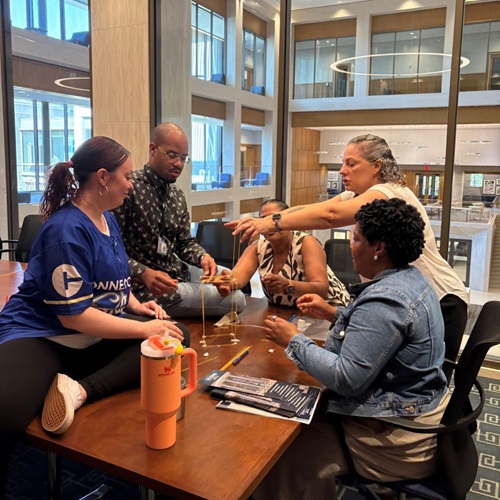
When the COVID-19 pandemic placed unprecedented strain on the workforce, the team faced a surge in FMLA requests from employees navigating health risks and caregiving needs. The team's approach was both practical and forward-thinking. They prioritized compliance with federal and state regulations while actively pursuing process improvements. One of the most significant breakthroughs was integrating FMLA leave requests into the UKG system, enabling employees to submit documentation electronically. "It was a big shift,” said Annis. “It streamlined the process for employees and helped staff work more effectively and efficiently.”
Equally impactful has been the team’s ability to load balance cases across the centralized HR structure:
In 2022, the state experienced a historic retirement wave, and through cross-training, collaboration, and load balancing, the team kept services moving during one of the most demanding periods in state HR history. “We can distribute cases across our statewide team instead of relying solely on a single agency HR office,” Annis explained. “It helps us manage workloads more evenly and provide employees with a more predictable experience—no matter what agency they work for.”
This approach has also brought new efficiencies to the Workers' Compensation program, where consolidating work under subject matter experts has led to more consistent application of policies and improved service for employees and agencies alike.
One of the strengths of HR centralization has been its ability to spotlight and support other initiatives to improve service. In 2023, the state began centralizing employee accommodations under the Americans with Disabilities Act (ADA), creating a more coordinated and consistent process for managing requests at supported agencies.
The 2025 merger of the Benefits & Leaves and Workers' Compensation divisions into HR Shared Services marked another pivotal step in the state’s centralization journey. This consolidation has deepened collaboration, expanded expertise, and strengthened consistency across specialized HR functions. Yet the mission remains the same: to deliver expert, reliable support for employees and the state.
“Centralization gives us the ability to keep improving,” Annis said. “As we move forward, our focus is on innovation—finding new ways to make HR services more accessible, efficient, and impactful for everyone we serve.”
Looking Ahead: A Stronger Workforce for the Future
As DAS continues to refine the centralized model, key priorities include:
- Automating more workflows and expanding self-service capabilities;
- Growing the expertise of specialized HR teams;
- Enhancing workforce data transparency;
- Standardizing on-site support and hiring practices;
- Expanding L&D offerings to drive workforce agility.
“We’ve built something the State can rely on—especially in the toughest times,” said Nick Hermes. “And we’re just getting started.”


