Unpermitted Dwelling/Sleeping Unit (or other) Conversions
This advisory is intended to help building officials respond when they become aware of a potential unpermitted apartment conversion or alterations to a dwelling unit. These situations can arise in many ways and often involve property owners who may not fully understand permit requirements or applicable building code provisions. The guidance that follows is meant to support a clear, consistent, reasonable, and coordinated approach – one that prioritizes life safety while helping property owners achieve compliance through the permitting process.
Building officials are responsible for administering and facilitating the Connecticut State Building Code and play an important role in promoting compliance through education, communication, and technical guidance. When conditions do not pose an imminent danger to occupants, and basic life-safety features are in place – such as working smoke and carbon monoxide alarms, a code-compliant means of egress, and no obvious hazardous conditions – it may be appropriate to allow continued occupancy while the property owner applies for permits and completes corrective work. Each situation should be evaluated based on the specific conditions observed.
As a reminder, pursuant to §29-315b of the Connecticut General Statutes, whenever a one- or two-family dwelling is occupied during interior alterations or additions requiring a building permit, the temporary installation of battery-operated smoke alarms shall be required in the vicinity of such alterations or additions for the duration of construction activities.
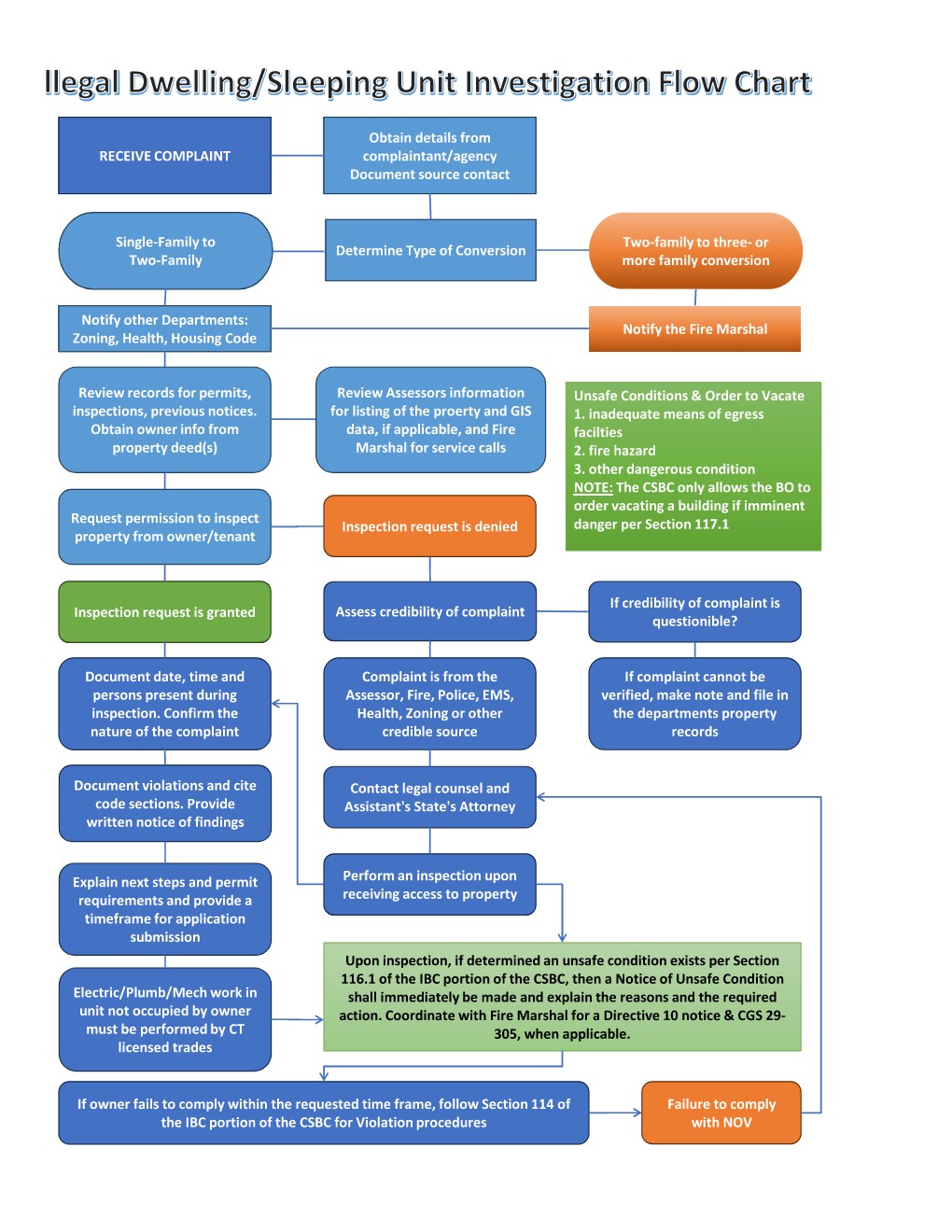
Whenever possible, the emphasis should be on education, communication, and providing a reasonable path for owners to legalize existing conditions through the permitting process. The checklist and flowchart included in this advisory distinguishes between conversions that remain within one- or two-family dwellings and those that result in three or more dwelling units or involve commercial buildings, as these determinations affect coordination with other departments and Fire Marshal involvement.
The overall intent of this guide is to encourage voluntary compliance, promote life safety, protect occupants, and ensure that unsafe conditions are addressed effectively and in accordance with the Connecticut State Building Code and applicable statutes. Please contact this office should additional clarification or information be required. This advisory may also be used as general guidance when addressing other types of unpermitted work.
Unpermitted Dwelling Unit Investigation Checklist
- Determine conversion type:
- Single-family (Group R-3) → two-family (Group R-3) (Fire Marshal not required)
- Two-family (Group R-3)→ three+ units (Group R-2) or unit in commercial building (Fire Marshal involved after BO abatement process for plan review and construction inspections to bring it up to code)
- Three+ units (Group R-2 to R-2) or unit is in a commercial building (B, A, M, etc.) → Units added (Fire Marshal may take the lead in the abatement process)
- Intake & Verification
- Obtain details from complainant/agency (nature of complaint, duration, evidence)
- Document source contact information
- Review building records for permits/plans
- Confirm whether use has changed. Short-term rentals do not change occupancy except Bed and Breakfasts--notify ZEO if zoning implications exist)
- Determine whether the building remains classified as one- or two-family.
- Coordinate with Other Departments
- Notify Zoning Department
- Notify Health Department
- Notify Housing Code Department
Only if 3+ units or commercial conversion:
- Notify Fire Marshal
- Preliminary File Review & Contact
- Review internal permit/inspection history
- Contact property owner/tenant to inform them of the complaint
- Request permission to inspect the property
- If Inspection Is Granted
- Confirm if conversion exists and if permitted
- Verify egress, smoke/CO alarms functional
- Document violations with code citations
- Record date, time, persons present
- Provide written notice of findings
- Explain next steps and permit requirements to the owner/tenant
- Provide timeframe for permit submission
- Inform owner that electrical/plumbing/mechanical work in a unit not occupied by the owner must be by CT licensed trades (CGS §20-340(11))
- If Inspection Is Denied
- Assess credibility of complaint (Assessor, Fire, Police/EMS, Health, etc.)
- Consult legal counsel and Assistant State Attorney for direction
- If evidence supports violation → issue Notice of Violation (IBC Section 114)
- If evidence does not support violation → building official shall make a note on the property records in the department
Only for 3+ units or commercial buildings:
- Building official shall notify Fire Marshal of complaint and Fire Marshal will follow their procedures.
- Unsafe Conditions
- If unsafe per IBC Section 116.1 → issue Unsafe Notice (IBC Section 116.3)
- Explain reasons and required actions
Only for 3+ units or commercial buildings:
- Fire Marshal to issue order if egress/light/ventilation/fire hazards exist
- Compliance & Enforcement
- Allow reasonable time for permit/application
- Request written compliance plan with timeline
- If owner fails to comply → follow Section 114 CSBC/IBC for Violation procedures
Sincerely,
Omarys Vasquez, AIA, NOMA
State Building Inspector