CTLRTP Logo

Image of cars driving along Merrit Parkway with navy blue overlay. The Connecticut 2055 Long-Range Transportation logo is at the top of the frame and the words Executive Summary are below.

A vision for the future of Connecticut's transportation system

Connecticut 2055 is the Connecticut Department of Transportation’s (CTDOT) long-range transportation plan (LRTP), which provides a roadmap for the future of Connecticut's transportation system by setting our long-term plans and goals. This people-first plan is the foundation for prioritizing transportation projects and implementing policies and programs based on funding availability and needs. CTDOT updates the LRTP regularly to reflect changing transportation needs, travel trends, community desires, emerging traffic management methods, and the evolving availability of financial resources.

 
Discover Connecticut 2055 by clicking below to review the final plan, executive summary, and complete set of appendices. Explore the tabs to quickly see what’s included in the plan.

Open Book Icon

Connecticut 2055

Read the full plan to see our vision for the future of transportation in Connecticut.
Icon of a piece of paper with five horizontal lines and a square in the top left corner of the paper

Executive Summary

Check out our executive summary for a brief overview of what's included in Connecticut 2055.
Icon of a book with a magnifying glass in the bottom right corner

Appendices

Looking for a deeper dive on one of the topics within the plan? Read the appendices.


Your guide to Connecticut 2055

Click below to explore the key highlights of our state's new long-range transportation plan.

Connecticut 2055’s vision is a forward-thinking statement of the ideal Connecticut transportation system that businesses, commuters, and residents desire. Our vision statement is: “We envision a safe and accessible transportation system that connects and enhances our communities. We strive for reliable and resilient multimodal transportation options for everyone. Our mission is to improve lives through transportation.”

The goals of Connecticut 2055 are:  

Safety for All Users
Provide a modern, reliable, and accessible transportation system where every person can travel safely, with the goal of eliminating serious injuries and fatalities.

Connected Communities
Connecticut residents and visitors will experience a multimodal transportation network that connects them to where they need and want to go, fostering prosperity and improving lives. 

Innovative Future
People in Connecticut will benefit from the adoption of emerging technology. 

Resilient and Sustainable Infrastructure
People in Connecticut will benefit from a transportation network that is resilient and sustainable through planning, design, construction, and operations. 

Vibrant Economy
Connecticut communities will thrive with the seamless movement of people and goods, creating greater opportunities and fostering growth. 

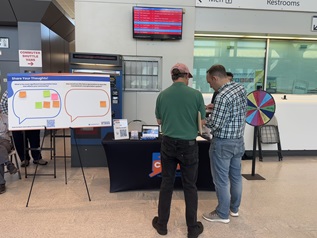
Throughout the long-range transportation planning process, we conducted extensive public and stakeholder engagement gathering input on how people in Connecticut envision the future of the transportation system. We received over 750 comments through…

10 pop-up events | 5 stakeholder group meetings | 4 virtual public information meetings | 2 public comment periods | 1 online survey | Coordination with 9 MPO/COGs, 3 adjacent states, and 6 Tribal Nations.

 
Your feedback helped us: 

  • Develop and align the vision and goals
  • Identify and confirm transportation challenges and opportunities
  • Inform strategic actions and funding priorities for plan implementation

Looking to learn more about our public and stakeholder outreach? Read Appendix A!

Photo of a woman wearing a camel colored jacket with long brown hair and man in a black coat and fedora style black hat facing a prize wheel at a pop-up event        Photo of a board on an easel. The board has a blue and orange border and is titled "Share Your Thoughts". There are multiple different colored sticky notes covering the board.         Image of two men standing at a pop up. The man to the left is wearing a red hat, green polo shirt, and black pants. The man to the right is wearing a blue and white plaid shirt and jeans. Both men are facing away to the camera with their heads down looking at something. A board with sticky notes and a prize wheel can be seen in the back.

The following set of strategies highlights many of CTDOT’s priorities for implementing Connecticut 2055. These strategies provide the first steps to meeting Connecticut 2055’s goals and will lay the foundation for achieving CTDOT’s long-term objectives. By focusing on initial steps, CTDOT can prioritize initiatives, build momentum, and gain broader public support for its long-term vision. Further strategies are comprehensively listed in the Implementation Matrix in Appendix E.

Safety for All Users

  • Prioritize implementation and updates of the Strategic Highway Safety Plan
  • Increase work zone safety programs
  • Expand successful programs: wrong way detection program and automated speed enforcement program
  • Promote legislation and administrative reforms to improve safety

Connected Communities

  • Invest in and expand bus routes, service frequency, and bus rapid transit to close service gaps
  • Expand the statewide Complete Streets program and support mixed-used development to increase walking, biking, and transit use
  • Invest in rail by modernizing the train fleet, adding new stations, and accessibility improvements 

Innovative Future

  • Continue integrating connected and autonomous vehicles through pilot programs
  • Embrace the use of drones in traffic monitoring, emergency management, and data collection
  • Transition to electric buses and expand the state’s electric vehicle charging network
  • Minimize cybersecurity risks and prepare for incidents through planning

Resilient and Sustainable Infrastructure

  • Develop improved data collection and forecasting tools
  • Improve emergency preparedness
  • Incorporate resilient roadway design to minimize erosion and strengthen infrastructure
Vibrant Economy
  • Leverage state-owned property to improve communication networks
  • Address truck bottlenecks
  • Improve freight access to ports and navigation channels

Connecticut’s transportation story is one of connection and change. With thousands of miles of roads, bridges, rail lines, bus routes, and other infrastructure, the state’s network helps support mobility wherever it is needed. CTDOT and its partners maintain this interconnected system to support driving, riding the bus or rail, bicycling, walking, and moving goods throughout the state.

In Connecticut, there are…

  • 376 overall miles of state-maintained roads
  • 17,480 overall miles of town-maintained roads
  • 1 statewide transit system (CTtransit)
  • 16 regional transit districts
  • 4,002 state-maintained bridges
  • 289 miles of multi-use trails
  • 238 miles of state-maintained rail
  • 20 public-use airports
  • 3 deepwater ports
  • 5 ferry services

Read Appendix B to learn more about Connecticut's transportation system.

Our capital projects and programs are based on a multifaceted set of priorities to enhance transportation infrastructure and services within the state. These priorities align with this Plan’s goals and objectives and are implemented through the projects developed and summarized in our Capital Plan and Statewide Transportation Improvement Program. Our capital priorities are focused towards:

  • Safety (Our #1 priority. We aim to reduce crash fatalities and serious injuries, create a safer environment for all users, and avoid long-term economic costs from crashes) 
  • State of good repair
  • Addressing congestion
  • Addressing rail and bus travel times
  • Active transportation considerations
  • Major programs and initiatives

As Connecticut changes, the system must adapt to meet the evolving multimodal needs of its people. Transportation facilities need to be regularly maintained, updated, and expanded to help Connecticut’s residents and visitors today and in the future. Some of the key challenges and opportunities that need to be addressed in the coming years include:


Challenges: 
Enhancing safety | Congestion hotspots | Meeting public transportation demand | Aging infrastructure | Adapting to technological change

Opportunities: 
Enhancing and expanding safety programs | Expanding travel options | Improving reliability and closing service gap | Designing resilient infrastructure | Investing in innovative technology

We will address Connecticut’s transportation challenges through a comprehensive, multimodal strategy to strengthen the state’s transportation corridors. CTDOT’s major capital investments and ongoing operations and maintenance efforts are continually refined to address many of these challenges. Through Connecticut 2055, CTDOT is further prioritizing the investments needed to meet these opportunities and advance a safer, more integrated network to move its people.

Successfully implementing the strategies of Connecticut 2055 will require the dedication of our people, the formation and collaboration of key partnerships, and the active involvement of Connecticut’s residents. You can learn more about CTDOT's proposed implementation strategies in Appendix E.

Our people
Staff at CTDOT will carry out each step for implementing Connecticut 2055. This LRTP requires a dedicated workforce to meet the future transportation challenges of Connecticut.

Photo of six men wearing yellow and orange reflective jackets and yellow hats with the CTDOT logo standing in front of construction equipment.
So, what happens next? We are already hard at work to address the transportation needs of the state so that we can keep improving lives through transportation. We will continue working on numerous major projects, multimodal planning studies, policies, and programs that are needed to improve safety, reduce congestion, and modernize infrastructure through planning, engineering, and public feedback. These efforts require valuable input and coordination with federal and state agencies, metropolitan planning organizations, local governments, and the public at large. We will focus on our most critical and immediate transportation needs while also addressing our long-term strategic goals.