

Streamlining Permitting for Dam Repair and Removal

Connecticut hosts the highest number of dams per river mile in the country, most of which are privately owned and many of which serve an important role for water supply, recreation, energy production, and other beneficial uses. Goal 18 focuses on updating DEEP’s dam safety permitting and guidance to facilitate and accelerate dam repair and removal activities, making it easier for regulated parties to keep the public safe. Background on this goal is presented in DEEP’s 20BY26, Setting the Target: CT DEEP 2026 Goals (February 2024).
 Latest Progress (as of April 1, 2026)
 This goal is 75% complete.
In Q1 2026, DEEP created a virtual guide to Dam Removal that highlights past dam removal projects and outlines the process of and available resources specific to dam removal activities. DEEP also made improvements to the Dam Safety Individual Permit Instructions after seeking feedback from permit users, as well as posting the processing status of Dam Safety Permits on the Dam Permitting webpage.
DEEP continues to enforce Emergency Action Plan (EAP) regulations, which require that owners of high hazard (Class C) and significant hazard (Class B) dams file an EAP every two years. Of the 54 notices of violation for dams lacking the required EAP that were sent to the owners of hazard class B-dams in January 2025, DEEP has now accepted 21 EAPs and worked with the remaining 24 private dam owners to resolve non-compliance. Six dams are missing owners and 3 have been reclassified to a lower hazard not requiring EAPs.
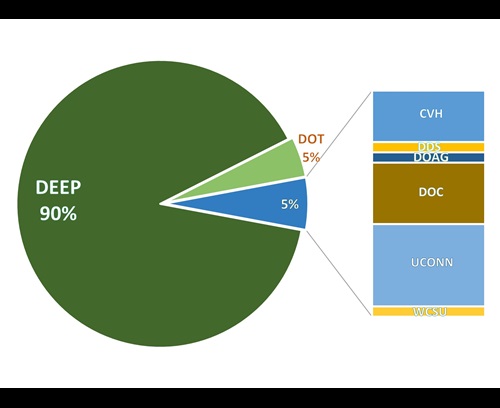
DEEP’s State Dams Program continues its work on CT’s Flood Control Systems StoryMap, including State-owned NRCS and USACE flood control dams, dikes, and flood control channels. The State Dams Program submitted 13 required EAPs to DEEP’s Dam Safety Program; these were approved. DEEP’s repair of the Tankerhoosen Lake North dam in Vernon was completed in 2025.
 Up Next
DEEP is developing sediment management guidance and will seek input from the Dam Safety advisory group when drafted.
DEEP will continue to map state-owned flood control projects and finalize its inspection program of state-owned low-hazard dams, including wildlife conservation dams. With the new data layer for flood control, DEEP will develop a Story Map using ARC GIS. The State Dams Program will begin repairs to CT Valley Hospital State Dam #1 in Middletown later in 2026.
GOAL 18 PROGRESS FROM PREVIOUS QUARTERS
Fall 2025
Following a robust stakeholder engagement and drafting process with the Dam Safety Permit Advisory Group, DEEP reissued three improved Dam Safety general permits GP-014, GP-015, and GP-016 on October 16, 2025. The updated general permit application forms, as well as a table outlining expanded authorized activities, are posted on the DEEP dam permitting website.
In Q4 2025, DEEP continues to enforce Emergency Action Plan (EAP) regulations. Of the 54 notices of violation for dams lacking the required EAP that were sent to the owners of hazard class B-dams in January 2025, DEEP received 16 EAPs in response and worked with private dam owners to resolve non-compliance.
DEEP’s State Dams Program continues its work on CT’s Flood Systems Map, including State-owned dams, and NRCS and ACOE flood control dams, dikes, and flood control channels. The State Dams Program submitted 13 required EAPs to DEEP’s Dam Safety Program; these were approved. In Q4 2025, the State Dams Program selected a removal contractor in collaboration with DMHAS for the deconstruction of CT Valley Hospital State Dam in Middletown later in 2026.
Summer 2025
DEEP presented on three improved and soon-to-be-reissued Dam Safety General Permits GP-014, GP-015, and GP-016 at the CT Water Works Association technical workshop on September 9, 2025.
DEEP continues to enforce Emergency Action Plan (EAP) regulations. Of the 54 notices of violation for dams lacking the required EAP that were sent to the owners of hazard class B-dams in January 2025, DEEP received 11 EAPs in response.
In Q3 2025, DEEP’s State Dams Program began developing a GIS data layer for NRCS and ACOE flood control dams, dikes, and flood control channels that will depict areas of impact. The State Dams Program also completed its analysis of all DEEP-owned dams — for elevation, drainage basin size, spillway length, land rights downstream, and infrastructure downstream (using the CREST and 1995 report) — determining that none could generate enough electricity with hydropower infrastructure. Additionally, DEEP’s State Dams Program is collaborating with the Wildlife Division to explore funding sources to inspect dams.
Spring 2025
DEEP issued public notice for all GPs on April 16, 2025, with comments closing May 16, 2025. Only one comment was received.
DEEP is working on GIS map development of state-owned flood control projects, including locations of flood control channels, dams, and inundation areas, which is important information for resiliency infrastructure. In addition, DEEP conducted inspections of 30 state dams and flood control areas. DEEP recently purchased a 640-acre property in Killingly, a large open space acquisition, that contained 2 dams and 1 dike in poor condition. We will perform inspection and maintenance of the dam structures. DEEP also issued an RFP and selected a contractor to develop an Emergency Action Plan (EAP) on 13 state-owned high-hazard and significant-hazard dams. This project is funded by the National Dam Safety Grant.
Of the 280 notices of required inspection sent to dam owners in January 2025, DEEP received and processed 150 inspection reports. Of the 54 notices of violation sent to the owners of hazard class B-dams in January 2025 for not submitting an EAP, DEEP received 8 EAPs in response. Enforcement will follow.
DEEP has begun drafting sediment management guidance for dam safety, including methodology for analysis that is in line with other states, like New Hampshire.
Winter 2025
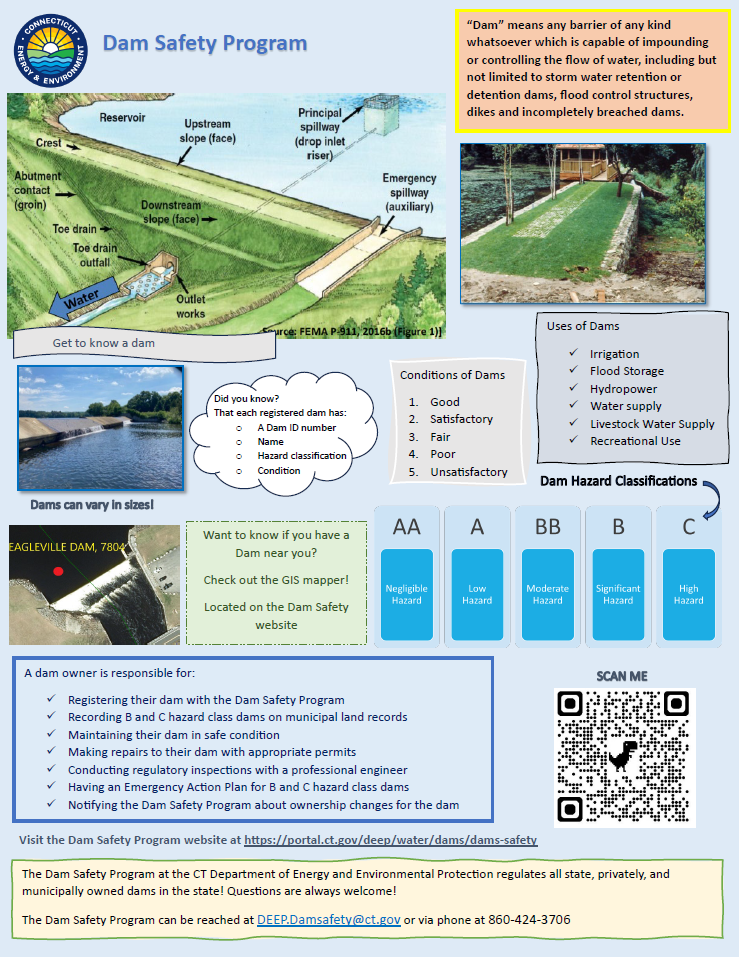
In Q1 2025, DEEP’s Dam Safety Regulatory Program focused on drafting General Permits 14, 15, and 16 to modernize and expand coverage under the GPs that will facilitate dam repair and removal. The Dam Safety Permitting Advisory Committee met 5 times this quarter to provide feedback to DEEP on these GPs, and DEEP incorporated internal updates from Fisheries, Remediation, Materials Management, Wildlife, and Land and Water Resources programs. DEEP’s new Dam Safety Infographic describes the features of a dam and owner responsibility according to hazard class to improve regulatory compliance.
 On January 14, 2025, as required by CGS Sec. 22a-409(c), DEEP Issued 280 notices of required inspection to dam owners. We also filled an enforcement position in the Dam Safety Program that will help us to strengthen dam regulatory compliance.
DEEP’s State Dams Program conducted internal coordination on DEEP-owned dams, including vegetation clearing and inspections for Eastern and Western Districts and providing DEEP’s Wildlife Division information for the inspection of dams in Wildlife Management Areas. The State Dams Program entered into a contract with the USDA for beaver control at DEEP-owned dams to reduce human health and safety issues and damage caused by beavers. DEEP’s State Dams Program is also working to develop a GIS map of state-owned flood control projects and is reviewing state-owned Dams for hydropower potential.
Fall 2024
This stakeholder-suggested goal was launched in August 2024. DEEP gathered an advisory group of industry professionals and met 3 times in Q4 2024 to collect recommendations on improving dam safety general permits. DEEP also held an internal kaizen event in November 2024 to streamline the consultation process for Individual Dam Safety Permits with other DEEP programs, thereby expediting the review process. The Fisheries Consultation Form was the first item to be improved – from two forms down to one form and adding clarity – and was embedded in the Individual Dam Safety Permit in December 2024.
DEEP compared the processing time for Individual Dam Safety Permits for dam repair and found that in the five-year period from 2020 through 2024, the median turnaround time was four months shorter when the applicant had a pre-application meeting with DEEP. As a result, we have added the recommendation to request a pre-application meeting in the upcoming instructions and guidelines for these types of permits.
DEEP’s compliance analysis of non-state-owned dams resulted in the issuance of 61 notices to Class B dam owners with missing EAPs.
Summer 2024
DEEP's Dam Safety Program began considering expansion of eligible activities under three General Permits (GPs) - GP-014, GP-015, and GP-016 - which expire on October 1, 2025. This expansion will allow the GPs to cover more activities and be easier to implement. DEEP conducted outreach and solicited stakeholder updates to the GPs at the Connecticut Water Works Association meeting. The Dam Safety Program issued notices of non-compliance to Class B (Significant Hazard Potential) dam owners missing Emergency Action Plans (EAPs).
Content last updated July 2026.