
Speeding Permitting for Decarbonization

In Goal 14, DEEP is exploring and implementing best practices to streamline renewable energy permitting and maximize investments in critical decarbonization efforts, including to meet decarbonation goals and follow plans, such as DEEP’s 2021 Integrated Resources Plan. Background on this goal is presented in DEEP’s 20BY26, Setting the Target: CT DEEP 2026 Goals (February 2024).
 Latest Progress (as of April 1, 2026)
 This goal is 100% complete.
DEEP gave a Community Renewable Energy Siting Tool (CREST) demonstration webinar for Sustainable CT on January 20, 2026, guest-lectured in February at UConn about permitting and siting renewable energy in CT, and presented at the CT Land Conservation Council annual conference in March.
DEEP also launched a Solar Facilities Dashboard that displays projects approved by the Connecticut Siting Council and their company, town, and capacity, which will eventually be incorporated into CREST. CREST is currently being applied to efforts by GreenerGov and the CT Green Bank to help assess the suitability of various state facilities to host future solar installations. DEEP is also holding quarterly meetings with solar siting and environmental justice experts from Massachusetts, Michigan, and New York to compare notes on common issues that transcend state boundaries.
 Up Next
Beyond the goal, two studies will be conducted pursuant to sections 11 and 16, respectively, of PA 26-127. DEEP will translate its work and research to date on the topic of agrivoltaics to the study required by the Legislature by January 1, 2027, and launch an Advisory Council in early July to provide input on the Solar Siting Study due to the Legislature November 30, 2026 as draft, with the final report due February 1, 2027.
DEEP will also announce the projects chosen in the zero-carbon energy generation procurement.
GOAL 14 PROGRESS FROM PREVIOUS QUARTERS
Fall 2025
In Q4 2025, DEEP, ECOS, and NASEO held a workshop on October 9, 2025, where DEEP presented the Community Renewable Energy Siting Tool (CREST) and other states were invited to present and discuss their tools for renewable energy siting. DEEP also presented CREST at the CACIWC (CT Association of Conservation and Inland Wetlands Commissions) Annual Meeting and Environmental Conference on November 15, 2025. Additionally, DEEP featured CREST at the COST (CT Council of Small Towns) Fall Meeting on October 22, 2025 and our October 30, 2025 Municipal Connection newsletter featured CREST.
Summer 2025
 In Q3 2025, DEEP gave CREST demonstration webinars for the Connecticut chapter of the American Planning Association on September 10, 2025 and “Sun” Day at CCSU on September 21, 2025. NBC interviewed Commissioner Dykes, where she discussed the CREST and its viewer metrics since its launch in May 2025. CREST has been accessed over 1,700 times, peaking when the tool went live and after each webinar and workshop.
In September, DEEP released an expedited request for proposals for zero carbon energy generation resources and, for the first time, included a link to CREST for solar developers to evaluate site suitability before submitting their project bids to DEEP.
Spring 2025
In Q2 2025, DEEP launched the Community Renewable Energy Siting Tool (CREST) on a dedicated webpage, where information on the tool, its use, and its data layers can be found. (Read the press release here.) We then conducted outreach to stakeholders with demonstrations of the tool to CEEJAC’s Energy & Technology subcommittee and hosted a webinar on June 18, 2025 with UConn CLEAR.
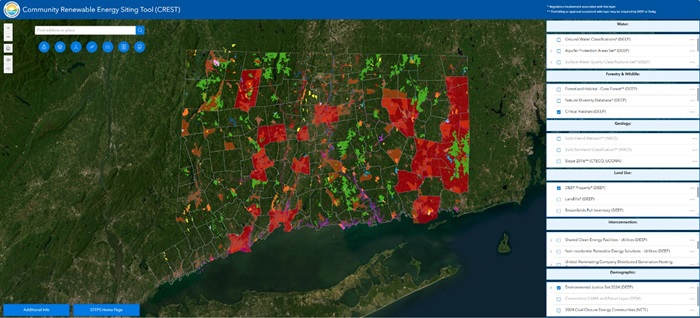
DEEP’s STEPS team continued work on developing strategic recommendations for permit streamlining and accelerating decarbonization through renewable energy projects by conducting a benchmark evaluation in other states across the country.
Winter 2025
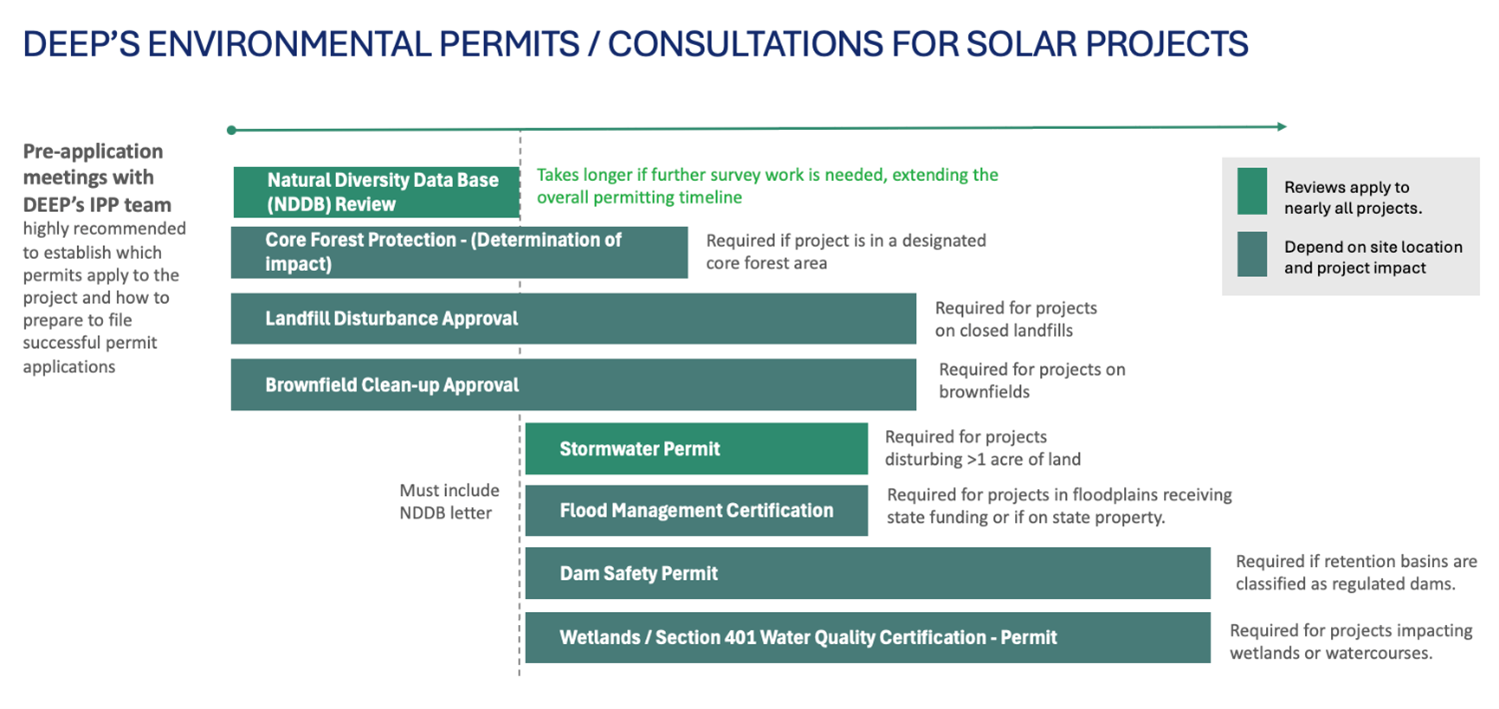
DEEP continued work on the Community Renewable Energy Siting Tool (CREST) mapping application, pursuant to PA 24-31, and made the CREST available to members of the CREST Collaborative, CEEJAC, CT Office of Policy Management, and the CT Legislature to test drive. As part of our research to provide recommendations for streamlining, DEEP evaluated decarbonization models in various states and developed infographics to visualize the permitting processes related to renewable energy generation projects.
DEEP, along with partners NASEO and ECOS, hosted their third workshop on March 6, 2025, for energy and environmental state representatives from New England, New York, and New Jersey with a presentation on “Planning for Future Electricity Demand Drivers” from ISO New England.
Fall 2024
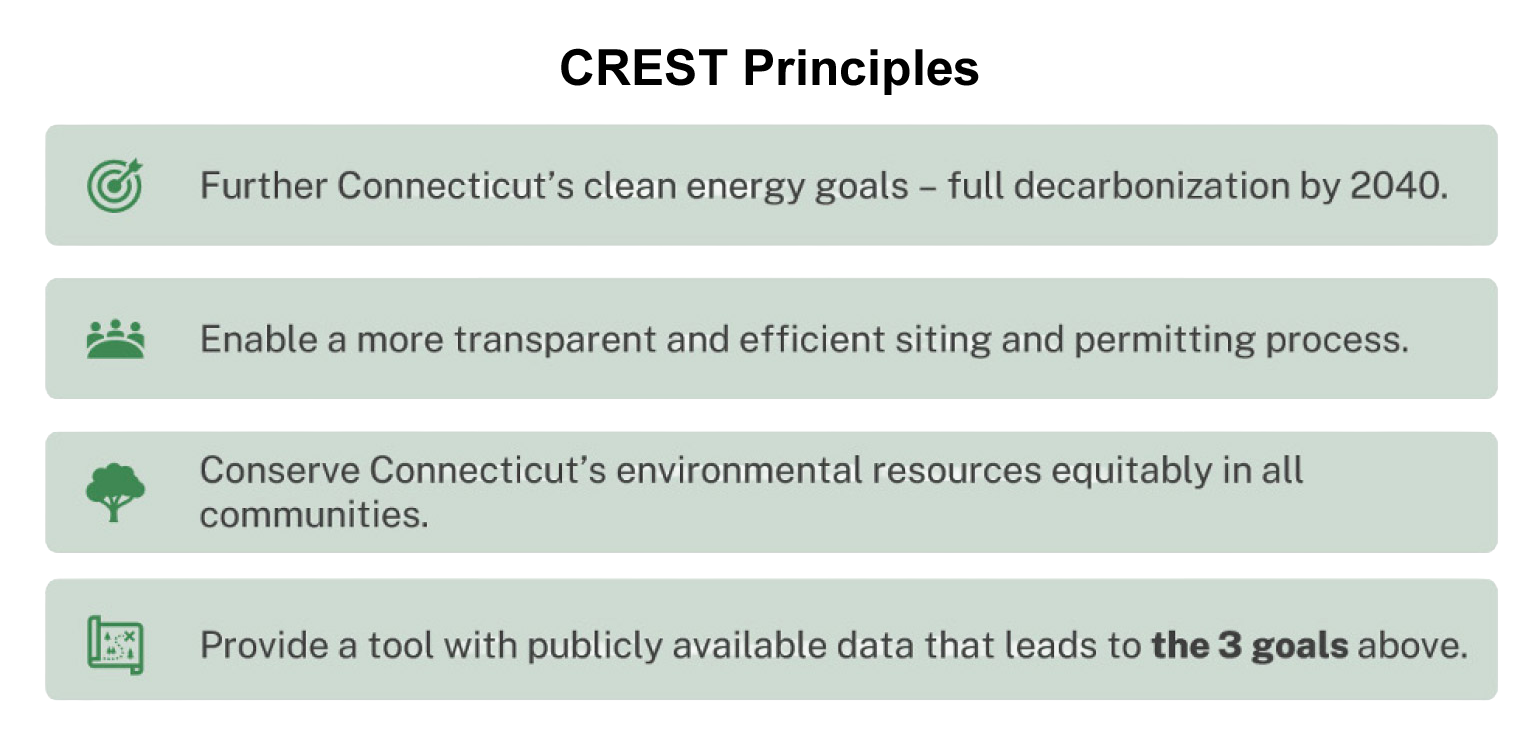
DEEP kicked off the Community Renewable Energy Siting Tool (CREST) Collaborative in October 2024, bringing together representatives from 25 organizations - municipal, conservation, farmland, solar developers, climate advocates, and others. This group advised DEEP and UCONN-CLEAR on the development of a renewable energy suitability siting map, pursuant to PA 24-31 (Sec. 5).DEEP then created a beta version of CREST, leveraging ArcGIS Online to publish an interactive application with layers identified as integral to siting future solar projects in Connecticut. Beta CREST was presented at the December 2024 CREST Collaborative meeting for their feedback.
In November 2024, DEEP worked with ECOS and NASEO to offer a regional permitting for decarbonization workshop: “Clean Energy Infrastructure Permitting and Timing – Opportunities and Challenges" – the first in a series of these workshops – during which NYSERDA focused on NY’s permitting successes and challenges.
In December 2024, DEEP released a draft report, held a public comment meeting, and delivered the Final CSC Study to the Connecticut General Assembly.
Summer 2024
In July, DEEP co-hosted a regional permitting for decarbonization workshop with the Environmental Council of the States (ECOS) and the National Association of State Energy Officials (NASEO), featuring energy and environmental representatives from New England states, New York, and New Jersey.
BETP participated in a working group led by CT Green Bank on decommissioning and disposal of batteries for energy storage and photovoltaic panels.
Pursuant to PA 24-144 (Sec. 12), DEEP began, with partner agencies, a study of the Connecticut Siting Council (CSC), received 65 public scoping comments, and set a public comment meeting.
Winter and Spring 2024
DEEP assessed the challenges associated with site development for solar energy generation and created a hierarchy of siting considerations for developers, which will be fundamental for projects to smoothly navigate the regulatory process. This hierarchy will be incorporated in future Sustainable, Transparent, and Efficient Practices for Solar (STEPS) siting guidance.

Previous Page | Next Page
Content last updated July 2026.