

Accelerating Access to DEEP Funding
DEEP is accelerating access to its funding through 20BY26 Goals 11 and 15.

In Goal 11, DEEP is speeding up key grant and contracting processes that it controls. DEEP administers roughly 35 individual grant programs from 14 different federal agencies totaling $370 million and counting. These funds support agency operations and pass-through contracts to nonprofits, municipalities, and other grantees. Background on this goal is presented in DEEP’s 20BY26, Setting the Target: CT DEEP 2026 Goals (February 2024).
 Latest Progress (as of April 1, 2026)
 This goal is 75% complete.
In Q1 2026, DEEP established an internal working group of grant program, contracting, and fiscal leads to break down siloed information and share best practices across the agency. This group kicked off in February 2026 and meets quarterly.
DEEP continues to work with OPM and other agencies to set up the pilot of a new statewide Grant Management System (GMS) using the Euna Grants platform. This system will assist DEEP in various phases of the grants administration process, from grant seeking to grant making. Critical benefits will flow to DEEP and grantees, including streamlined administration, simplified reporting, expedited payment processing, and improved grant opportunity awareness. Ten DEEP grant programs were selected in the pilot phase.
DEEP’s grant programs, in coordination with legal and fiscal offices, are developing templates to standardize information, documentation, and processing.
 Up Next
DEEP will deploy the new GMS solution in mid-2026. The Grants 101 page will feature required documents in the contracting process for each grant program.
GOAL 11 PROGRESS FROM PREVIOUS QUARTERS
Fall 2025
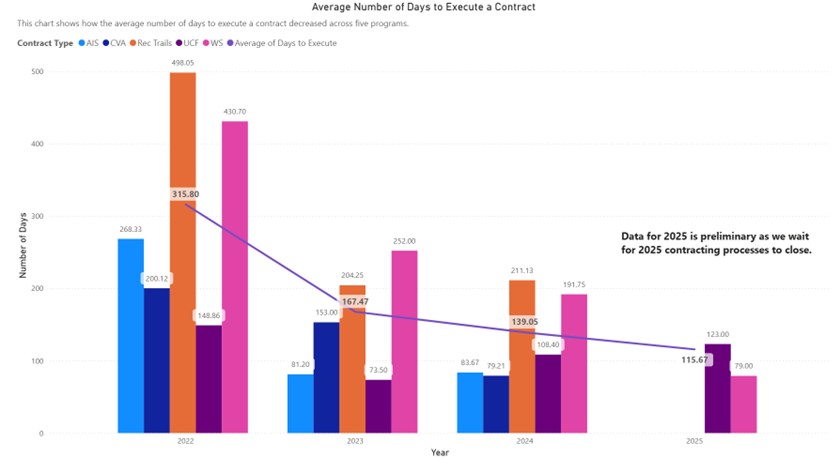
In Q4 2025, DEEP sustained processing times about 60% faster than the 2022 baseline, continuing to exceed our 50% goal. The average days to execute a contract across all programs decreased from 316 days in 2022 to 139 days in 2024, or 56%. Processing delays with federal grants continued. Please note that contracting for 2025 is not yet complete, so these metrics may change slightly over time.
DEEP continues to work with OPM and other agencies in the pilot of a new statewide Grant Management System (GMS) using the Euna Grants (formerly known as AmpliFund) platform.
Summer 2025
In Q3 2025, DEEP sustained processing times more than 60% faster than the 2021/2022 baseline, continuing to exceed our 50% goal. Processing delays with federal grants continued.
DEEP is participating with OPM and other agencies in the pilot of a new statewide Grant Management System (GMS) using Euna Grants.
DEEP also added more interactive content, current tools, and resources for grant seekers to the Grants 101 webpage.
Spring 2025
As of Q2 2025, the time to execute a contract slightly increased from last year to an average of 124 days in 2025, representing a 63% improvement on processing time below the 2021/2022 baseline average of 335 days which meets our 50% goal. Also, this quarter, federal agencies added a processing step that is leading to processing delays with federal grants. CVA contracts, for example, are currently shown in the “contracts pending execution” category below because of these delays.
Winter 2025
In Q1 2025, the time to execute a contract fell to an average of 103 days in 2024, representing a 69% improvement (reduction) on processing time since the 2021/2022 baseline average of 335 days.
 DEEP executed 221 contracts from 2021 to the end of Q1 2025, with 49 of those just in this quarter, and has 92 current pending contracts for grants awarded in 2024 and 2025 across the five major grant programs – Aquatic Invasive Species (AIS), Clean Vessel Act (CVA), Recreational Trails (Rec Trails), Urban Forestry (UCF), and Watersheds (WS).
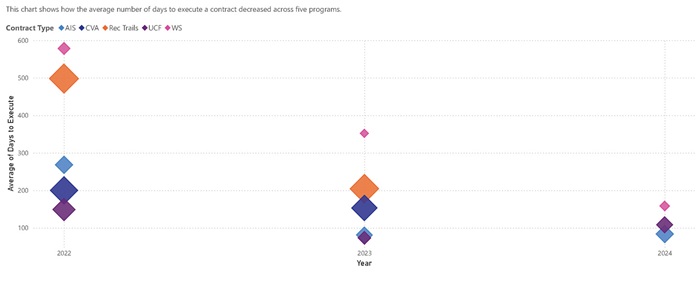
The scatter chart below shows reductions in days to execute a contract across the five programs over the last three years, as of Q1 2025. Implementation of a Microsoft Planner Board with associated flow charts and SOPs and the development of contract templates for some programs are the most transformational changes responsible for reducing the time from award letter to contract execution.
AVERAGE NUMBER OF DAYS TO EXECUTE A CONTRACT
Fall 2024
DEEP established a tracking baseline that starts with the grant award letter and ends with a fully executed, signed contract to measure and assess success metrics for this goal. During Q4 2024, DEEP collected baseline data for four of its main grant programs on contracting timeframes, focusing on the last two complete grant contracting years (2022 and 2023) to compare with the current year (2024). DEEP’s agency-wide planner board went online earlier this year, and some of the most recent results might be incomplete until 2025. During the 2022 – 2024 period, there were 172 executed contracts as well as 85 contracts still pending execution. The average number of days to execute these grant contracts fell over the years. The Aquatic Invasive Species program executed about 12 contracts per year, ranging from 268 days to issue in 2022, down to 84 days in 2024. About 30 contracts per year were executed under the Clean Vessels Act and completed in 200 days in 2022, down to 153 days in 2023. The RecTrails program executed about 38 contracts per year, ranging from about 498 days to issue in 2022, down to 204 days in 2023. Urban Community Forest grants executed about 21 contracts in 2022 and were completed in 149 days, down to 108 days across 10 contracts in 2024. Watershed grants executed 7 contracts in 2022, taking 602 days to complete, down to 158 days across 3 contracts in 2024.
Summer 2024
DEEP welcomed a durational Federal Grants Policy Advisor in the Commissioner’s Office and two Grants & Contract Specialists in DEEP's Bureau of Energy and Technology Policy (BETP). DEEP researched various contract management systems, and BETP field-tested a new "application to fulfillment" grant management tool through Amplifund with the acceptance of applications for broadband access. In August, DEEP conducted outreach with the Opportunities for Funding Connecticut Communities webinar.
Winter and Spring 2024
DEEP deployed an agency-wide contracting planner board, developed legal contract templates for individual grant programs, and conducted training to map the contracting process for staff internally as well as speed contract drafting.

In Goal 15, DEEP is focused on leveraging vital federal and state incentives and funding to expand clean energy, energy efficiency, broadband, and reduction of greenhouse gases, among other environmental priorities, and sharing this information broadly with residents and businesses. Background on this goal is presented in DEEP’s 20BY26, Setting the Target: CT DEEP 2026 Goals (February 2024).
Latest Progress (as of April 1, 2026)
 This goal is 50% complete.
In Q1 2026, DEEP continues to improve upon the Grants 101 website and conduct internal testing of the Euna Grants Management System (GMS) software.
Up Next

We expect to announce the selected vendor for the Energy, Sustainability & Broadband Navigator Tool and estimated development timeline before year end. The Euna state-wide GMS is projected to rollout in Summer 2026.
DEEP will add a tool highlighting required documentation for different stages of select funding opportunities will be added to the Grants 101 website.
GOAL 15 PROGRESS FROM PREVIOUS QUARTERS
Fall 2025
In Q4 2025, DEEP continued to improve upon the Grants 101 website, with new features coming in early 2026, and internally tested the Grants Management System (GMS) software. Currently, the 10 programs that will pilot Euna's statewide GMS, as described in Goal 11, are:
- Aquatic Invasive Species
- Broadband Equity, Access, and Deployment (BEAD)
- Clean Vessel Act
- DEEP Climate Resilience Fund
- Grid Resilience
- Home Energy Rebates
- Materials Management Infrastructure
- Open Space and Watershed Land Acquisition
- Rec Trails
- Urban Green and Community Garden
Summer 2025
In Q3 2025, DEEP received 9 proposals for the Energy, Sustainability & Broadband Navigator Tool, and a team of representatives from Connecticut’s Electric Distribution Companies, CT Green Bank, PURA, DEEP, and technical consultants reviewed them.
DEEP’s Offices of Telecommunications & Broadband and of Affordable Housing & Energy Retrofits coordinated with the CT Department of Housing to improve the broadband process with developers, increase broadband and energy efficiency, and establish a working group to problem solve.
As described in Goal 11, Connecticut’s Office of Policy & Management (OPM) has selected a vendor to work with DEEP and other state agencies to pilot a “total grants management system” (GMS), which would allow grant seekers to apply for grants and allow state agency grant givers, like DEEP, to more efficiently manage the grant administration process. In Q3 2025, OPM announced Euna Grants (formerly known as AmpliFund) as the state’s GMS vendor, and DEEP selected 10 programs for piloting the GMS.
DEEP updated the BIL & IRA transparency dashboard to track funding that the federal government is seeking to terminate.
Spring 2025
In Q2 2025, DEEP launched the revised Grants and Financial Assistance dashboard. On the front end, this new dashboard allows grantseekers to efficiently search for applicable grants, loans, and other funding opportunities. On the back end, the funding opportunity form directly connects program coordinators with the dashboard enabling quick updates and an automated review and approval processes.
DEEP also launched the Grants 101 page as an additional resource for all grantseekers. The webpage provides a quick view of available funding opportunities, an overview of DEEP’s contracting process, and support for navigating the funding process.
In April 2025, DEEP issued an RFP to contract with a vendor to develop the Energy, Sustainability & Broadband Navigator Tool. This tool will more easily connect residents with the available state, local, and federal energy, sustainability, and broadband incentives and funding opportunities.
DEEP also worked with Emerald Cities to host three stakeholder roundtables in June 2025 on multi-family energy programs and barriers to their use. The information gathered during these roundtables will make DEEP’s energy offerings more accessible to communities in the long-term, including affordable multifamily buildings (see Goal 19 Community Hubs).
Winter 2025
DEEP finalized the design of the Grants and Financial Assurance Dashboard and created an instructional video . This updated site enables applicants to search for available funding across various parameters including eligibility, funding program, and type of project.
Fall 2024
DEEP prepared the draft Request for Proposals for our Energy, Sustainability, & Broadband Navigator Tool. In addition, DEEP used Power BI to create a tool for applicants to search grant opportunities on our Grants & Financial Assistance webpage (see coordination with Goal 11), and updated the information on our BIL / IRA webpage to show where DEEP is now with respect to the funding awarded - DEEP was granted over $500 million, with approximately half of the awards for clean, efficient, and reliable energy.
Summer 2024
DEEP added new graphics to the BIL/IRA dashboard to show DEEP's involvement in large multi-state grant coalitions.
Winter and Spring 2024
DEEP launched its BIL/IRA online transparency dashboard for over $370 million in BIL and IRA funds.
Content last updated July 2026.