
Strengthening Enforcement
DEEP is strengthening its consistency, transparency, and resources around enforcement and compliance through 20BY26 Goals 4, 5, and 6.

Goal 4 of 20BY26 sets targets to increase consistency and transparency in enforcement programs across DEEP and to incorporate equity and environmental justice into decision-making. Since announcing this initiative, DEEP has deployed new tools to strengthen our enforcement programs. Background on this goal is presented in DEEP’s 20BY26, Setting the Target: CT DEEP 2026 Goals (February 2024).
 Latest Progress (as of April 1, 2026)
 This goal is 75% complete.
DEEP continues to add information on complaints that result in inspections collectively by Town, as well as new enforcement cases on a quarterly basis, to the Enforcement Viewer to make our enforcement work all the more transparent. Increasing our enforcement resources, DEEP’s Emergency Response and Spills Prevention Division hired two Emergency Response Coordinators and one staff person in the Site Assessment Support Unit during Q1 2026.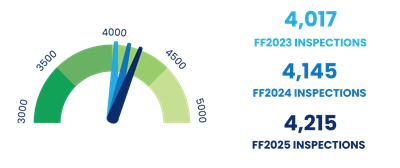
DEEP posted their federal fiscal year's enforcement annual report for 2025. Annual inspections continue to increase.
 Up Next
DEEP will publish updates to its Supplemental Environmental Projects (SEP) Policy to include environmental justice and climate resiliency considerations, among other updates.
DEEP's Air Bureau will share GMAP monitoring data on its dedicated webpage, offering the public greater insight into DEEP’s inspection targeting and compliance assurance processes.
GOAL 4 PROGRESS FROM PREVIOUS QUARTERS
Fall 2025
DEEP continues to add enforcement information on a quarterly basis to the Enforcement Viewer. DEEP’s Emergency Response and Spills Prevention Division hired an Underground Storage Tank Compliance Specialist during Q4 2025. DEEP is seeing a steady increase in compliance inspections over the last two years, from 4,017 in 2023 up to 4,215 in 2025.
Summer 2025
DEEP continues to add enforcement information on a quarterly basis to the Enforcement Viewer. DEEP’s Emergency Response and Spills Prevention Division hired an Environmental Analyst Trainee in the licensing and enforcement unit during Q3 2025.
Spring 2025
DEEP continues to add information on complaints that result in inspections collectively by Town, as well as new enforcement cases on a quarterly basis, to the Enforcement Viewer to make our enforcement work all the more transparent. Application structure, metadata, and data aggregation methodology have been updated for a simplified user experience and more automated layer creation. WPED published the annual list of SIUs in noncompliance for 10/1/23 to 9/30/24 in June 2025.
 DEEP has awarded four new Supplemental Environmental Projects (SEPs), totaling almost $1.7M - to Tolland and Ansonia, which are EJ communities, and to East Windsor and a state-wide radiation project. SEPs are those that use enforcement penalty monies to pay for beneficial environmental projects in communities impacted by pollution.
DEEP also welcomed three new staff in enforcement positions in the Emergency Response and Spill Prevention and Waste Engineering and Enforcement Divisions.
Winter 2025
In Q1 2025, DEEP welcomed an enforcement coordinator for the Dam Safety Program to further ensure timely inspections and permit compliance. In January 2025, DEEP submitted the Underground Storage Tank program regulations for civil penalties, after a 45-day public notice period in Fall 2024, to the Legislative Regulation Review Committee. The regulations passed unanimously on Earth Day, April 22, 2025, became effective May 7, 2025, and will increase the predictability and transparency for penalty amounts associated with specific types of violations. We continue to add information on inspections that result in enforcement, as well as new enforcement cases on a quarterly basis, to the Enforcement Viewer to make our enforcement work all the more transparent.
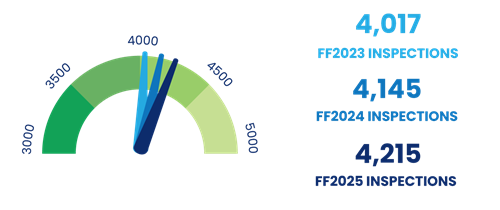
DEEP published the Federal Fiscal Year 2024 Annual Enforcement Statistics Report, which shows an overall increase in DEEP’s total number of inspections (4,145) compared to the previous federal fiscal year (4,017). DEEP continued to work on strengthening enforcement resources through filling vacant and new enforcement positions in municipal wastewater, ERSPD, WEED, and WPED programs. DEEP also added a data layer to the Enforcement Viewer that aggregates reported complaints resulting in DEEP inspections for LWRD and WPED. DEEP’s Underground Storage Tank program developed a set of regulations for civil penalties, increasing the predictability and transparency on penalty amounts associated with specific types of violations. These regulations were publicly noticed for 45 days in Fall 2024
Summer 2024
WPED published a list of all Significant Industrial Users discharging wastewater who are in significant noncompliance with federal standards during federal FY2023 (10/1/22 to 9/30/23). LWRD defined special conditions in licenses that can address typical violations that are found during construction, giving permittees more clarity and reducing the number of violations. The Water Planning and Management Division (WPMD) hired an enforcement coordinator for the Municipal Wastewater Program.
Winter and Spring 2024
Leveraging ArcGIS Online tools, DEEP created the Enforcement Viewer Application for public transparency in locating formal enforcement actions across the state. DEEP also concluded its Geospatial Measurement of Air Pollution (GMAP) tour in Hartford/East Hartford.

In Goal 5, DEEP is developing additional tools and providing greater compliance assistance in sectors with higher non-compliance. Background on this goal is presented in DEEP’s 20BY26, Setting the Target: CT DEEP 2026 Goals (February 2024).
Latest Progress (as of April 1, 2026)
This goal is 100% complete.
In Q1 2026, DEEP created a Compliance Calendar to remind the regulated community of programmatic annual reporting dates, times of year to submit certain recurring applications, regularly scheduled events providing compliance information, annual fee submittals, and the like. For example, annual reporting for commercial waste organics is required by March 1 (Public Act 23-170).
DEEP’s Land and Water Resource Division’s permits and requirements are clearer and easier to navigate on the revamped permitting webpages. LWRD & USACE held a stakeholder engagement meeting on the implementation of the 2026 Nationwide Permits (“NWP”) & the 401 Water Quality Certification on the Nationwide Permits on February 9, 2026. View the meeting recording here.

Our new online Statewide Inland Wetlands and Watercourses Activity Reporting Form, powered by Survey123, launched in late February 2026 and allows for instantaneous reporting of municipal agency actions, geotagged submissions, and immediate database updates for data analysis. Concurrent with the form, the Inland Wetlands Management Program has been hosting monthly office hours to assist municipalities in the transition and after just three months the program has received a total of 393 submissions from 41 separate municipal agencies. This reporting system also includes all past reporting, as well as incoming reports.
DEEP’s Emergency Response and Spill Prevention Division conducted an information session on the revised Underground Storage Regulations including Administrative Civil Penalties to the Connecticut Bar on January 13, 2026 and provided two training sessions on the new Permitted Environmental Professionals program for those supporting remediation of releases pursuant to the Release-Based Cleanup Regulations.
Up Next
DEEP’s Water Permitting and Enforcement Division (WPED) will launch a new newsletter pertaining to subsurface wastewater discharges (aka septic systems) –The Groundwater Guardian – sign up here!
Continuing to go beyond the goal of providing tools and resources to sectors of non-compliance, DEEP’s Air Enforcement Division will launch an air complaint module for reporting concerns and potential sources of air pollution. This reporting system will complete the agency-wide complaint system.
GOAL 5 PROGRESS FROM PREVIOUS QUARTERS
Fall 2025
In Q4 2025, DEEP’s Water Permitting and Enforcement Division (WPED) presented at various industry workshops: CT Environmental Forum October Meeting 10/8/25, CT Council of Small Towns Conference 10/22/25, CT Water Works Association/ CT Chapter of American Water Works Association Fall Conference 10/24/25, and Environmental Business Council NE presentation 11/5/25. WPED completed training towns subject to MS4 permitting and developing resources for towns new to MS4. WPED also launched two newsletters – The Runoff Report and Industrial Discharge Insights – sign up here! Along with developing Significant Industrial User (SIU) and Non-SIU plain-language guides for Publicly-Owned Treatment Works, WPED created easy fill forms for the recently reissued general permit applications/registrations (see Goal 2).
DEEP’s Land and Water Resources Division (LWRD) held its bi-annual Beach Association Guide meeting in October 2025.
Summer 2025
In Q3 2025, DEEP’s Environmental Quality Divisions were very active in their compliance outreach. DEEP’s Water Permitting and Enforcement Division (WPED) presented at the CT Business Industry Association Monthly Meeting on 9/18/25 to communicate requirements of reissued general permits (GPs). WPED published new websites with compliance assistance information for GPs:
WPED provided training for the three of seven towns newly subject to the MS4 permit and engaged consultants and permittees in training for pre-treatment wastewater permits. In preparation for reissuance of the Stormwater Construction GP, WPED held compliance engagement meetings with conservations districts, the solar community, and DOT.
DEEP’s Emergency Response and Spills Division posted a factsheet identifying the most common reporting and cleanup violations and how to come into compliance on the Compliance Hub webpage.
Spring 2025
In April 2025, Land and Water Resources held a Beach Association Guide stakeholder meeting at DEEP Marine Headquarters, and will continue to do so annually to directly reach stakeholders and increase compliance. Additionally, the Remediation Division held training on 5-year inspections for Environmental Use Restrictions.
In May 2025, WPED published a guidance document to assist permittees with discharges of wastewaters to sanitary sewers or surface waters prepare for an inspection and reduce instances of non-compliance. WPED also posted factsheets identifying the most common violations and how to come into compliance on the new Compliance Hub webpage. WPED held workshops for the recently public-noticed five General Permits (see Goal 2) with various stakeholder group for transparent and educational compliance engagement. Reporting of non-compliance through WPED’s reporting tool reached 943 notifications in FFY2025; about 80 more than in the previous year.
Winter 2025
DEEP developed a license transmittal letter to provide consistent information to the permittee on relevant compliance assistance tools. DEEP also created new public complaint submission and review systems for Waste reporting (including solid and hazardous waste) and Emergency Response reporting (including PCBs, Underground Storage Tanks, and Marine Terminals) using Survey123 in ArcGIS Online, further standardizing the processing of public complaints agency-wide.
DEEP’s Land and Water Resources and Waste programs posted factsheets identifying the most common violations and how to come into compliance on the new Compliance Hub webpage - LWRD’s Top 10 Compliance Issues and How to Fix Them; Solid Waste's Top 8 Compliance Issues and How to Fix Them; Hazardous Waste's Top 10 Compliance Issues and How to Fix Them; and Pesticide’s Top 10 Compliance Issues and How to Fix Them.
DEEP’s Sustainable Materials Management program has developed informational resources for commercial food scrap generators to more easily determine if their operations trigger the Commercial Organics Law (CGS section 22a-226e). These compliance resources describe which operations are subject to the law, how to comply with the law, and FAQs. Annual reporting is required by March 1 in accordance with Public Act 23-170, and inspections are conducted to ensure compliance and provide assistance. The reporting form can be found on the Commercial Organics webpage.
Fall 2024
DEEP created complaint reporting systems for the Emergency Response & Spill Prevention Division (ERSPD) and Waste Engineering and Enforcement Division.
The Land and Water Resource Division hosted a Beach Association Guide stakeholder meeting at Fort Trumbull, New London in October 2024.
The Water Permitting and Enforcement Division (WPED) refined their MS4 Targeted Compliance Assistance Plan based on stakeholder feedback and used data from annual reports to generate a list of facilities in need of compliance inspections and assistance. WPED posted the public notice for the Industrial Stormwater General Permit in December 2024 to solicit feedback from stakeholders. The General Permit has a new Corrective Action Plan section built into the permit, providing facilities in noncompliance with concise and consistent steps to return to compliance.
The Remediation Division started an Environmental Use Restriction (EUR) compliance inspection program to ensure that institutional and engineered controls covered under the recorded EUR continue to be in place. The Environmental Use Restriction Five-Year Comprehensive Inspection Forms, developed with the help of Environmental Professionals of Connecticut, are now available for use. A brief presentation on EUR Five-Year Comprehensive Inspections was presented at the March 25, 2025 Remediation RoundTable.
Summer 2024
DEEP began using Power Automate to connect our complaint intake systems to automatically and simultaneously send response emails. As part of its ongoing assessment of feedback from the MS4 Technical Workshops hosted in Spring 2024, WPED identified and prioritized fundamental components of the MS4 Program allowing the team to develop a Targeted Compliance Assistance Plan for the regulated community. Waste Engineering and Enforcement Division (WEED) launched an inspection protocol for commercial food scrap generators to determine if their operations trigger the Commercial Organics Law (CGS Section 22a-226e) and began compliance assistance checks in August 2024.
Winter and Spring 2024
DEEP created new compliance tools to help meet the Goal’s objectives. DEEP converted traditional phone and email-based public complaint systems to digital surveys through ArcGIS Online’s Survey123 to streamline public engagement, provide faster response, and reduce the staff time needed to address complaints. DEEP published major guidance on Stormwater and coastal activities in Spring 2024.

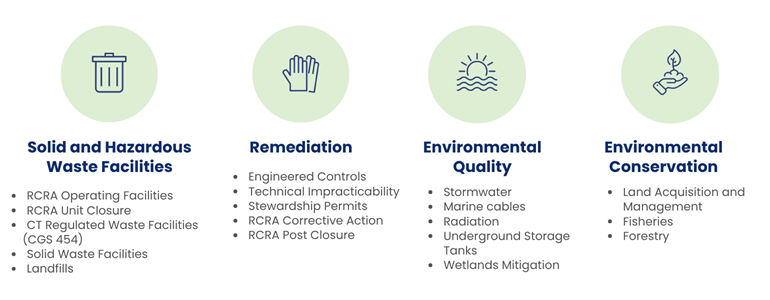
Goal 6 of 20BY26 concentrates efforts on strengthening our financial assurance management, which applies to money held in trust to address failed remedies or unfulfilled permitted actions. Fourteen programs across DEEP use financial assurance (FA) instruments. Background on this goal is presented in DEEP’s 20BY26, Setting the Target: CT DEEP 2026 Goals (February 2024).
Latest Progress (as of April 1, 2026)
This goal is 50% complete.
In Q1 2026, DEEP launched its centralized Financial Assurance tracking system, which catalogues, tracks, stores, and shares FA instruments in a standardized manner across DEEP, and finalized draft template language for FA instruments. Please remember to submit your financial assurances by certified mail with the Financial Assurance Transmittal Form directly to Accounts Receivable, as indicated on the form.
Up Next
DEEP will populate the upgraded FA tracking system and will create a centralized webpage for all programs that use financial assurances with links to templates.
GOAL 6 PROGRESS FROM PREVIOUS QUARTERS
Fall 2025
In Q4 2025, DEEP finalized its centralized, upgraded Financial Assurance tracking system and continued to draft template language for FA instruments.
Summer 2025
In Q3 2025, DEEP conducted user testing of its centralized, upgraded FA tracking system and continued to draft template language for FA instruments that can be applicable across programs.
Spring 2025
DEEP began drafting template language for financial assurance instruments, such as Letters of Credit, trust, bonds, and guarantees. These templates will be streamlined, cover all programs, and consider the regulatory criteria for each program. With the advent of the Financial Assurance Transmittal Form, we are tracking all financial assurance instruments uniformly, instead of according to program-specific policies. DEEP continues to construct its centralized, upgraded FA tracking system.
Winter 2025
DEEP revised the Financial Assurance Transmittal Form after receiving feedback from the regulated community on its use. DEEP is also developing a database with shared access for DEEP staff to track documents and their storage, along with basic information about the Financial Assurance instrument itself.
Fall 2024
DEEP created an intake form to accompany financial assurance (FA) documents submitted by the regulated community that will improve processing procedures and consistency by indicating where FA documents are to be submitted and details for the accompanying information, such as the site location and DEEP program for which the FA has been established. This required information helps DEEP staff determine how the documents will be stored, tracked, and routed to the correct DEEP program. Storage in DEEP's vault is critical to secure legal documents, and tracking reduces time spent by staff locating documents.
Summer 2024
DEEP continued reviewing financial instruments for standardization across programs and worked to establish an agency-wide tracking database.
Winter and Spring 2024
DEEP formalized an internal standard operating procedure to guide staff on the proper management of financial assurance.Content last updated July 2026.