

Release-Based Cleanup Regulation Development
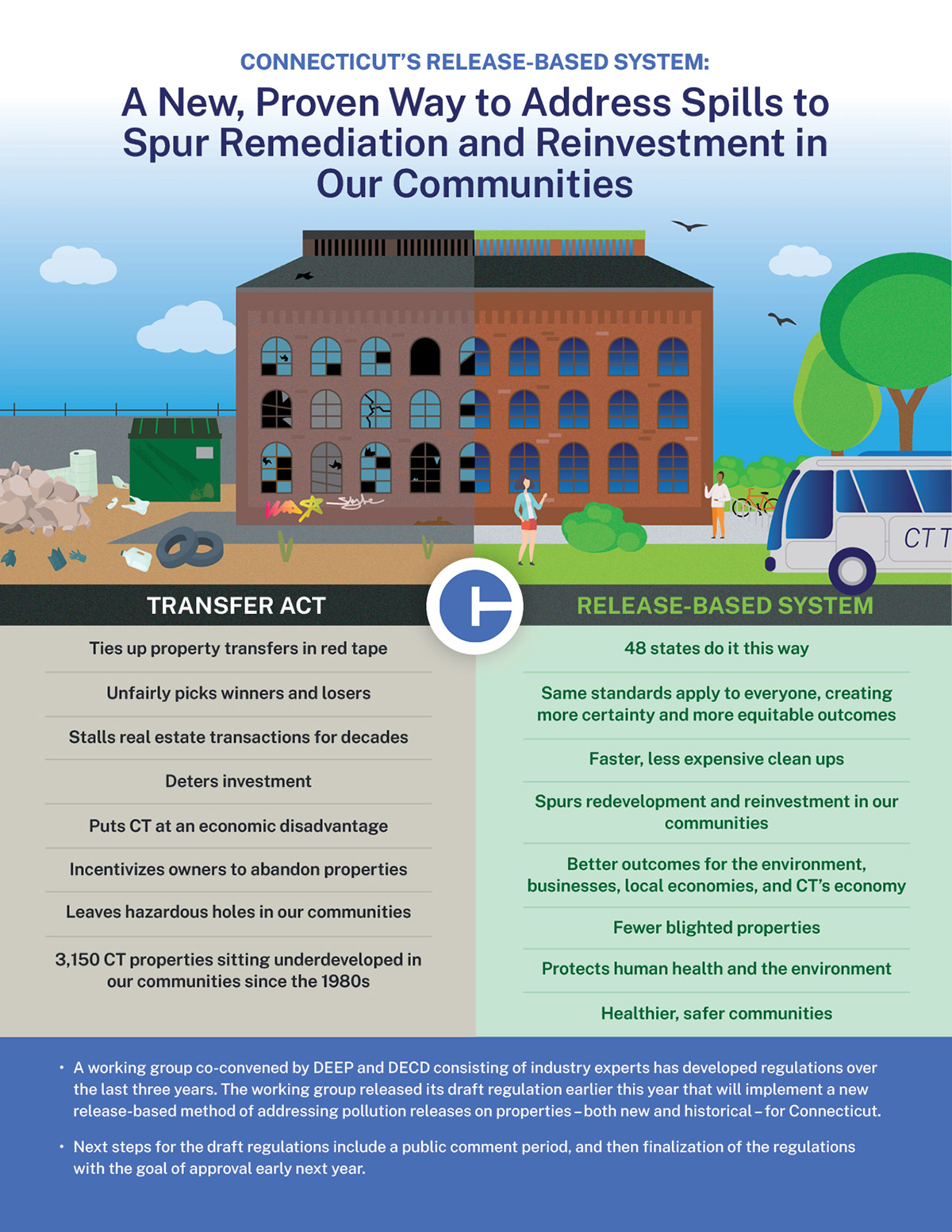 The Release-Based Cleanup Regulations (RBCRs), which were adopted on May 16, 2025 with an effective date of March 1, 2026, fulfill the statutory requirement created by CGS 22a-134pp to 134xx.
Public Act 25-6 and Public Act 25-54 were passed to smooth the transition to the Release-Based Cleanup Regulations, extend the Working Group until 2030, and set up a voluntary parcel-wide cleanup program.
Information about the transition to the Release-Based Cleanup Program will continue to be posted to this webpage.
Learn about how the Property Transfer Act integrates with the Release-Based Cleanup Regulations in this brief PTP-RBCR Transition Information Sheet.REACT and Release-Based Cleanup Regulation Training Opportunities are now being posted. Training courses began on December 11, 2025 via Zoom. The Release, Environmental Assessment, and Cleanup Tracker (REACT) cleanup tracking system has launched!
(NEW) DEEP has recently released a general permit under CGS 22a-454 for contractors wishing to act as a release response contractor to contain or remove or otherwise mitigate the effects of certain releases. For more information on the requirements of CGS 22a-454 and to find information on both the Individual and General Permits issued under CGS 22a-454, please see details at Permits to Act as a Contractor to Contain or Remove or Otherwise Mitigate the Effects of a Release.
Information regarding the Permitted Environmental Professionals roles, qualifications, training, approved courses, and exams are posted at Emergency Response and Spill Prevention.
The General Assembly directed the DEEP Commissioner to adopt regulations that will sunset the Connecticut Property Transfer Act and transition the state to a release-based cleanup program (see Legislative Authorization). The new regulations cover:
- Existing Releases (also known as historical releases or historical pollution) - newly discovered after these regulations go into effect
- Significant Existing Releases (existing pollution that poses an imminent risk to human health or the environment)
- Emergent Reportable Releases (new releases, sometimes referred to as spills)
The RBCRs will require that releases, either new spills or newly discovered historical releases, be cleaned up to the same cleanup criteria and follow the same regulations defining the investigation and cleanup process. This uniformity clarifies applicable performance standards and cleanup processes for all releases while protecting human health and the environment and providing clarity for buyers of properties and their lenders.
The Voluntary Program under CGS 22a-133y (see section 4) has been revised to create a Voluntary Parcel-Wide Cleanup Program that had been requested for use with the RBCRs.
Draft Release-Based Cleanup Regulations Frequently Asked Questions - Please let us know if there are any additional questions that you would like to see answered at DEEP.Cleanup.Transform@ct.gov.
Stakeholder Engagement
Working Group’s meetings (Working Group extended by Public Act 25-54)
Property Transfer Act
The Property Transfer Act will sunset on March 1, 2026. This means that no filings will be required for transactions occurring on or after March 1, 2026. Property Transfer sites that have not been verified will continue cleanup under the Transfer Act until remediation is complete, as documented with a verification report, using the RB cleanup standards as the compliance endpoints. Public Act 25-54 includes provisions to allow Property Transfer sites to transition to the use of the process requirements and deadlines identified in the RBCRs.
General
Under the new regulations, investigations will be driven by business decisions where an owner hires a professional to investigate their property. Review of historical records indicating a release had occurred on the property does not constitute discovery of a release.
The RBCRs incorporate the Remediation Standard Regulations, which were originally created in 1996 to set the performance standards for the cleanup of releases. These regulations were an important first step in identifying the cleanup endpoints, although they did not define the mechanism for triggering investigation and cleanup. Significant new provisions such as alternate remedy solutions have been added to the regulations that will expedite and reduce costs for many cleanups, including:
- Creating new cleanup standards for multifamily properties
This new standard aligns requirements with actual risk, therefore, expediting development of housing. - Creating a new permit-by-rule that creates a streamlined approach to manage polluted soil below buildings, concrete, and pavement
This is a safe and effective way to manage risk, expedite cleanups, and reduce costs for property owners. - Creating a new permit-by-rule that eliminates the need to excavate and dispose of lightly polluted soil when the property is used for commercial or industrial uses.
This provision will save money for businesses in Connecticut without compromising environmental or public health.
These regulations exclude many societal-type pollution sources and, in many cases, set “lower bounds”-standards below which action is either not required or is limited.
The process of cleaning up releases from regulated Underground Storage Tanks are specified in the UST regulations, with the RBCRs applicability limited to identifying soil and water cleanup criteria and alternate remedy solutions.
Residential Properties
The new regulations strike an important balance between protecting human health and the environment and the financial burden that cleanup could create for homeowners. Similar to today’s rules, if a residential property is subject to a new release or if an owner discovers a significant existing release (those that pose the highest risks), owners need to report and clean up the release. The vast majority of releases on residential properties involve heating oil. The new regulations create a new and less stringent approach for clean up of heating oil releases caused by homeowners (spills caused by delivery personnel cannot use this approach).
Content last updated February 10, 2026