


Frequently asked questions about aquaculture and the shellfish sanitation program
How are shellfish growing areas classified?
What are Fecal Coliform Bacteria?
What are the sources of Fecal Coliform Bacteria?
What are Adverse Pollution Conditions?
Why is the area where I usually shellfish closed?
What is the minimum closure period and what are the requirements for reopening an area?
What are Molluscan Shellfish?
"Molluscan shellfish" are edible species of oysters, clams, mussels, and scallops (whole or roe on only). Scallops consisting only of the shucked adductor muscle are not included in this definition. Lobsters, crabs, snails, and finfish are also not included in this definition.
What is Shellstock?
Shellstock refers to raw, in shell molluscan shellfish.
How are shellfish growing areas classified?
Shellfish waters are classified based on the findings of a sanitary survey. The sanitary survey identifies all actual and potential pollution sources, and their impact upon a growing area, reviews bacteriological quality of waters in the growing area, analyses meteorological, hydrodynamic, and geographic characteristics of the growing area, evaluates changes in land use and their potential to impact the growing area, and evaluates the performance of sewage treatment plants and looks for any failing septic systems. The NSSP-MO requires sanitary surveys to be reevaluated and updated yearly, reviewed and updated every three years, and repeated every 12 years. Any area not meeting all NSSP-MO criteria for its current classification, due to new or existing pollution sources or degradation of water quality, will be downgraded. Any upgrade in an areas classification must be supported by the findings of a sanitary survey.
Learn more about the different shellfish growing water classifications.
What are pollution sources?
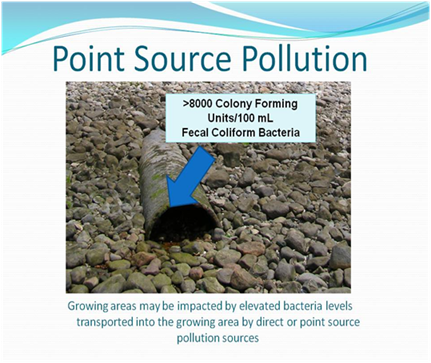
There are two types of pollutions sources, point (direct) and non-point (indirect) which are further categorized as actual or potential. Point sources are direct inputs such as pipes; non-point sources include farms, roadways, and any other area with the potential to negatively impact a growing area primarily through runoff. Water sampling is conducted throughout the year under Adverse Pollution Conditions to monitor water quality and assess the impacts of these pollution sources on the growing area.
What are Fecal Coliform Bacteria?
Fecal coliform bacteria are found in the feces of warm blooded mammals. Fecal coliform bacteria are indicator bacteria that show there may be human pathogens present in the water.
What are the sources of Fecal Coliform Bacteria?
Fecal coliform bacteria can get into the water from a variety of sources such as wastewater treatment facilities, runoff, septic systems, boats, wildlife, and domestic animals.
What are Adverse Pollution Conditions?
The NSSP-MO defines adverse pollution conditions as a state or situation caused by meteorological, hydrologic or seasonal events, and point or non-point source discharges that have historically resulted in elevated fecal coliform levels. Adverse pollution conditions may vary on an area by area basis.
Why is the area where I usually shellfish closed?
Shellfish growing waters are closed following certain environmental factors or pollution events that are known to negatively impact water quality in a particular area. Conditionally Approved areas close following rain events ranging from 1" to 3”. Additionally, an area can be closed as a result of sewage discharges or other events that would negatively impact water quality in a particular growing area.
What is the minimum closure period and what are the requirements for reopening an area?
Any shellfish growing area that is closed due to a rainfall event, sewage discharge, or other reason will be closed for a minimum of seven days following the end of the closure event. Prior to an area re-opening, the DOAG must collect water and shellfish meat tissue samples with satisfactory fecal coliform results. No areas in Connecticut are automatically reopened following a closure event and no area will re-open before the eighth day following a rainfall or sewage related closure.
What is a biotoxin?
Biotoxins are chemicals (toxins) produced naturally by living organisms. Some microscopic organisms in the water column called phytoplankton can produce biotoxins. Because shellfish are filter feeders, they can accumulate these biotoxins. When consumed, they can cause human and animal illnesses. The Bureau monitors and controls for these toxins to protect public health.
Learn more about biotoxins and the organisms that produce them.

