

Hydrilla
What is Hydrilla?
Hydrilla is an invasive aquatic plant that grows underwater and can spread quickly through lakes and rivers. It usually grows from the bottom, but even small pieces that break off can float away and start new growth somewhere else. Once hydrilla takes hold, it forms thick mats that block sunlight, crowd out native plants, and make it harder for boats, fish, and wildlife to move through the water.
A unique form of hydrilla was discovered in the Connecticut River near Glastonbury in 2016. This strain grows especially fast and produces more reproductive structures than typical hydrilla, although it does not form tubers. Since its discovery, it has spread to six other waterbodies in Connecticut and Massachusetts. There are currently three types of hydrilla found in the United States.
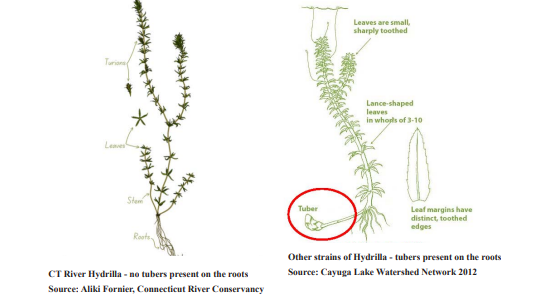
Leaves: Hydrilla leaves grow in whorls around the stem, most often in groups of five. They are bright green, narrow, and finely serrated. The strain found in the Connecticut River often has more leaves per whorl than typical hydrilla, giving it a fuller, denser appearance.
Stems: Slender stems can grow more than seven meters from the bottom to the water’s surface. Near the surface, they branch heavily and form thick mats. Hydrilla produces small buds called turions along the stems—these easily break off and start new plants. The Connecticut strain produces turions in especially high numbers, contributing to its rapid spread.
Flowers: Tiny, translucent to reddish-white flowers float at the surface on long, thin stalks. Plants may have both male and female parts or be entirely male or female.
Roots: Hydrilla usually roots in the sediment, but fragments can survive and grow while floating. Roots produce tubers that can remain dormant for years. The Connecticut River strain is unusual because it does not produce tubers, relying instead on heavy turion production and fragmentation.
Reproduction & Spread: Hydrilla spreads through stem fragments, turions, and (in most strains) tubers. Boats, trailers, water currents, and waterfowl easily move it between waterbodies. Because the Connecticut strain produces so many turions and fragments, it can establish quickly even without tubers.
What is being done in Connecticut?
Efforts to control the invasive aquatic plant hydrilla are underway across the Connecticut River and several connected waterbodies. The U.S. Army Corps of Engineers, in partnership with the Connecticut Agricultural Experiment Station and regional partners, are conducting multi-year herbicide demonstration projects to evaluate safe and effective treatment options. Field treatments began in 2024 at several sites, with additional locations under consideration as monitoring continues. These projects aim to reduce dense hydrilla growth, protect native habitats, and maintain safe access for boaters and anglers.
Residents, boaters, and community partners can stay informed and support prevention efforts through several reliable resources. The Connecticut Department of Energy & Environmental Protection provides statewide information on aquatic invasive species, including hydrilla identification, prevention guidance, and reporting tools.
Examples of Aquatic Invasive Species in Connecticut
DEEP General Information on Aquatic Invasive Species
CAES/OAIS Connecticut River Project
More information on the CT River Hydrilla project can be found here:
Connecticut River Hydrilla Fact Sheet PDF
Connecticut River Project Fact Sheet PDF
North East Aquatic Nuisance Species Panel CT Hydrilla information
Connecticut River Conservancy Hydrilla information
Army Core of Engineers Connecticut River Project information
Content Last Updated June 2nd, 2026