

Water
Rivers, Lakes, and Estuaries Water of Long Island Sound Warming and Rising Waters Clamming and Oystering Drinking Water
Swimming
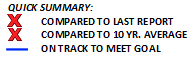
There were 279 beach action* days for all 73 reporting coastal beaches in Connecticut in 2024. Of the 279 beach action days, which was approximately 56 percent greater than the previous ten-year average (179), 188 (67 percent) were closures and 91 (33 percent) were contamination advisories.42
Precipitation in the summer of 2024 was approximately 4.1 percent greater than the previous 60-year average, and the impact of combined sewer overflows (CSOs) and sanitary sewer overflows (SSOs) (see above) were likely the reasons for the increase in beach action days in 2024. The chart above displays both closings and advisories at Connecticut’s public coastal beaches since 2014, which from a water quality perspective are functional equivalents. The beach-specific advisories or closings are issued by the reporting state or local government entity.
Goal: The goal for keeping beaches open is to reduce the number of coastal beach closings in half by 2035 from 2014, with the number for 2014 calculated using a five-year rolling average.43
Because the number of beaches varies by county, the Council utilizes a ratio of beach action days (closures and advisories) to the number of reporting beaches in each county to illustrate the relative impact that pollution has on coastal recreation waters. Typically, the western half of Connecticut’s coastline, which has more impervious surfaces, sees the most beach actions.
Inland Beaches**: There are currently 17 state parks with designated swimming areas. From the start of the 2014 beach season to the end of the 2024 beach season, there were 203 separate beach closures at these 17 swimming areas. The number of beach closures in 2024 was 46 percent less than the previous year (59) and 21 percent less than the previous ten-year average (40). 98 percent of those beach closings in 2024 were due to high bacteria levels, one percent due to cyanobacteria blooms; and one percent due to flooding or unsafe conditions.
Technical Note: *A beach action can include beach-specific advisories or closings issued by the reporting state or local governments. A beach action is recorded for a beach even if only a portion of the beach is affected. During a beach closure, water conditions are deemed unsafe for swimmers and other users. “Preemptory actions” (advisory/closure) that some jurisdictions issue are to inform the public of possible fecal contamination, based on past experience, prior to receiving from the laboratory a confirming water quality. **2018 - Wharton Brook swimming area closed for entire 2018 season - not reflected in the data provided; 2020 - Results impacted by COVID-19; 2024 - Indian Well swimming area closed for remainder of season due to flooding damage beginning on August 18, 2024.
—————
42 EPA, Beach Advisory and Closing On-line Notification, accessed January 27, 2025; beacon.epa.gov/ords/beacon2/r/beacon_apex/beacon2/report-page.
43 Long Island Sound Study Comprehensive Conservation and Management Plan, 2015; longislandsoundstudy.net/2015/09/2015-comprehensive-conservation-and-management-plan/.