


SGCN and SAPS Explained
What are Species of Greatest Conservation Need and State Assessment Priority Species, and how were they identified?
In this section: Summary | Definitions (SGCN / SAPS) | The 2025 SGCN and SAPS Lists | Northeast Regional Context
Summary
Updating the SGCN and SAPS list for 2025 required three major steps. The first step of the process was to identify all sources of data and regional, national, and global vulnerability status for all species known to live in the state. Those results were compiled and shared with teams of scientific experts (hereafter, “Taxa Teams”). The second step involved and engaged Taxa Teams, which met multiple times in fall 2023 to evaluate the data and vote on preliminary lists of SGCN and SAPS. The third and final step involved soliciting input and reviewing the SGCN/SAPS list at multiple levels within CT DEEP, the Mohegan and Pequot Tribes, and our conservation partners in Connecticut. The SGCN/SAPS list was posted on CT DEEP’s website for public feedback in late 2023. Once revised based on input provided during the review process, the list was again sent to Taxa Teams, CT DEEP, Tribes, and partners and posted online for public input in early 2024 for a final review and finalization. The following sections provide details on each step of the process.
Definitions (SGCN / SAPS)
These terms are defined in the Northeast Lexicon (Crisfield and NEFWDTC, 2022).
Species of Greatest Conservation Need (SGCN) – Defined by each state fish or wildlife agency in its Wildlife Action Plan, typically a native species with declining populations or vulnerabilities expected to benefit from strategic conservation attention.
State Assessment Priority Species (SAPS) – Species for which more information is needed to fully understand status and trends to determine the level of conservation concern or SGCN status. These species, separate from SGCN, are a priority for additional assessment or survey to address data deficiency.
The 2025 SGCN and SAPS Lists
SGCN and SAPS. Of the 4,650 species considered, 12% (573) were identified as SGCN and 11% (515) were listed as SAPS (see Appendix 1.2 and 1.3 for the full list of SGCN and SAPS, respectively). Of the 573 SGCN, there are 32 amphibians and reptiles, 79 birds, 34 fish, 126 invertebrates, 17 mammals, and 285 plants (Table 1.2). Of the 515 SAPS, there are 3 amphibians and reptiles, 28 birds, 12 fish, 183 invertebrates, 13 mammals, and 276 plants (Table 1.3, Figure 1.1).
Approximately 42% (242) of all 573 SGCN were identified as “Most Important,” 20% (114) were listed as “Very Important,” and 38% (217) were listed as “Important” (Table 1.3), while approximately 3% (16) of all 515 SAPS were identified as “Most Important,” 22% (111) were listed as “Very Important,” and 75% (388) were listed as “Important” (Table 1.3).
Table 1.2 - Connecticut's 2025 Species of Greatest Conservation Need (SGCN)
| Taxa | Most Important | Very Important | Important | Total SGCN Species | SGCN percent of total species | Total CT Species |
|---|---|---|---|---|---|---|
| Amphibians and Reptiles | 16 | 5 | 11 | 32 | 64% | 50 |
| Birds | 20 | 30 | 29 | 79 | 26% | 301 |
| Fish | 21 | 10 | 3 | 34 | 27% | 126 |
| Invertebrates | 34 | 44 | 48 | 126 | 10% | 1,288 |
| Mammals | 13 | 3 | 1 | 17 | 27% | 64 |
| Plants | 138 | 22 | 125 | 285 | 10% | 2,821 |
| Total | 242 | 117 | 217 | 573 | 12% | 4,650 |
Table 1.3 - Connecticut's 2025 State Assessment Priority Species (SAPS)
| Taxa | Most Important | Very Important | Important | Total SAPS Species | SAPS percent of total species | Total CT Species |
|---|---|---|---|---|---|---|
| Amphibians and Reptiles | 0 | 1 | 2 | 3 | 6% | 50 |
| Birds | 0 | 5 | 23 | 28 | 9% | 301 |
| Fish | 0 | 2 | 10 | 12 | 10% | 126 |
| Invertebrates | 15 | 82 | 86 | 183 | 14% | 1,288 |
| Mammals | 0 | 3 | 10 | 13 | 20% | 64 |
| Plants | 1 | 18 | 257 | 276 | 10% | 2,821 |
| Total | 16 | 111 | 388 | 515 | 11% | 4,650 |

Figure 1.1 - Total number of species in each group that are listed as SGCN or SAPS.
 Differences between the 2015 and 2025 SGCN Lists. There are four more species on the 2025 SGCN list than the 2015 SGCN list; however, when considering both the SGCN and the new SAPS lists together, the number of species considered by the 2015 SWAP increased from 569 to 1,088 in this 2025 revision (Table 1.4; see Appendix 4 for a list of the differences between the 2015 and 2025 lists). Aside from adding a SAPS list in 2025, the biggest change between the two lists is that fewer bird and fish species are included in the 2025 SGCN and SAPS Lists, while many more plant species are included (Table 1.4).
The primary reasons for these differences are:
- The plant taxa team had more capacity and data in 2025 than in 2015, enabling a better evaluation of all 2,338 species, with additions of 201 more SGCN and 276 more SAPS.
- The number of wildlife SGCN decreased (except for amphibians and reptiles) because many wildlife species on the 2015 SGCN list that are not on the 2025 SGCN list were shifted to the SAPS list due to a lack of data. In 2015, species could be designated as SGCN because they were data deficient, and those species were lumped together with SGCN on the same list.
- Biologists and conservation stakeholders are shifting their perspectives to focus limited attention and resources on species that would benefit the most from conservation action, rather than listing all species that may be declining, but not necessarily at a point where intervention is as important as for other species being considered. This approach focuses on specific species that function as “indicator” or “umbrella” species for conservation action since these actions often benefit other declining species within the same habitats.
- Some species, such as notable species of birds and fish, have either improved statuses (i.e., populations are recovering due to management action, like the Osprey) or have access to other, more considerable conservation focus and funding opportunities enabling resources to be directed where they are most needed (e.g., recreational and commercial fisheries).
Table 1.4 – Comparison of Connecticut’s 2015 and 2025 SGCN Lists
| Taxa | Species in CT | 2015 SGCN Total | 2025 % of CT Species | 2025 SGCN Total | 2025 SGCN % of CT Species | 2025 SAPS Total | 2025 SAPS % of CT Species | 2025 SGCN and SAPS Total | 2025 SGCN and SAPS % of CT Species |
|---|---|---|---|---|---|---|---|---|---|
| Amphibians and Reptiles | 50 | 32 | 64% | 32 | 64% | 3 | 6% | 35 | 70% |
| Birds | 301 | 128 | 43% | 79 | 26% | 28 | 9% | 107 | 36% |
| Fish | 126 | 80 | 63% | 34 | 27% | 12 | 10% | 46 | 37% |
| Inverts | 1,288 | 218 | 17% | 126 | 10% | 183 | 14% | 309 | 24% |
| Mammals | 64 | 25 | 39% | 17 | 27% | 13 | 20% | 30 | 47% |
| Plants | 2,821 | 86 | 3% | 285 | 10% | 276 | 10% | 561 | 20% |
| Total | 4,167 | 569 | 12% | 573 | 12% | 515 | 11% | 1,088 | 23% |
SGCN Distribution and Abundance in Connecticut. SGCN are broadly distributed throughout the state and Long Island Sound. However, data on distribution and abundance are sparse or non-existent for many species, especially small mammals, invertebrates, and plants. In these cases, the efforts needed to fill these data gaps are identified as priority research or survey needs or conservation actions in Chapters 4 and 5. See the taxon-specific sections of this chapter for more specific distribution information for each taxonomic group.
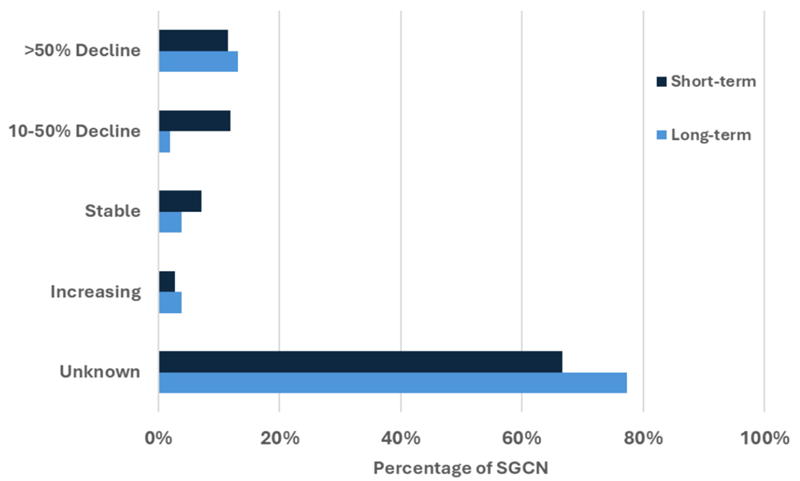
There is little information about abundance and population trends for many of Connecticut’s SGCN, and some taxonomic groups have more data than others. Importantly, some population trend information provided in this chapter is based on the expertise of the Taxa Teams members rather than from long-term, empirical studies. However, 67% of SGCN still lack data on their short-term population trends, measured over the species’ last three generations — a period that can vary significantly between species (Figure 1.2). Even more SGCN (77%) do not have data for their long-term population trends (measured over the past 200 years; Figure 1.2). While the total number of SGCN with unknown population trends is high, this is primarily attributed to the lack of information on many plant species, which comprise half of all SGCN. Most SAPS had unknown population trajectories. While vertebrate groups had significantly lower percentages of missing data (except for mammals), the population trends of plants and invertebrates remain unknown within the state, highlighting the importance of data collection over the next decade (see Chapter 4).
Most of the remaining SGCN with known population trends are declining, while a few are stable or increasing (Figure 1.2). Of particular note, 6% of all SGCN have seen population declines of 90% or more across the Northeast region, and over 13% of SGCN have lost over 50% or more of their populations over the last 200 years, while only 8% have been either stable or increasing over the same time frame (Figure 1.2). Overall, Connecticut’s SGCN largely follows general global trends of population loss (WWF, 2024), as well as specific trends for each taxonomic group, detailed in the taxon-specific sections of this chapter.
Figure 1.2 – Long- and Short-term Population Trajectories for Connecticut’s SGCN. Short-term population trends are based on three generations or 10 years, and long-term population trends are based on the past 200 years.
Northeast Regional Context
Connecticut actively participates in the regional collaboration for fish and wildlife conservation in the Northeast. The 13 Northeastern states (Virginia north to Maine) and the District of Columbia have a long history of cooperation through the Northeast Association of Fish and Wildlife Agencies (NEAFWA). These states recognize that a cooperative effort is necessary to protect and manage many of our region’s most endangered and threatened species.
Of 17,923 Northeast species, 7,270 were evaluated and prescreened using the NEAFWA RSGCN selection criteria and fell within the 20 Taxonomic Teams. The 2015 State Wildlife Action Plans list almost 27% (4,788 species) of these species as SGCN in the Northeast. Of these SGCN, approximately 693 invertebrates from other taxonomic groups and 230 plants were beyond the scope of the regional assessment due to data deficiency, a lack of current regional expertise across the entire taxon, or the scope of jurisdiction. Species that regularly occur in the region are included, and many invertebrate taxa are under review and, therefore, omitted from this analysis. The invertebrate list is incomplete; however, because the RSGCN process continues to evaluate them, the number of major invertebrate groups reviewed has increased from two in 2018 to 13 through the 2023 RSGCN process, and these are included in the analysis. Twenty Taxonomic Teams identified 382 RSGCN, 37 Proposed RSGCN, 229 Watchlist Assessment Priority, and 62 Proposed Watchlist Assessment Priority (see the Northeast Wildlife Diversity website for more information). Results are presented in this order by category below. Of the total Northeast species considered for the RSGCN list, 5% warranted regional conservation needs and were assigned to one of the RSGCN list categories. The RSGCN categories are:
- SGCN – Number of species identified as an SGCN in the 2015 Wildlife Action Plan for at least one of the states in the northeastern region.
- RSGCN – Identified as an RSGCN during the 2023 regional update (TCI and NEFWDTC, 2023).
- Proposed RSGCN – Species proposed as RSGCN during the next regional update to the list.
- Watchlist Assessment Priority – Species without sufficient information to fully determine their RSGCN status.
- Watchlist Defer – RSGCN with less than 25% of regional responsibility that is deferred to an adjacent region to include on their RSGCN lists.
- Watchlist Interdependent – Species that RSGCN require to survive or breed, but do not meet the criteria as an RSGCN (e.g., food source or host plant for laying eggs).
The large number of species included in these lists reflects the magnitude of the threats facing fish and wildlife species in the Northeast, as well as the commendable efforts of the individual Northeast states to ensure that their State Wildlife Action Plans were comprehensive in their coverage of species across major taxonomic groups. The percentage of vertebrate species identified as SGCN in one or more of the Northeast State Wildlife Action Plans approaches 48% of the total number of vertebrate species in the Northeast. For invertebrates, Northeast states identified 39% of invertebrate species as SGCN in State Wildlife Action Plans. Major taxonomic groups with the highest percentage of RSGCN in the Northeast include freshwater fish (12%), birds (9%), and terrestrial snails (7%). Of the 806 RSGCN, approximately 53% have high Regional Responsibility (>50% of their range occurs in the Northeast) and 50% have High or Very High Regional Concern (TCI & NEFWDTC, 2023).
Photo on this page: Osprey (Pandion haliaetus) on nest with young. Due to recovery, Osprey is no longer considered a Species of Greatest Conservation Need in Connecticut. Photo by Paul Fusco / CT DEEP.
For references and more information, view Chapter 1 of Connecticut's 2025 Wildlife Action Plan.
Content last updated on November 13, 2025.