

Wastewater Discharges from Subsurface Sewage Treatment and Disposal Systems
Individual Permit
The Underground Injection Control (UIC) Program regulates wastewater discharges to Connecticut’s groundwaters to ensure the long-term protection of the state's natural resources. While many common discharges are eligible for streamlined General Permit coverage, certain high-impact systems—including all alternative sewage treatment systems and lateral sand filters, regardless of design flow—require an Individual Permit.
An Individual Permit provides a site-specific regulatory framework tailored to the unique technical and hydrogeologic conditions of a project. Before beginning the application process, we strongly encourage a thorough review of General Permit eligibility to ensure the most efficient and cost-effective permitting pathway for your facility.
Quick Links
- How Do I Get Started?
- Application Submission Process
- Fast Track Permitting
- Common Errors and Omissions Resulting in Delays
- Need to Make a Change?
- UIC Technical Resources
- Compliance Assistance
- Additional Resources
- Contact Us
Stay Informed! *New*
Subscribe to our Newsletters
- Industrial Insights: Regulatory development and industry news to keep you informed.
- The Runoff Report: Timely stormwater updates and news delivered to your inbox.
- The Groundwater Guardian: Stay up to date with UIC Program updates.
Sign up for one or all three - we'll take care of the rest
Get started today: Subscribe Now!Application Process
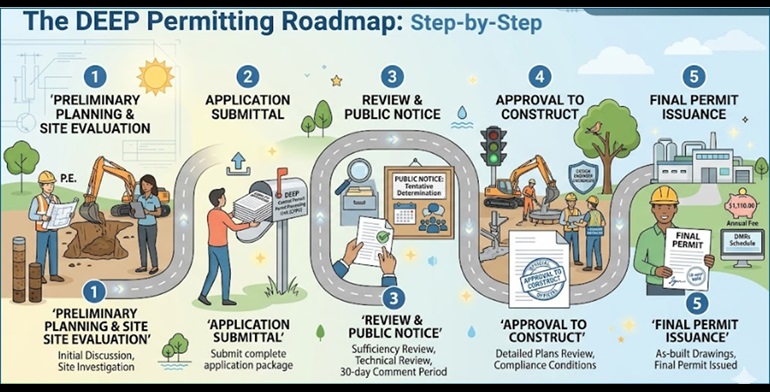
1. Preliminary Phase: Pre-Application and Site Evaluation
Before a formal application is filed, the applicant must engage in preliminary planning:
- Initial Discussion: A pre-application meeting or discussion with DEEP staff is recommended to review the project type, design flow, and proposed treatment method. Contact DEEP's Concierge Team to get started!
- Schedule a DEEP Site Investigation: Before submitting an application and preparing plans, applicants must schedule a site investigation with the UIC Program Supervisor.
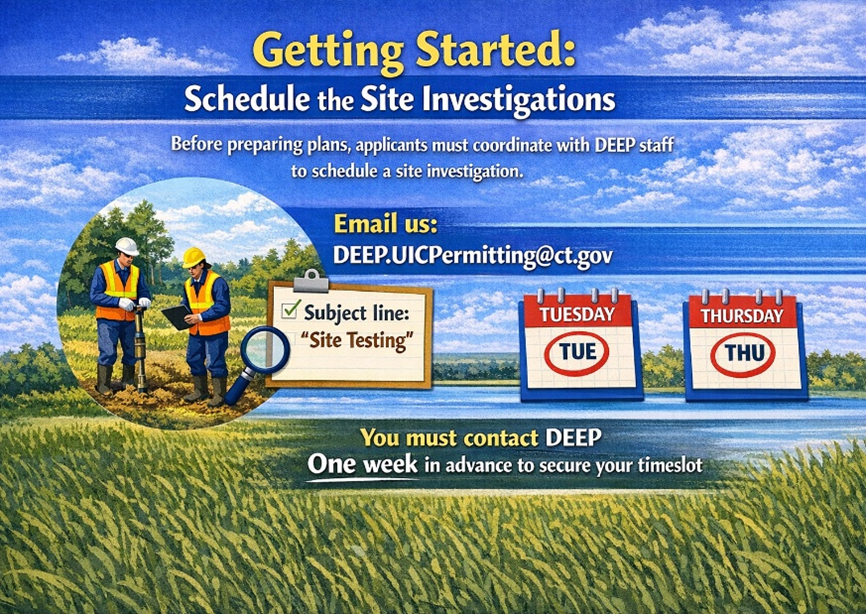
Email Us: DEEP.UICPermitting@ct.gov Subject Line: "Site Testing"
2. Application Submittal
Once site testing is complete, the applicant must submit a complete application package.
3. Administrative and Technical Review
- Sufficiency Review: DEEP reviews application for completeness and applicant is notified that the
application is either sufficient or insufficient. If the application is insufficient, it will not be processed
further until the applicant corrects the insufficiency. - Technical Review: DEEP reviews the application and may request additional information from the applicant.
- Public Comment Period: DEEP publishes a 30-day public comment period.
- Public Hearing: A public hearing may be held if requested by the public or deemed necessary by the Commissioner.
4. Final Determination & Approval to Construct
Following the public review and issuance of the Final Determination Letter, the applicant's consultant submits detailed construction plans and specification to DEEP for review. Once approved, DEEP issues an
Approval to Construct, which includes conditions such as:
- Construction must be performed by a licensed installer.
- The design engineer must provide construction oversight.
5. Final Permit Issuance
Upon completion of the project, the applicant must submit As-Built drawings and documentation verifying the system was installed according to the approved plans. DEEP then issues the final permit, which includes:
- Permit Duration: 10 years
- Annual Fee: $1,110.00 (Municipalities receive a 50% discount)
- Electronic Reporting: NetDMR for Discharge Monitoring Reports (DMRs)
- Compliance Audit: Third party compliance audits required according to permit conditions
Application Submission Process
The application process is a 5-step, time-sensitive process.

Step 1 - Prepare
Review the permit and confirm eligibility requirements.
Step 2 - Complete the Application Form
Refer to the Application User Guide for step-by-step instructions and the list of required information needed to complete the Application form.
Step 3 - Submit the Application Transmittal Form
The Application Transmittal Form allows DEEP to trace fee payments and match them to the correct application. The Permit Application Transmittal Form is required for this permit and must be submitted with your permit-specific forms. Click to download the Word Doc or PDF version.
- After completing the Application Transmittal Form, email it to: DEEP.CentralPermits@ct.gov
- Important: Keep a copy for your records. You will receive a confirmation email with instructions for submitting payment and accessing the file transfer site. Once the Application Transmittal Form is submitted and payment (if required) is received, the remainder of the process is time-sensitive.
Step 4 - Upload Required Documents
Within 10 business days of submitting the Application Transmittal Form, upload all required documents to DEEP's File Transfer Protocol (FTP) site, File Sharing Website, using the instructions provided in your confirmation email.
Critical Deadline: Applications will be closed and rejected if required documents are not received within 10 business days. Submit documents as soon as possible after submitting the Application Transmittal Form and payment.
Step 5 - Application Review and Decision
DEEP will begin processing your application upon receipt of all required documents.
Fast Track Permitting
For the fastest permit processing time, submit a complete application package including:
1. Application Form: Permit Application for Wastewater Discharges from Subsurface Treatment and Disposal Systems.
2. Application Fee: A non-refundable fee of $4,975.00 (Municipalities receive a 50% discount).
3. Application Public Notice: The applicant must publish a notice of the permit application in a local newspaper before submittal. A copy of this notice and a "Certification of Notice Form" must be included, or the application will not be processed.
4. Technical Documentation: A comprehensive Engineering Report and technical plans prepared, signed, and sealed by a Professional Engineer licensed in Connecticut.
5. Required Attachments:
- Attachment AA: A copy of the published notice of permit application, as described in the beginning of these instructions, attached to a completed Certification of Notice Form - Notice of Application
- Attachment A: Executive Summary Form
- Attachment B: Applicant Background Information Form
- Attachment C: Applicant Compliance Information Form
- Attachment D: USGS Quadrangle Map and Latitude and Longitude Form
- Attachment E: Coastal Consistency Review Form
- Attachment F: Copy of the NDDB Determination Letter that has not expired. Include a copy of any mitigation measures developed for this activity and approved by NDDB, if applicable
- Attachment G: Conservation or Restriction Information, if applicable
- Attachment Q: Engineering Report for Subsurface Sewage Treatment and Disposal Systems
- Attachment U: For applications to discharge from a community sewerage system not owned by a municipality, submit a signed letter from the Water Pollution Control Authority or responsible authority of the municipality in which the system exists or will be located, if applicable. Community Sewerage Systems (Sample Letter)
Common Errors and Omissions Resulting in Delays
Common errors and omissions that result in processing delays or the rejection of subsurface discharge permit application typically fall into administrative, technical, and procedural categories.
Administrative and Fee Errors
- Public Notice Timing (Individual Permits): The applicant must publish a Notice of Application in a newspaper of general circulation prior to submission. If "Attachment AA" (proof of notice) is missing, the application will not be processed.
- Insufficient or Missing Fees: A registration or application is not deemed complete and will not be processed unless the required non-refundable fee is paid in full.
- Secretary of State (SOTS) Mismatch: The registrant's name must exactly match the business name registered with the CT Secretary of State. Search for your business name to verify here: Secretary of State Business Search.
- Missing Signatures and Certifications: Applications require specific certifications and signatures from both the registrant and the individual responsible for preparing the documents (such as a Professional Engineer); an application is considered incomplete without all the required signatures.
Technical Omissions
- Missing Technical Plans: For any application involving a system modification, repair, or expansion, a Technical Plan prepared by a Professional Engineer must be submitted.
- Missing or Expired NDDB Letters: For sites located in Natural Diversity Areas, an NDDB Determination Letter is required to be submitted with the application. Do not submit "Preliminary Site Assessments". For more information and to see whether your site is located in an NDDB Area, visit the NDDB webpage: Natural Diversity Data Base and Environmental Reviews.
- Lack of Professional Seal: Technical plans and WMPs must be signed and sealed by a Professional Engineer licensed in Connecticut; blueprints of a seal are not acceptable.
Need to Make a Change?
Contact the UIC Program and submit the appropriate form before doing any of the following:
- increasing wastewater flow
- modifying treatment
- expanding disposal areas
- installing a replacement treatment system
- transferring ownership
- abandoning or closing a system
Unauthorized modifications to your flows or treatment systems before obtaining authorization may result in loss of permit coverage. Some changes require the submission of updated engineering designs, plans, and specs.
If you have an active Individual Permit, use this form to request a modification:
Facility and Wastewater Treatment System Modification Notification and Request for Approval
Additional Resources
- 40 CFR Part 144 - Underground Injection Control Program
- US EPA UIC Program Fact Sheet
- US EPA Class V Wells for Injection of Non-Hazardous Fluids Into or Above Underground Sources of Drinking Water
- US EPA Protecting Underground Sources of Drinking Water from Underground Injection (UIC)
- Department of Public Health (DPH) - On Site Sewage Disposal
- Environmental Protection Agency (EPA) - Septic System Information
- US EPA Safe Drinking Water Act
- US EPA UIC Program Guidance
- US EPA UIC Online Interactive Training
- Underground Injection Control National Technical Workgroup
- Groundwater Protection Council, Injections Wells: A Guide to Their Use, Operations, and Regulation
- USGS Publication on Nitrogen Loading in Long Island Sound
- Search for your business to see who is authorized to sign application on behalf of your company: CT Secretary of State Business Records Search
NetDMR Resources
- DEEP NetDMR Homepage
- NetDMR/CDX: EPA NetDMR Portal
- NPDES eReporting Tool: eRule NetDMR Homepage
Mapping Resources
- Impaired Waters Map: CT DEEP GIS Viewer
- CT DEEP GIS Open Data
- Map: CT DEEP Water Quality
- Map: CREST Collaborative Solar Suitability Application
Contact Us
Have a question or need help with your permit?
Email us at DEEP.UICPermitting@ct.gov
Content Last Updated: October 21, 2026