

Air Source Heat Pumps

What is an Air Source Heat Pump?
 Air source heat pumps (ASHPs) are highly efficient heating and cooling systems that move ambient heat to heat or cool a space. In the winter, an air source heat pump draws heat from outside to inside to heat. In the summer, the process is reversed, and the heat pump draws heat from inside to outside to cool.
- Air source heat pumps are more energy efficient than traditional HVAC systems because they move heat, rather than producing it.
How Do Air Source Heat Pumps Work?
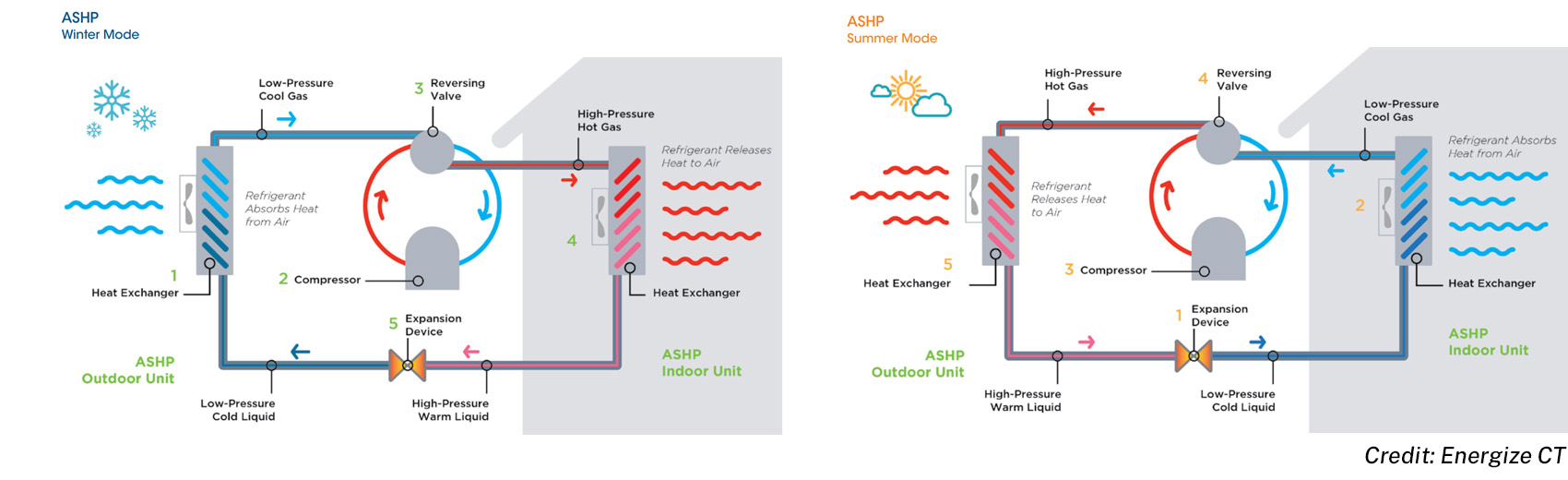
- Air source heat pumps work in a similar way to a refrigerator or an air conditioner – they use a refrigerant to move heat. But ASHPs can run in reverse, using the refrigerant to not only provide cooling but also heating for a space.
- To provide heating in the winter, ASHPs draw in ambient heat from outdoors, and move it inside using lines of refrigerant. Even in cold weather, cold climate ASHPs can draw in and concentrate sufficient heat to heat a building using the refrigerant. Once inside, the refrigerant releases the collected heat. This cycle repeats until the space reaches the set temperature on the thermostat. To provide cooling in the summer, the cycle runs in reverse, with the refrigerant collecting heat from indoors and releasing it outdoors.
Types of Air Source Heat Pumps
Cold Climate Heat Pumps (ccASHPs): ccASHPs are heat pumps designed for strong performance in cold climates, like in Connecticut. Older style electric heat pumps can experience poor performance in cold climates, but ccASHPs are designed to perform efficiently even when temperatures outside drop below freezing. Even when it’s cold outdoors in the winter, there is still heat energy in the air, which ccASHPs can harness to comfortably heat the indoors.
- ccASHPs that meet certain cold climate standards are the only heat pumps that are eligible for rebates under Connecticut’s Energize CT programs.
There are a few main types of air source heat pumps:
 Ducted Air Source Heat Pump Systems: Ducted ASHPs use ductwork throughout a building to deliver warm or cool air. These systems are a great option for buildings with pre-existing ductwork or for new construction.
- Ductless/Mini-Split Air Source Heat Pump Systems: Ductless or mini-split ASHPs are a great option for buildings without ductwork. These systems typically mount indoor units on a wall, floor, or ceiling which blow conditioned air into a space. The indoor units are connected to outdoor units via refrigerant lines.
- Air-To-Water Heat Pumps: Air-to-water heat pumps use water-based systems (also called hydronic systems) to disburse heat throughout a building. They work like other ASHPs, extracting heat from outside ambient air and transferring it indoors. Unlike other ASHPs which can also provide cooling, air-to-water heat pumps usually only provide heating. Air-to-water systems can be used in buildings with radiant heating systems and can be paired with low-temperature hydronic baseboard heating. In Connecticut, most homes with existing hydronic baseboard heating are not low temperature, so baseboards may need upgrades to be compatible.
- Variable Refrigerant Flow (VRF) Heat Pump Systems: VRF heat pump systems are like other air source heat pumps and can efficiently heat and cool larger building spaces. VRF systems can be used in various settings, like commercial and institutional buildings, residential complexes, and more. These heat pumps can adjust the flow of refrigerant to match the temperature needs of multiple zones simultaneously. Additionally, some VRF systems offer heat recovery, meaning they can recover heat from zones in cooling mode and redirect it to zones that require heating.
Heat pump systems can be configured as single-zones or multi-zones. Single-zone systems regulate temperature by measuring the temperature in one location in a building, while multi-zone systems regulate temperatures in multiple areas of a building, allowing for individual temperature control of each area.
Benefits of Air Source Heat Pumps
Energy Efficiency & Cost Savings:
- ASHPs are 2-3 times more efficient than traditional heating systems. Their efficiency also means that electricity use for heating can be reduced by up to 75% compared to electric resistance heating, according to Consumer Reports.
- Currently, homes that switch to heat pumps from oil, propane, or electric resistance can experience savings in both energy and costs.
- According to the U.S. Department of Energy, ASHPs can deliver 2-4 times more heat energy than the electricity it uses – this is because ASHPs don’t create heat but instead transfer heat from one place to another.
- ASHPs are an all-in-one heating and cooling system, and can replace traditional air conditioners and heating systems. Whether installed in new construction or as a part of a retrofit, ASHPs may reduce the time and costs associated with installing separate systems for heating and cooling.
- Compared to using a window AC to cool in the summer, ASHPs can provide increased cooling more efficiently and cost-effectively. ASHPs also have the added benefit of only needing to be installed once, in comparison with window ACs that may need to be installed at the start of the cooling season and removed at the end. Because ASHPs can serve both heating and cooling needs, they can eliminate the need to have two separate systems.
Health, Comfort, and Resilience:
- The need for efficient, affordable cooling continues to grow in Connecticut. ASHPs are a cost-effective way to add cooling and to help residents minimize cooling costs.
- ASHPs can improve indoor air quality through air filtration and dehumidification.
- ASHPs don’t rely on the combustion of fossil fuels to create heat, therefore local air quality is also improved through no direct emissions.
- ASHPs can be part of a building’s resiliency strategy. For example, in locations prone to flooding, ASHPs can be installed high on a building.
Environmental Benefits:
- Residential and commercial heating represented a combined 33% of economy-wide greenhouse gas emissions in Connecticut in 2021. ASHPs can help to reduce a home’s carbon footprint because they use electricity efficiently to heat and cool a home. Consumer Reports notes that ASHPs can help reduce household carbon emissions by up to 40% compared to gas furnaces.
Affordability
- Air source heat pumps may be an affordable heating and cooling option for your building.
- Future savings from efficient heating and cooling can help to offset initial installation costs.
- State and federal incentives can reduce upfront costs. Energize CT provides state incentives for residential and commercial air source heat pump systems. There may also be federal tax credits that can further reduce the cost.
- Depending on fuel prices, the operating costs of ASHPs are often lower than electric resistance, oil, or propane heating systems, enabling many homeowners and businesses to reduce their monthly expenses.
- Other factors that enhance affordability: Zero- or low-interest financing available through Energize CT and Connecticut Green Bank make it possible to spread installation costs across longer periods.
- Because an air source heat pump system provides both heating and cooling, it can eliminate the need for multiple appliances.
- The Clean Heating & Cooling Calculator can help residents compare annual costs and emissions savings by upgrading their heating and cooling system.
Trends in Connecticut
- The Energize CT Municipal Energy Dashboard Heat Pump Data section tracks rebates associated with the installation of heat pumps and heat pump water heaters in Eversource and United Illuminating territories.
Case Studies
Connecticut Residential:
- Energize CT – Simsbury – Jessica and Dana Albrycht
- Energize CT – Madison – Concord Meadows
- Energize CT – Colchester – Four Seasons of Colchester
Northeast Residential:
- Northeast Energy Efficiency Partnerships – Concord, MA – Slack Family
- Northeast Energy Efficiency Partnerships – Belmont, MA – Friedman/Merfeld Family
- Northeast Energy Efficiency Partnerships – South Hero, VT – Bartle Family
- Northeast Energy Efficiency Partnerships – Cambridge, MA – Finch Cambridge Housing Complex (VRF and ASHP)
Northeast Commercial and Institutional:
- Northeast Energy Efficiency Partnerships – Bennington, VT – Dickinson Science Center at Bennington College (VRF)
Energize CT Consumer Guidance
- Air source heat pumps (webpage)
- Your Guide to Air Source Heat Pumps (booklet)
- Heat Pump User Tips (booklet)
- Heat Pump Consultation (no-cost service)
- Find a Participating Installer (webpage)
- Clean Heating & Cooling (webpage)
- Heat Pump Qualified Product List (webpage)
Other Resources: Northeast
- Northeast Energy Efficiency Partnerships, Air Source Heat Pump Buying Guide (booklet)
- Northeast Energy Efficiency Partnerships, ccASHP Specification and Product List (webpage)
- Northeast Energy Efficiency Partnerships, Getting the Most Out of Your Heat Pump (booklet)
Other Resources: National
- U.S. Department of Energy, Lower Elwha Klallam Tribe Cuts Energy Costs by Going Ductless (video)
- U.S. Department of Energy, Residential Cold Climate Heat Pump Challenge (webpage), Fact Sheet
- Pacific Northwest National Laboratory, “Performance Results from DOE Cold Climate Heat Pump Challenge Field Validation” (2025)
- Energy Star, Air-Source Heat Pumps (webpage)
Contact
Content last updated April 2025