

Wildlife
Lobster and Fishes Piping Plovers Forest Birds State-Listed Species
Raptors
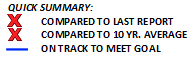

The 2024 mid-winter survey in Connecticut recorded 137 eagles throughout the state. Since 1980, observation trends of eagles during the Midwinter Eagle Survey have increased significantly. However, the number of eagles recorded in 2024 was twenty six percent less than in 2023 and approximately 15 percent less than the previous ten-year average. Variation in bald eagle observations can be attributed to the survey event occurring once a year, as well as differences in volunteer numbers and weather conditions.59
In 2023 (most recent data), there were 86 bald eagle active territories in the state, which represents an increase of approximately 4.9 percent from the previous year. The number of confirmed chicks decreased in 2023 to 78; however, there were 24 nests where the success of the nest or number of chicks is unclear*. There are several possible reasons why nesting outcomes might be unknown. Most notably, there are nearly a hundred nests distributed around the state, some with limited access, and the relevant information needs to be collected in a very narrow window of time.60
Goal: The goal for bald eagles is derived from the 1983 Northern States Bald Eagle Recovery Plan, prepared by the United States Fish and Wildlife Service. The Plan established a goal of 20 breeding birds (10 nests) for Connecticut. According to experts in the Bald Eagle Study Group, Connecticut could eventually host up to 200 nesting eagles (100 nests).
Osprey:
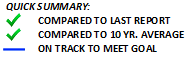
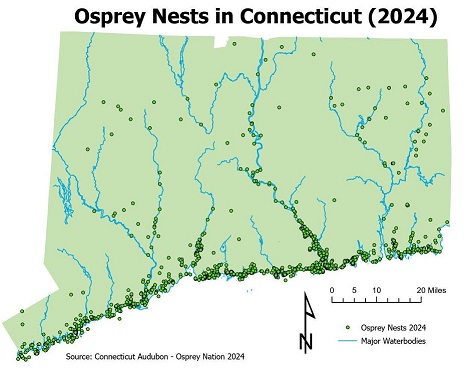
Another large fish-eating bird, the osprey**, has rebounded in similar fashion to the eagle. From a low of nine nesting pairs in 1974, more than 726 nests occupied by osprey were counted by the Connecticut Audubon Society in 2024. The active nests produced 1,077 observed fledglings, which resulted in a productivity rate of 1.48 fledglings per active nest.61
Goal: There is no established goal for ospreys in Connecticut, but ospreys, like eagles, are a “sentinel species,” meaning their health indicates the health of the environment around them.
Osprey, also known as the “fish hawk,” feed primarily on fish; consequently, osprey nests are typically located along the Connecticut shore or proximate to water.
Technical Note: *Territories are resource areas used by eagles that have only one active nest. **Data on fledglings for osprey for 2014 was not available. Osprey counts in 2020 might have been affected by the COVID 19 pandemic and might not be complete.
—————
59 DEEP, Wildlife Division, Wildlife Diversity Program, and State and Tribal Wildlife Grants programs; personal communication from B. Hess, January 9, 2025.
60 DEEP, personal communication from B. Hess, March 3 and 4, 2025.
61 The Connecticut Audubon Society, Osprey Nation 2024 Season Report, November 8, 2024; www.ctaudubon.org/wp-content/uploads/2024/11/Osprey-Nation-2024-Report.docx-2.pdf