History of the Third Connecticut Volunteer Light Battery

AS WRITTEN BY CAPTAIN THOMAS S. GILBERT

Third Connecticut Volunteer Light Battery

       The history of the Third Connecticut Light Battery is necessarily brief.  The Battery was organized during the summer and early fall of 1864.  Some of its members enlisted for one year and others for two years' service.  It naturally attracted a number of men who had served terms of enlistment in other commands, notably in the First Connecticut Heavy Artillery, who, after a short period of civil life — the excitement of the war period still continuing — were easily induced to re-enter the service as an independent body of artillerymen.  Soon, therefore, as authorized, the work of enlistment went briskly on; the Battery was organized, its officers commissioned, and, in pursuance of Special Order No. 126, from Headquarters Volunteer Recruiting Service of Connecticut, left the State.  According to instructions I reported the Battery to Brig.-Gen. Henry L. Abbott, commanding the First Connecticut Heavy Artillery, at his headquarters, Broadway Landing, Va., on the 19th day of November, 1864, and was instructed by him to disembark the Battery and encamp at City Point, Va., near the line of artillery defenses then nearly completed.  On the 26th of November we were assigned to these defenses as the permanent garrison, and occupied Redoubts Nos. 2, 5, 7, and 8 of this line.
      The Battery was divided into detachments under the command of lieutenants, as follows:  Lieutenant Middlebrook was assigned to No. 2 on the right of the line, with a detachment of twenty-three men, and an armament of six 30-pounder Parrott guns; No. 5, near the railroad, was headquarters of the Battery.  I was assisted here by Lieutenant Gilberts, who acted as adjutant of the command. 
 
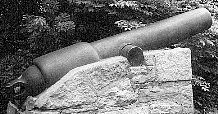
4.5-inch (20-pounder) Blakely rifle. New Canaan, CT
4.5-inch (20-pounder)
Blakely Seige Rifle
New Canaan, CT
This redoubt was armed with eight 4 ½ inch siege guns, commanding the railroad and a wide range on either side.  No. 7 was commanded by Lieutenant Beecher, with a detachment of twenty men and an equipment of six 30-pounder Parrott guns.  No. 8 was under the command of Lieutenant Hayden, with a force of twenty men and an armament of six 4 ½ inch Rodman guns. 
  The Battery was also provided with infantry muskets and equipments.  These redoubts were very complete fortifications, connected by a line of infantry parapet, and furnished with excellent magazines and a full complement of ammunition.
All the officers, most of the non-commissioned officers, and many of the enlisted men of the Battery, had been in the service prior to this, and were, therefore, fairly instructed in soldierly duties and inured to the trials of the camp and field.  A short time sufficed to familiarize ourselves with our surroundings and get into soldierly harmony with our work, so that although these separate garrisons were small, but within supporting distance, we sought to make them efficient as possible by learning to work together according to our best knowledge and ability.

            We drilled constantly, and every man of the Battery was soon taught the special duty he would have to perform in any emergency.

            The position to which we were assigned was of great honor and responsibility.  These defenses protected the vast army stores at City Point, the hospitals, charitable commissions, and the headquarters of Lieut.-General Grant.  Under the observant eyes of great chieftains and notables the Battery drilled and worked, keeping the redoubts neat and the personnel of the camp free from reproach.

            To "be always ready," was the brief instruction given us, and no pains were spared to obey the injunction.  The men were instructed to manoeuvre the guns, to fix and prepare ammunition, taught soldierly deportment and conduct, instructed in the laws of health, and commanded to be alert and vigilant, quick to respond to any call, and occupy the place to which previous training had accustomed them.  In this attitude the Battery watched and waited.  When the rebel iron-clads attempted to force a passage by the batteries and obstructions in the James River, a section of the Battery, with four 4 ½ inch siege guns, was stationed in front of General Grant's headquarters, covering the wharves and storehouses, ready for action.  The attempt of the rebels did not succeed, and the battery was returned to the redoubts.

            At the time of the grand advance of the army upon the rebel lines our works were strengthened by the addition of a section of light guns which could be readily moved along the line of breastworks that adjoined the redoubts, and the entire line was left wholly dependent upon the officers and men of our Battery.  By day and by night, resting on our arms, we stood by our guns watching and waiting.  The roar of battle was in our ears, its mortal wreckage drifted past us, and our veins beat in unison with the tempest.  This was all.  Lee surrendered; the war was finished.  It had been ours to watch and to wait, to "be ready"; this was all.

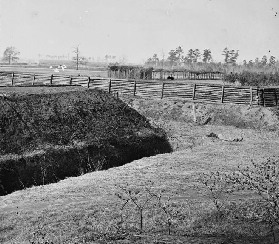
Chapin's Bluff, Virginia. Vicinity Fort Burnham
Chapin's Bluff, Virginia
Vicinity Fort Burnham
We were soon ordered to work with a battalion of the First Connecticut Artillery, commanded by Major Brooker, of pleasant memory, in dismantling the rebel fortifications in the vicinity of Chapin's Bluff on the James River.  There we worked, relieved from the strain of constant anxiety, and looking cheerfully forward to the hour of release from the exacting duties of military life.
      On the 22d of June, 1865, I was directed by the commissary of musters, Department of Virginia, to prepare muster-out rolls of all the enlisted men of the Battery whose terms of service expired prior to October 1, 1865.  These rolls contained the names of ninety-three (93) men, and were furnished on the 23d.  With the exception of twenty-seven (27) men who were transferred to the First Connecticut Heavy Artillery, in accordance with instructions from the Department of War, the Battery was mustered out.        A transport steamer took us to New York, and thence by boat we went to New Haven, Conn.  We were met at the dock by the New Haven Grays, under command of Col. Samuel E. Merwin, and escorted in a drenching rain to the Union House, where a splendid feast awaited us, all of which "home cheer" was gratefully partaken.
      On the 3d of July, 1865, the officers and men of the Battery were paid and the command disbanded.  The Battery lost but one man by death during its period service, Corporal Beecher, who died from exposure a few days after our arrival at City Point.  Only one man was severely injured, and that by accident — Private Hubbell — who was burned by the bursting of a buried shell in front of one of the rebel works. 
      The service of the Third Connecticut Independent Battery was all rendered in considerably less time than one year, but it witnessed the collapse of the Great Rebellion, and there were officers and men in the organization who had witnessed its advent, as an armed power, and now rejoiced to see its downfall.


         Casualties Third C. V. Light Battery

Accidentally Wounded

Died

Discharged for disability

Total

1

3

2

6

Editor’s Note:  This is the ninth monthly installment of the history of Connecticut’s service in the Civil war, as published in the RECORD OF SERVICE OF CONNECTICUT MEN IN THE WAR OF REBELLION, 1861 TO 1865.  (Transcribed by Staff Sergeant Brett W. Wilson, Administrative Assistant to the USPFO for Connecticut).