Educator Competency-Aligned Instructional Routines
Introduction
Effective reading instruction is grounded in research, consistent practice, and clear links to student needs. Instructional routines offer a structured approach to delivering high-quality, evidence-based instruction that supports all learners, especially those with dyslexia or word-level reading difficulties. This page explains why routines matter, which language domains they target, and how to spot a high-quality routine. It also connects you to curated, open-source set of routines mapped to the Connecticut Educator Competencies for Structured Literacy and Dyslexia, ensuring that instruction is both purposeful and accessible.
Why Use an Instructional Routine?
Instructional routines foster a sense of belonging by making teacher-student interactions predictable and consistent. Predictable routines allow students to focus on the content of the lesson rather than the format of the activity which lowers anxiety and reduces repeating directions. While beneficial for all learners, students with reading difficulties depend on this consistency to stay fully engaged.
Why These Language Domains?
Dyslexia is a brain-based word-level reading disability. Research has shown that the greatest impact appears in the following three language domains:
- Phonological awareness, with an emphasis on phoneme awareness
- Phonics, spelling/encoding, and word identification
- Reading fluency
Instructional routines targeting these domains address the root causes of dyslexia. Early identification and focused instruction can close gaps in phonemic awareness, word reading, and spelling deficits; however, many students will continue to need support in reading fluency, spelling, and written expression.
Click on one of the three Educator Competency domains below to explore the instructional practice and knowledge competencies addressed in these areas:
What Makes a Routine Effective?
Quality instruction is explicit and systematic. Look for routines that provide a clear, step-by-step framework, are evidence-aligned, offer repeated practice and timely, corrective feedback. Effective routines empower educators to meet diverse student needs with confidence.
Explicit instruction:
- Uses clear, direct, and unambiguous language
- Checks for understanding frequently
- Avoids assuming student mastery
- Keeps all students actively involved
- Follows the gradual release model (“I Do, We Do, You Do”)
- Offers ample opportunities for accurate responses (targeting 90%+ accuracy)
- Interleaves practice across skills
- Gives specific feedback immediately after each response
Systematic instruction:
- Follows a logical, cumulative sequence
- Introduces foundational skills before more complex ones
- Is guided by a carefully designed scope and sequence
Responsive support:
- Adapts to each student’s strengths and challenges
- Pairs verbal cues with clear signals or gestures to guide responses
- Adjusts pacing to student needs (“as fast as you can but as slow as you must”)
- Uses visual aids (e.g., slides, apps, or schedules)
- Engages multiple modalities (auditory, visual, kinesthetic) to strengthen learning and accuracy
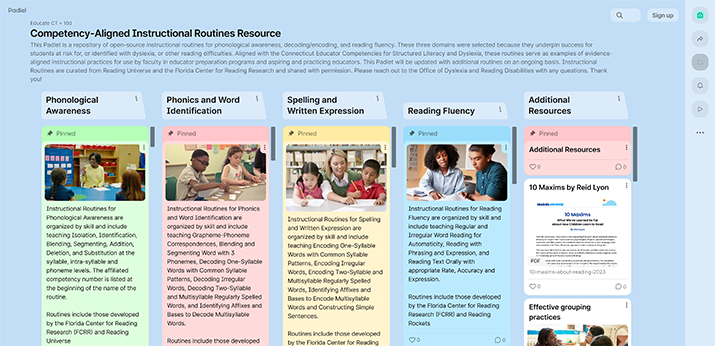
Competency-Aligned Instructional Routines Padlet
Explore the Competency-Aligned Instructional Routines Padlet for open-source, evidence-aligned routines not tied to any specific commercial program or resource. Curated from the Florida Center for Reading Research and Reading Universe (and used with permission), each instructional routine has been aligned to a specific Educator Competency in one of the three selected domains. The Padlet will be updated as new routines become available.