

The Writing Rope
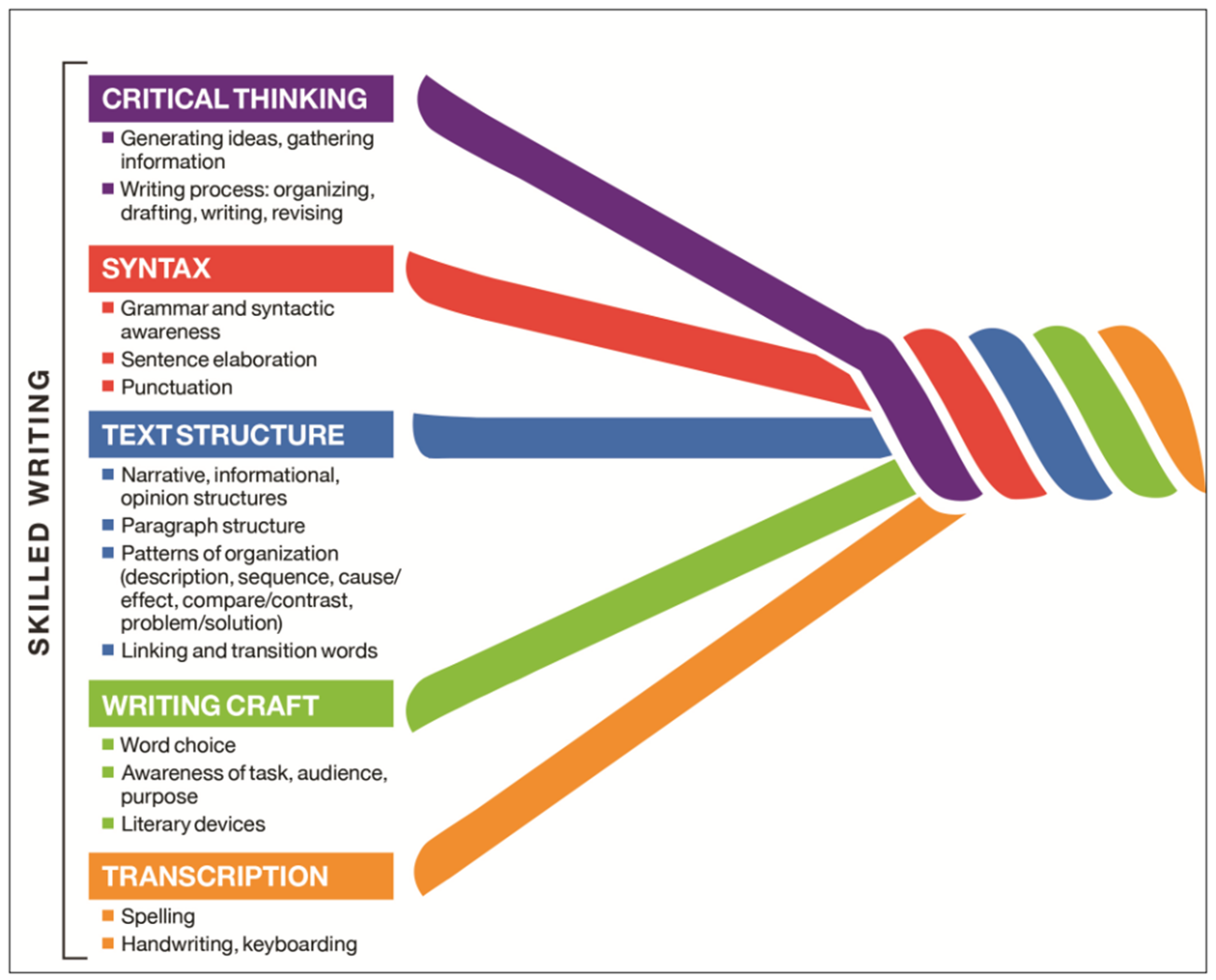
The Writing Rope, developed by Joan Sedita in 2019, is a comprehensive framework designed to identify the multiple components necessary for skilled writing. While considering Scarborough’s Reading Rope, the Writing Rope organizes writing instruction into five interwoven components: critical thinking, syntax, text structure, writing craft, and transcription skills. Each strand of the rope represents a crucial element of skilled writing, and together they reflect the interconnected nature of the writing process. The Writing Rope serves as both a conceptual model and a guide for building student proficiency in writing across all grade levels and content areas.
The Writing Rope Strands
- Critical Thinking: Focuses on the awareness of the writing process, background knowledge development, and critical thinking skills. Includes explicit instruction in brainstorming strategies, note taking, graphic organizers, and editing/revising.
- Syntax: The study and understanding of grammar and sentence structure. Supports not only writing but also listening and reading comprehension. Instruction includes sentence elaboration and combining.
- Text Structure: Provides a blueprint for text organization. Includes narrative, informational, and opinion structures, as well as paragraph development. Explicit instruction helps students comprehend and produce well-organized writing.
- Writing Craft: Encompasses word choice, awareness of task, audience, and purpose, and the use of literary devices such as plot, character, theme, and figurative language.
- Transcription: Covers the basic skills of spelling, handwriting, and keyboarding. As fluency develops, students can shift attention to higher-order writing skills.
References
- National Assessment of Educational Progress. (2019). Reading assessment. Retrieved from https://nces.ed.gov/nationsreportcard/reading/
- Scarborough, H. S. (2001). Connecting early language and literacy to later reading (dis)abilities: Evidence, theory, and practice. In S. Neuman & D. Dickinson (Eds.), Handbook for research in early literacy (pp. 97–110). New York, NY: Guilford Press.
- Sedita, J. (2019). The Writing Rope: The strands that are woven into skilled writing. Keys to Literacy.
- Sedita, J. (2023). The Writing Rope: A framework for explicit writing instruction in all subjects. Baltimore, MD: Paul H. Brookes Publishing Co.
- The nation’s report card: Writing 2011. Retrieved from https://nces.ed.gov/nationsreportcard/pubs/main2011/2012470.asp