

The Scarborough Reading Rope
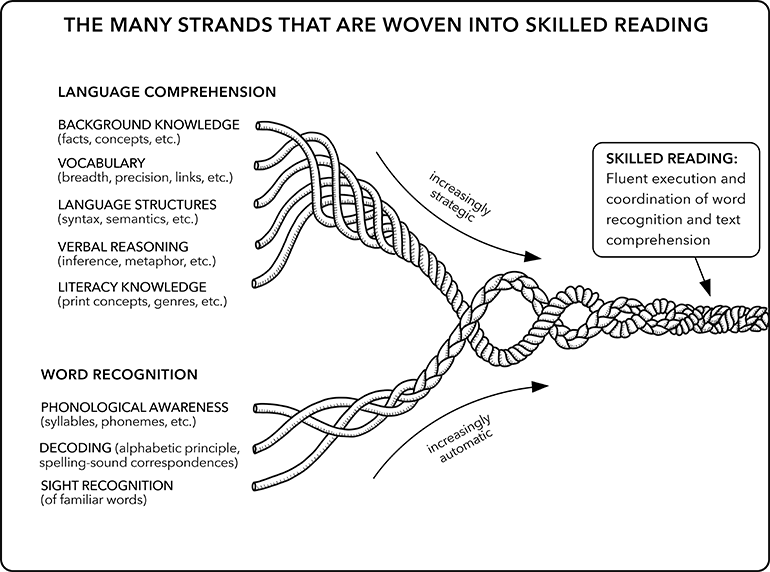
Scarborough, H. S. (2001). Connecting early language and literacy to later reading (dis)abilities: Evidence, theory, and practice. In S. Neuman & D. Dickinson (Eds.), Handbook for research in early literacy (pp. 97-110). New York: Guilford Press. Reprinted with permission from The Guilford Press.
Scarborough’s Reading Rope provides another model for conceptualizing the components involved in learning to read. Like the Simple View, it emphasizes the contribution of both language comprehension and word recognition. Yet it offers a more detailed glimpse into the subskills inherent in both of those components.
Language Comprehension
The Language Comprehension bundle is comprised of five strands:
- Background Knowledge
- Vocabulary
- Language Structures
- Verbal Reasoning
- Literacy Knowledge
Background Knowledge
Background Knowledge: This refers to the information and understanding one has acquired about a given topic through their experiences, reading, and communication. Students with background knowledge about the text topic generally comprehend it better than those with a more limited understanding (Recht & Leslie, 1988). The old adage “First you learn to read, then you read to learn” should really be “First you learn to read AND you ALWAYS need to learn,” signifying the importance developing knowledge through oral communication, read-alouds, podcasts, and real-world experience right from the beginning.
Vocabulary
Vocabulary: This refers to one’s understanding of the meaning of words, including the number of words they know, the depth and specificity of their understanding, and how words may be interconnected. Weaknesses in vocabulary are hard to overcome, often persisting throughout a child’s K-12 education and into adulthood (Catts et al., 2006). Additionally, these weaknesses can impact every school subject (Christian, Morrison, Frazier, & Massetti, 2000). Effective instruction is essential.
Language Structures
Language Structures: This refers to the way in which words are structured to make phrases and sentences (syntax) that are meaningful (semantics). Students must be able to “parse the syntactic and semantic relationships among the words” (Scarborough, 2001) in order to comprehend text. That is, they must understand how sentences are structured and how the words within them are related in order to break them apart and make meaning from them.
Verbal Reasoning
Verbal Reasoning: This refers to how meaning is derived from what is read or heard. Verbal reasoning includes sequencing events, making connections between characters and concepts, understanding how figurative language (e.g., metaphor) conveys meaning within the text, generating inferences, and analyzing, synthesizing, and evaluating the text.
Literacy Knowledge
Literacy Knowledge: This refers to one’s understanding of a text’s structure, spanning from print concepts (e.g., how to hold a book, reading from left to right and from top to bottom, etc.) to the features and purposes of the various text structures. When students understand the differences between poetry and prose and the organizational structures of informational text (e.g., descriptive, sequential, cause and effect, compare and contrast, definition and example, etc.), they can more effectively make meaning from them. Additionally, when readers understand the purpose behind such text features as table of contents, headers, pictures, captions, and glossaries, they can more effectively navigate the text to aid their comprehension.
Word Recognition
The Word Recognition bundle is comprised of three strands:
- Phonological Awareness
- Decoding
- Sight Recognition
Phonological Awareness
Phonological awareness: This is the understanding that sentences are made up of individual words, and that words are made up of syllables and sounds. A subset of phonological awareness is phonemic awareness, which is the ability to hear, identify, and manipulate individual sounds in words. It is a necessary skill for reading and spelling. When children have phonemic awareness, they can blend sounds together to read words, segment sounds to spell words, and change sounds to build new words.
Decoding
Decoding: This is the process of using knowledge of letter-sound relationships, syllables, and patterns to read words. To do this, students must first understand the alphabetic principle – that is, the direct connection between letters and sounds, and how they can be combined to make words. Decoding is enhanced when students practice encoding (spelling) the same words in tandem.
Sight Recognition
Sight Recognition: When students practice decoding and encoding words, the words are mapped into their long-term memory, making them instantly recognizable by sight. In typically developing readers, this mapping can occur within one to four exposures (Kilpatrick, 2015). Others may need much more practice in order to build automaticity, or sight recognition. This process is important so that students can focus their attention on text comprehension instead of effortfully sounding out the words they see.
Interwoven Nature
The metaphor of a rope suggests that the strands of the rope are interwoven: the skills are interconnected and are best developed in tandem. For example, when delving into a knowledge-building text, developing students’ understanding of relevant vocabulary, sounding out unfamiliar words, breaking apart complex sentences, and practicing comprehension strategies based on the text’s structure will have greatest impact. Even when reading a decodable text to build fluency, students benefit from discussing the meaning of unfamiliar words, noting how structures within the sentences convey meaning (e.g., adjectives, verbs, questions, exclamations, etc.), and making connections between events and texts to deepen their understanding of the topic.
All Strands Are Important
The rope metaphor carries an additional message: if even one strand frays, the strength of the rope is impacted. That is, weakness in even one skill area will impact a student’s ability to become a skilled reader. But effective instruction and repeated practice in each of these areas over time, based on the needs of the learner, leads to a tightly wound rope, or skilled reading.
How Does Dr. Scarborough Reflect upon the Rope over 20 Years Later?
The Reading Rope: Key Ideas Behind the Metaphor
“It is important to remember that the strands do not develop independently. Rather, growth on one strand often affects growth on others.”
Read the powerpoint by Hollis Scarborough. Reprinted with permission from The Reading League.
References
- Catts, H. W., Adlof, S. M., & Weismer, S. E. (2006). Language deficits in poor comprehenders: A case for the simple view of reading. Journal of Speech, Language and Hearing Research, 49, 278-293.
- Christian, K., Morrison, F. J., Frazier, J. A., & Massetti, G. (2000). Specificity in the nature and timing of cognitive growth in kindergarten and first grade. Journal of Cognition and Development, 1(4), 429-448.
- Kambach, A. E. & Mesmer, H. A. (2024). Comprehension for emergent readers: Revisiting the reading rope. The Reading Teacher, 77(6), 888-898.
- Kilpatrick, D. A. (2015). Essentials of Assessing, Preventing, and Overcoming Reading Difficulties. Hoboken, NJ: John Wiley & Sons, Inc.
- Scarborough, H. (2023). The Reading Rope: Key Ideas Behind the Metaphor. Retrieved from The Reading League: https://www.thereadingleague.org/.../The-Reading-Rope-Key-Ideas-Behind-the-Metaphor.pdf
- Recht, D.R. & Leslie, L., (1988). Effect of prior knowledge on good and poor readers’ memory of text. Journal of Educational Psychology, 80(1), 16-20.
- Scarborough, H. S. (2001). Connecting early language and literacy to later reading (dis)abilities: Evidence, theory, and practice. In S. Neuman & D. Dickinson (Eds.), Handbook for research in early literacy (pp. 97-110). New York: Guilford Press.