

Integrated Water Planning Management 2
The Response to Comments for IWPM2 and the IWPM2 Framework Document are now available. Thank you to all who submitted comments.
Overview of Integrated Water Planning Management
Integrated Water Planning Management (formerly known as Integrated Water Resource Management) is a long-term Water Quality Planning approach that identifies waterbodies for Water Quality Action Plan (WQAP) development. The Environmental Protection Agency (EPA) and the States began a 10-year planning approach that shifted the focus from the rate at which WQAPs were developed and focused more on state specific water quality priorities and using the right tool to restore or protect surface waters. EPA referred to this process as the 303 (d) Vision. CT called this approach Integrated Water Resource Management, now called Integrated Water Planning Management (IWPM).
CTDEEP worked closely with existing / potential partnerships, active Environmental Groups and other stakeholders to choose priority topics and focus watershed areas using this methodology for IWPM Phase 1.
The focus topics that were chosen for Action Plan development for restoration and protection through public engagement were:

Nutrients in Lakes and Embayments
Fish and Wildlife health
Stormwater
Please refer to the IWPM Phase 1 website for more information on how CT waterbodies were chosen for Action Plan Development.
Swimming and shellfishing
IWPM Phase 2
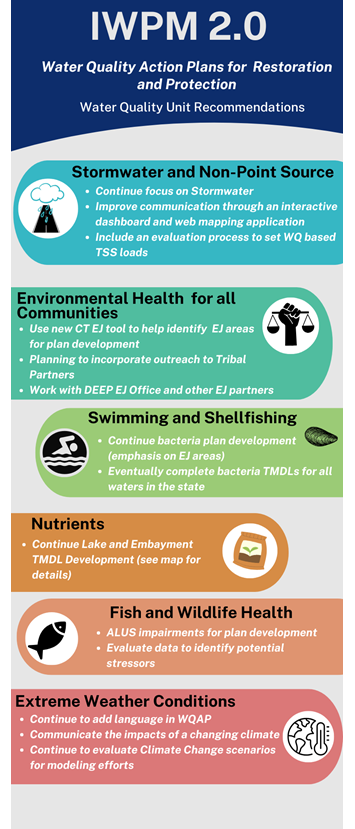
CTDEEP is now in the 2nd phase of IWPM. The new 10-year planning period spans from October 2022 through September 2032. IWPM 2 will entail the same general process as IWPM 1. CTDEEP is recommending refining the topics that were outlined in IWPM 1 with a robust emphasis on Environmental Justice and Climate Change and recommending no new topics for IWMP 2.
For more information on the proposed topics for IWPM 2.0 please refer to the IWPM Phase 2 Factsheet.
|
Comment # |
Original Comment Letter Link |
Topics |
Affiliation |
|---|---|---|---|
|
1-3 |
Climate Change, Environmental Justice, Public Water Supply-Protection |
Council on Environmental Quality, Executive Director |
|
|
4 |
Tuttle Brook / New Haven Harbor |
East Haven, Resident |
|
|
5-11 |
Pesticides, Artificial Turf, Water Conservation, Single Use Containers, NPS Pollution, Wetland Preservation, Wastewater Treatment Facilities |
New Haven, Resident |
|
|
13 |
Chloride |
Environmental Health & Safety Department, UConn |
|
|
14-20 |
Artificial Turf, Chloride, NPS Pollution Management, Pesticides, Public Water Supply-PFAS, Water Conservation |
Westport, Resident |
|
|
21-24 |
Chloride, Emergency Spill Notification, Invasive Plant Species, Water Quality Monitoring |
Environmental Technician, Windham Water Works |
|
|
25 |
1,4 Dioxane |
New Haven, Resident |
|
|
26 |
Baker Cove |
Economic Development Manager City of Groton |
|
|
27-29 |
Implementation Funding, Avery Pond, Yantic River |
Watershed Project Manager, Eastern Connecticut Conservation District |
|
|
30-31 |
Climate Change, Public Water Supply-protection |
Chair, Connecticut Council on Soil and Water |
|
|
32a-33 |
Artificial Turf, Pesticides, Public Water Supply-PFAS |
Westport, Resident |
|
|
34 |
Artificial Turf |
Westport, Resident |
|
|
35-37 |
Artificial Turf, Pesticides, Water Conservation |
Westport Resident, Save Westport Now Co-Chair, Aquaya Chair |
|
|
38-41 |
Climate Change, Nutrients, Lake Lillinonah, Twin Lakes, Lake Waramaug, Upper Housatonic Watershed Partnership, TSS |
Friends of the Lake |
|
|
42 |
New Drinking Water Resources |
State Health Care |
|
|
43-50 |
Bacteria, Interagency Communication, Public Water Supply – PFAS, Staffing, Water Management, Advocacy, Water Quantity, Public Water Supply-Protection |
Westport, Smarter Water |
Learn More:
- IWPM2 Final Report
- IWPM2 Response to Comments
- IWPM2 Presentation slides
- IWPM2 Morning and Evening Presentation Recordings
- CT Integrated Water Planning and Management Phase1 Webpage
- CT Integrated Water Planning and Management Phase 1 Factsheet
- CT Integrated Water Planning and Management Phase 2 Factsheet
- CT Total Maximum Daily Load
- CT Integrated Water Quality Report
- Environmental Protection Agency 303 (d) Vision
- CT Water Monitoring and Assessment Program
- CT Water Quality Standards and Classifications
Content last updated August 20, 2025