

General Permit for the Discharge of Dewatering and Remediation Wastewaters
Connecticut’s Dewatering and Remediation General Permit (D2R GP) provides a streamlined regulatory framework for managing the discharge of treated wastewaters into the state’s surface and ground waters. This permit supports critical environmental restoration and development projects—from petroleum storage tank replacements to large-scale construction dewatering—by establishing clear, standardized requirements for monitoring and treatment. By ensuring rigorous oversight and the use of modern safeguards, the D2R GP effectively protects human health and preserves Connecticut’s water quality, fulfilling the state’s commitment to sustainable environmental remediation.
Quick Links
- D2R General Permit
- Application Process & How to Apply
- Resources and Contacts
- Compliance Assistance Page
- Need to Make a Change
- Online Noncompliance Reporting
- Additional Assistance
Stay Informed! *New*
Subscribe to our Newsletters
- Industrial Insights: Regulatory development and industry news to keep you informed.
- The Runoff Report: Timely stormwater updates and news delivered to your inbox.
Sign up for one of both - we'll take care of the rest
Get started today: Subscribe now!
D2R General Permit
*Registration Opens March 1, 2026*
General Permit for the Discharge of Dewatering and Remediation Wastewater
- Appendices
- D2R General Permit Fact Sheet
- D2R General Permit Response to Comments
- D2R General Permit FAQs
Application Timeline & Deadlines
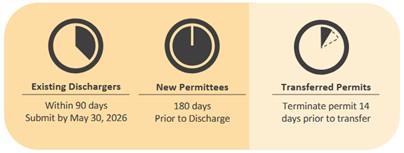
Deadlines for Existing Permittees
If your site was previously authorized under the 2023 Groundwater & Remediation General Permit, the following application deadlines apply:
- Existing Discharges to POTWs
- Sites that were authorized to discharge to a Publicly Owned Treatment Works (POTW) under the 2023 permit must submit an application no later than March 1, 2026
- The reissued Dewatering & Remediation (D2R) General Permit no longer authorizes discharges to POTWs. A new application is required to maintain compliance
- Existing Discharges to Surface or Ground Water
- Sites that were authorized to discharge to surface water or groundwater under the 2023 permit must submit an application no later than May 30, 2026
- Note: Interim permit coverage is provided if a complete and timely application is received.
- Application for New Site
- New sites must apply 180 days (6 months) prior to initiating discharge
Application Process & How to Apply
Explore the step-by-step Application User Guides below:
How to Submit Your Application
The application process is a 5-step time-sensitive process

Step 1 - Prepare
- Review the permit and confirm eligibility requirements.
- Consult the following flow chart to aid you in determining whether your project is eligible for coverage under the D2R:
Step 2 - Complete the Application Form
- Refer to the Application User Guide for step-by-step instructions and the list of required information needed to complete the form.
Step 3 - Submit the Application Transmittal Form
- The Application Transmittal Form allows DEEP to track fee payments and match them to the correct application. The Permit Application Transmittal Form is required for this general permit and must be submitted with your permit-specific forms. Click to download Word or PDF
- After completing the Application Transmittal Form and required attachments, email it to: DEEP.CentralPermits@ct.gov
- Important: Keep a copy for your records. You will receive a confirmation email with instructions for submitting payment and accessing the file transfer site. Once the Application Transmittal Form is submitted, the remainder of the process is time-sensitive.
Step 4 - Upload Required Documents
- Within 10 business days of submitting the Application Transmittal Form, upload all required documents to DEEP's File Transfer Protocol (FTP) site - File Sharing Website - using the instructions provided in your confirmation email.
Critical Deadline: Applications will be closed and rejected if required documents are not received within 10 business days. Submit documents as soon as possible after submitting the Application Transmittal Form.
Step 5 - Application Review and Decision
- DEEP will begin processing your application upon receipt of all required documents. A high volume of applications is expected near submission deadline, which may result in processing delays. To help avoid delays, submit your application well in advance of posted deadlines.
Application Form for Dewatering and Remediation Wastewater
Application Attachments that must be completed and submitted:
- Attachment A - Site Plan & Map
- Attachment B - Coastal Consistency Review
- Attachment C - NDDB Determination Letter
- Attachment D - Department of Public Health Approval Letter
- Attachment E - USGS StreamStats Low-Flow Statistics Report
- Attachment F - Reserved
- Attachment G - Plans and Specifications of Treatment System
- Attachment H - Monitoring Plan
- Attachment I - Dewatering and Remediation Screening Analysis (use prescribed form)
- Attachment J - Analytical Lab Report
- Attachment K - Line & Process Flow Diagram(s)
- Attachment L - Erosion and Sediment Controls
- Attachment M - Ground Water Monitoring Program
- Attachment N - Subscriber Agreement (use prescribed form)
Need Assistance with the Application?
The Industrial Water Permitting Program Team can assist with questions related to the information required by the permit. The team does not provide IT support and cannot assist with account, login, or system related issues.
For Questions related to the permit:
DEEP Industrial Permitting Team DEEP.IndustrialNPDESCompliance@ct.gov
For technical issues with the online application system:
DEEP IT Support Team - DEEP.helpdesk.footprints@ct.gov
Due to anticipated high volume of inquiries, responses may take up 2-3 business days. Your patience is appreciated.
Application Resources
- Impaired Waters Map: CT DEEP GIS Viewer
- Water Quality Map: CT DEEP Water Quality
- USGS StreamStats: StreamStats Application
- EPA NPDES eReporting: EPA NPDES eRule
- EPA Enforcement & Compliance History Online: EPA ECHO
- CTDEEP NeTDMR: DEEP NetDMR
- NeTDMR/CDX: EPA NeTDMR Portal
- Central Data Exchange: CDX Sign-in
- NPDES eReporting Tool: eRule NetDMR Homepage
What to Expect
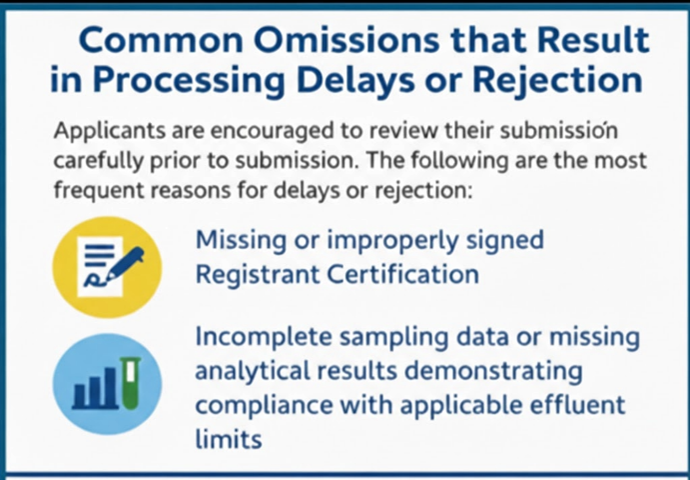
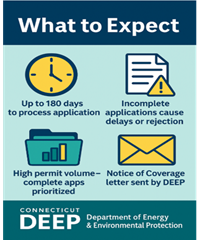
- Incomplete applications will result in processing delays or rejections
- Deep expects a high volume of applications in the first year of the permit term that
may lead to delays in processing time - You will receive a "Notice of Coverage" from DEEP confirming your permit coverage
Need to Make a Change at the Site?
Use the same form used to submit the initial application and submit a Notice of Change| Reason for Submittal | Description/Trigger |
| Name Change | Permittee name has changed after the initial notification of discharge. This does not include transfers in ownership. This permit is not transferable. |
| Correction of Information | Application contains inaccurate or misleading information that must be corrected. |
| Facility Modifications | Any change affecting the nature, volume, or characteristics of the discharge. |
| Change in Activity or Pollutant Loading | Change in the process generating the discharge or in the pollutant concentration of an existing pollutant. |
| New Source of Water | Introduction of a new water source into the process. |
| New Pollutant | Introduction of a pollutant not previously reported in the initial application. |
| Change in Flow | Increase in the maximum daily discharge flow. |
| Relocation of Monitoring Point | Moving an existing sampling or monitoring location. |
Online Noncompliance Reporting
Effective December 1, 2023, DEEP’s Water Permitting and Enforcement Division (“WPED”) receives noncompliance notifications and follow-up reports required under RCSA Section 22a-430 electronically using a web-based platform.
The online noncompliance notification and report forms should be used by facilities with discharge permits issued by WPED to report instances of permit noncompliance including but not limited to effluent limit violations, equipment malfunctions, spills, and bypasses. These forms do not replace DEEP’s 24-hour/day Emergency Response Unit call hotline.
Submit a notification of noncompliance here.
Submit a noncompliance follow-up report here.
Water Pollution Concerns
Report Water Pollution Concerns
Use the above link to report concerns related to water pollution. Submitted complaints are reviewed on an ongoing basis and will be investigated in accordance with the potential environmental harm and risk to public safety.
If your complaint is an environmental emergency, call DEEP's Emergency Response Unit 24 hours a day at 866-DEP-SPIL (866-337-7745) or 860-424-3338. Please see DEEP's Reporting Environmental Concerns and Problems webpage for additional reporting guidance.
Additional Resources and Contact Information
Compliance Assistance
Industrial Wastewater
Contact Us:
Have a question? Need help with your permit? We're here to help.
Industrial Water Permitting Program Staff
Connecticut Department of Energy & Environmental Protection (DEEP)
Email: DEEP.IndustrialNPDESCompliance@ct.gov
Content last updated June 30, 2026