

Press Releases

06/11/2026
Take Advantage of Electric Vehicle (EV) Charging Infrastructure Federal Tax Credit Before It Expires June 30th
Tax Credit Applies to Chargers Installed in Eligible Low-Income or Non-Urban Census Tracts and Can Cover Installation, Electrical Work, and Equipment
(HARTFORD)—The Connecticut Department of Energy and Environmental Protection (DEEP) reminds residents that until June 30, 2026, the federal Alternative Fuel Vehicle Refueling Property Credit (30C) can help cover up to 30% of the cost of purchasing and installing a residential or commercial electric vehicle (EV) charging station.
Connecticut residents continue to choose EVs for their lower total cost of ownership and maintenance, their environmental benefits, and because they are fun to drive. The Connecticut Hydrogen and Electric Automobile Purchase Rebate (CHEAPR) remains in place to help residents purchase or lease an EV, and with gas prices high due to geopolitical events, now is a good time to consider whether an EV and a charging station is right for you, your home, or your business.
The charging station tax credit is capped at $1,000 for residential installations and $100,000 for commercial installations in eligible low-income or non-urban census tracts.
Eligible expenses may include:
- Residential and commercial EV charging equipment
- Installation and wiring by a licensed electrician
- Upgrades to electrical panels, if required for charger compatibility
But time is limited: this 30% federal tax credit is only available for EV chargers purchased, installed, and operational by June 30, 2026. That might require getting licensed electricians and local permits. If you are interested, but have not already started the process, you should check with your installer to ensure you can meet the deadline. Check out the IRS guidance for more details on qualifying for the tax credit. If you have already installed a charger this year, you can claim the credit on your 2026 Tax Year return.
Whether you’re installing a level 2 charger in your garage, upgrading parking facilities at your workplace, or working with your local government to add public chargers, this federal tax credit might significantly reduce upfront costs.
“If you were planning to install an EV charger, now is a great time to take advantage of the significant savings offered by this federal tax credit before it expires,” DEEP Commissioner Katie Dykes said. “Connecticut consumers continue to show that they’re interested in going electric. Last year, total EV registrations in Connecticut grew by almost 21%, while year over year growth for the CHEAPR EV Rebate+ incentive grew by 83%. With record numbers of used EVs available and manufacturers introducing lower cost new EVs with purchase incentives on top of state incentives, an electric car is worth considering for an affordable, convenient, clean, and fun transportation option. DEEP continues to track EV deployment and market share nationally and in Connecticut. For the first quarter of 2026 Connecticut’s market share of new light-duty EV sales was just over 6%, which is a slight increase over the fourth quarter of 2025. Nationally, data from March 2026 shows the strongest level of EV sales since the expiration of the federal EV tax credit last year, which aligns with significant increases to the cost of gasoline and highlights how some drivers may be viewing the cost savings from EVs.”
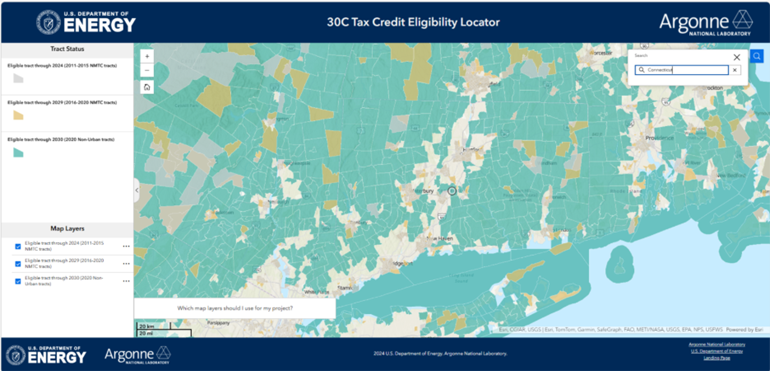
How do you know if you are eligible for the tax credit? The address where the charger is installed must be in one of the eligible census tracts. Find out if you qualify by using the 30C Tax Credit Eligibility Locator “search” box that can be opened by clicking on the magnifying glass icon (upper right of the map). Type in your address and verify your eligibility using the color coding on the map (see screenshot below). Please note that a city or town may have multiple census tracts in it that may or may not be eligible. Be sure to check the address.
The following website may provide useful information to help Connecticut residents navigate this federal tax credit: Federal Tax Credits for EV Charging Infrastructure (30C) - Plug In America
30C Tax Credit Eligibility Locator
Connecticut State Electric Vehicle Incentives
While federal tax credits for electric vehicles are expiring, popular state incentives will continue to be available to Connecticut residents and businesses choosing to adopt these technologies.
The Connecticut Hydrogen and Electric Vehicle Purchase Rebate (CHEAPR) program offers incentives to Connecticut residents who purchase or lease an eligible new or used battery electric (BEV) or plug-in hybrid electric (PHEV) vehicle from a licensed Connecticut automobile dealership or original equipment manufacturer. Standard incentives of $1,000 are available for all residents for the purchase of a new BEV. For Rebate+ qualified individuals, incentives of $4,000 for new BEVs and $5,000 for used BEVs are available.
Connecticut’s Electric Vehicle (EV) Charging Program is a statewide program that provides a $1,500 incentive for qualified United Illuminating or Eversource customers for residential and commercial light-duty EV charging equipment, as well as cash incentives of up to $300 per year for charging at off-peak times for all UI and Eversource customers. More information here for Eversource customers and here for UI customers. If you are not a UI or Eversource customer, check with your local utility to see if they provide incentives.
About CHEAPR Program
CHEAPR provides a cash rebate at the Point-of-Sale (POS) to Connecticut residents who purchase or lease a new eligible vehicle costing up to $50,000 from a licensed Connecticut new car dealer.
Incentive levels fall into two buckets: Standard and Rebate +. All Connecticut licensed drivers are eligible for the Standard incentive. To be eligible for Rebate +, a Connecticut licensed driver must be pre-qualified and either meet income thresholds, participate in an identified list of income qualified programs, or reside in either a distressed municipality or an environmental justice (EJ) community. The Rebate + incentive is awarded in the form of a voucher, so applicants must pre-apply to ensure eligibility.
The Standard incentive for a new battery electric vehicle is $1,000 and $500 for a plug-in hybrid vehicle. For individuals eligible for Rebate +, they can receive a $4,000 total incentive for a new battery electric vehicle and $2,000 for a new plug-in hybrid vehicle. While the price of an EV is quickly reaching parity with gas powered cars, used electric vehicles are another affordable option for many moderate-income residents. The Rebate+ program offers higher incentives for used battery electric and plug-in hybrid electric vehicles at $5,000 and $3,000, respectively.
About Connecticut EV Charger Program
Launched in January 2022, this nine-year program is administered by Connecticut’s regulated electric companies, Eversource Energy and The United Illuminating (UI) Company. The program aims to integrate EVs and related technologies into the electric grid efficiently, maximizing electric system benefits. Overall, the program aims to deploy over 65,000 residential and commercial EV charging ports by 2030. While this program is limited to UI and Eversource customers, municipal utilities may provide incentives as well.- Twitter: @CTDEEPNews
- Facebook: DEEP on Facebook
Contact
DEEP Communications
DEEP.Communications@ct.gov
860-424-3110