

Asian Longhorned Beetle
Protect Connecticut forests - be aware of the Asian longhorned beetle (ALB). This insect is devastating to trees and has been found in New York and Massachusetts. It may already be in Connecticut.
Trees at risk
Identification
Life cycle and behavior
Response
How to help
Resources
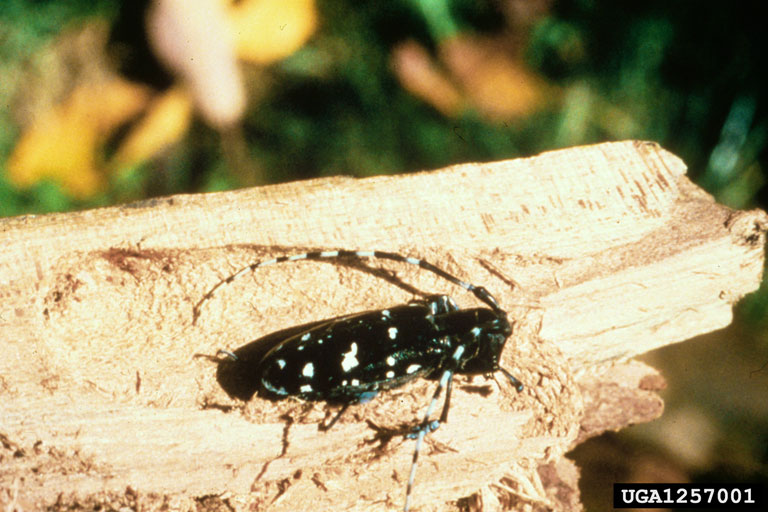
The Asian Longhorned Beetle
Kenneth R. Law, USDA APHIS PPQ, Bugwood.org
The Asian longhorned beetle (ALB) is devastating to trees and has been found in New York and Massachusetts. It may already be in Connecticut, and early detection is key.
The ALB is native to the forests of China and Korea. Following increased trade between the U.S. and China, the beetle entered the United States in the 1990s through poplar wood used for packaging and transport. ALB was first found in North America in 1996 in Brooklyn, NY.
The most severe infestation to date was in Worcester, MA, in 2008. It was estimated that this infestation was at least 12 years old at the time of discovery. Immediately upon discovery, experts began surveying and planning containment and eradication of the infestation. By October 2019, the infestation had spread to 110 square miles and led to the removal of nearly 30,000 trees. Control of the Worcester infestation is ongoing. As a result of the spread of ALB, the USDA Animal and Plant Health Inspection Service implemented national standards that regulate the movement of wood into and within the United States. It appears that these standards are working. However, Connecticut is still at risk from ALB. The beetle could easily be carried into the state accidentally through firewood or simply as a hitchhiker on a vehicle.
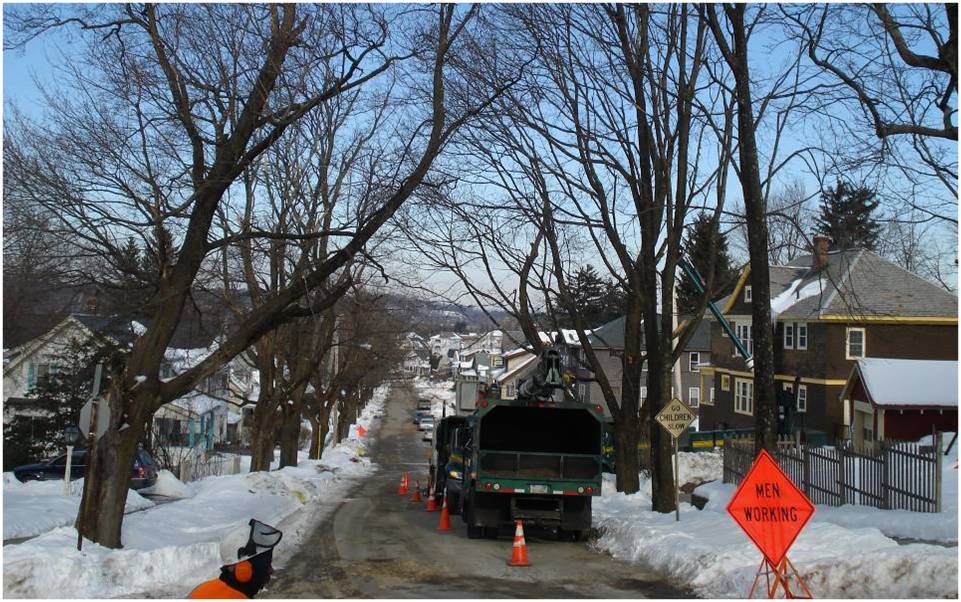
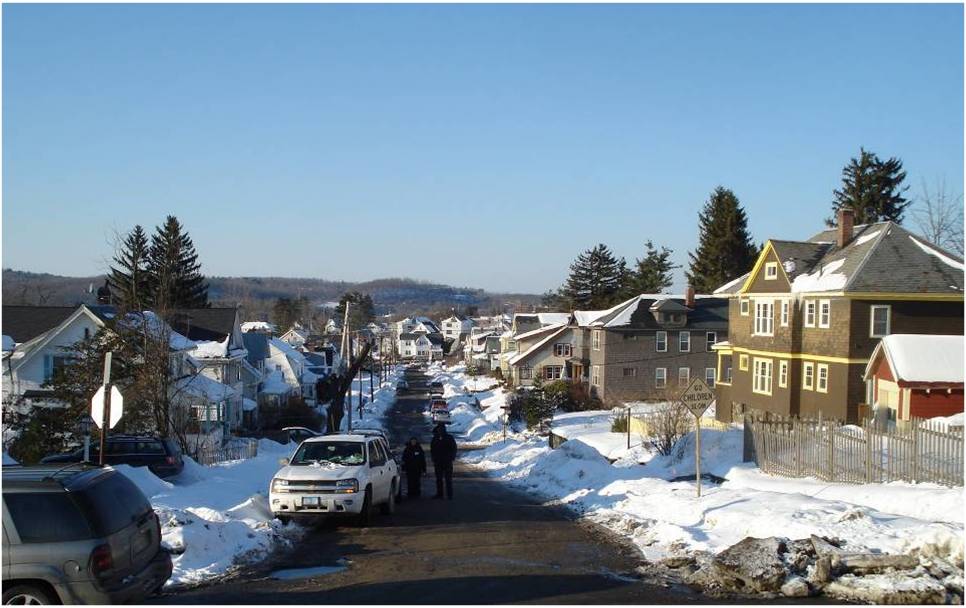
Worcester Street before (left) and after (right) tree removals from ALB
Kenneth R. Law, USDA APHIS PPQ
An ALB infestation can persist at a low level for years. Professionals and concerned community members must be vigilant to have a reasonable chance of finding this insect. In addition to tree and forest loss, ALB has the potential to negatively affect Connecticut’s economy. Fall foliage tourism, maple syrup, forest products, and nursery industries all face potential harm from the ALB. Additional financial threats include loss of property values, increased energy heating and cooling costs, loss of recreational values in our parks and forests, tree removal, and replanting costs.
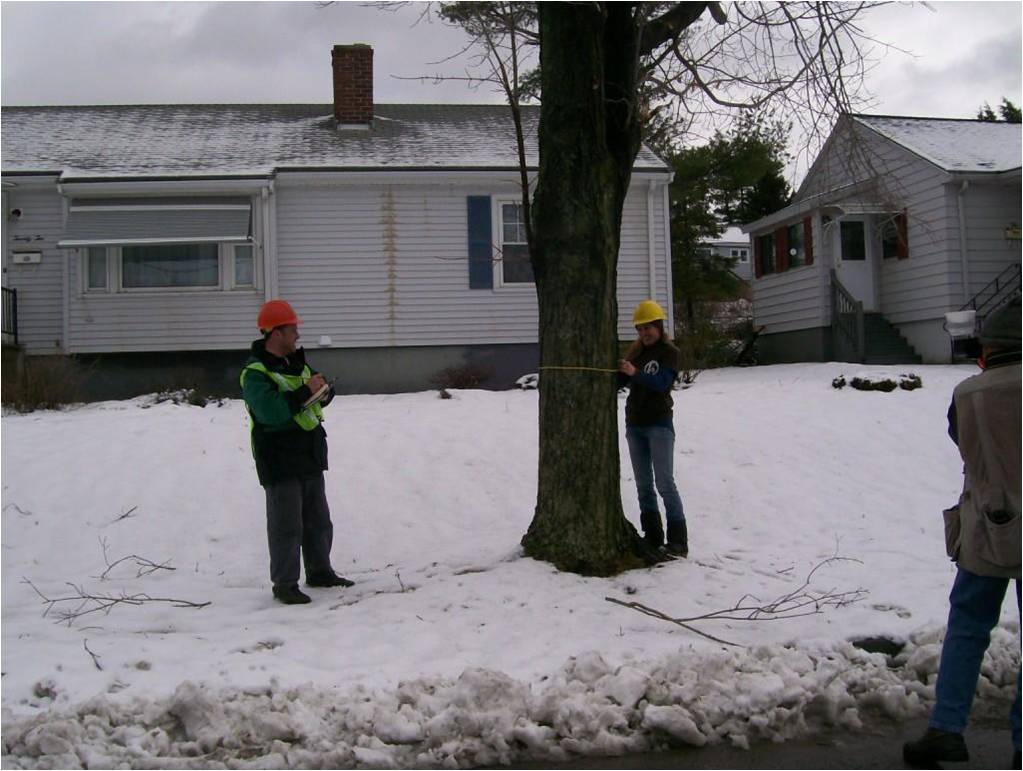
Surveying Trees in Worcester
Patty Douglas, USDA APHIS PPQ
The ALB has a large host range. Approximately 47% of the trees in our forests are considered susceptible to the ALB, with 32% considered to be highly susceptible (see Tree Lists).
Trees at risk
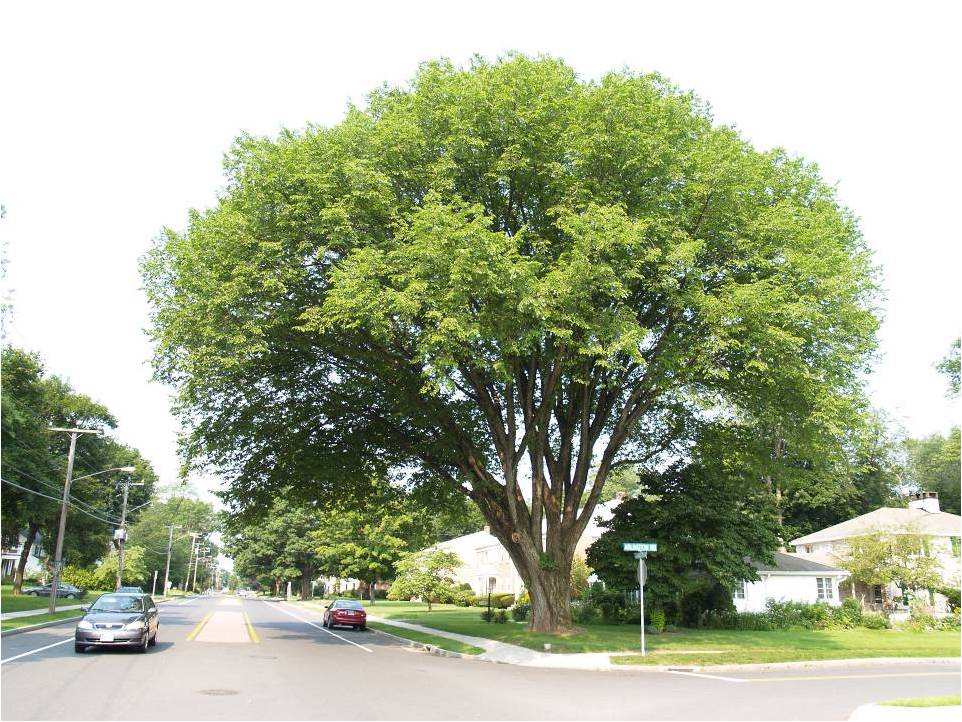
Elm in West Hartford
Chris Donnelly, CT DEEP
The ALB is notable for its wide range of potential host trees. While poplar trees in China had a major role in causing the ALB to arrive in North America, its attacks on maple trees on this continent have been most noted.
The ALB attacks hardwoods. The hardwoods most at risk include maple, elm, willow, paper and gray birch, horsechestnut, sycamore, and aspen.
Pine, spruce, fir, hemlock, and other conifers are safe from this insect. Other trees largely considered not to be at risk from the ALB include oak, apple, pear, hickory, beech, honey locust, tulip poplar, black and yellow birch, dogwood, walnut, magnolia, and tree-of-heaven.
Identification
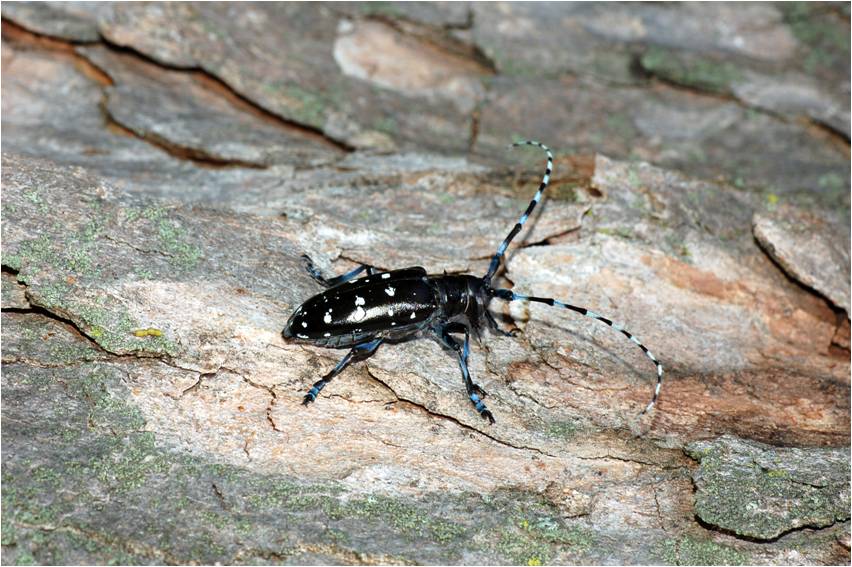
Adult Asian Longhorned Beetle
Peter Trenchard, CAES
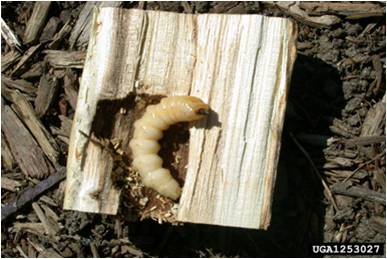
Larval Asian Longhorned Beetle
Thomas B. Denholm, New Jersey Department of Agriculture, Bugwood.org
The adult ALB is a jet-black, glossy beetle whose wing covers are marked with distinct white patches. The body of the adult female is about 1 inch to 1-½ inches in length and 3/8 to ½ inch in width. The adult male is slightly smaller. The antennae are up to 2 times their body length.
The details of the ALB’s appearance distinguish it from several look-alikes. Key characteristics are its size and glossy appearance. Also, the alternating blue-white and blue-black pattern on its antennae and the bluish tinge to the legs are important indicators.
The beetle most frequently mistaken for the ALB in Connecticut is the whitespotted sawyer, a native longhorned beetle that attacks pines. The whitespotted sawyer can be distinguished from the ALB in part because it is not nearly as glossy at the ALB, and in the differences in its spotting pattern.
The Connecticut Agricultural Experiment Station has produced a poster showing the most common ALB look-alikes.
The best indication of the presence of an ALB infestation is the insect itself. Other indicators that point to the presence of the ALB are:
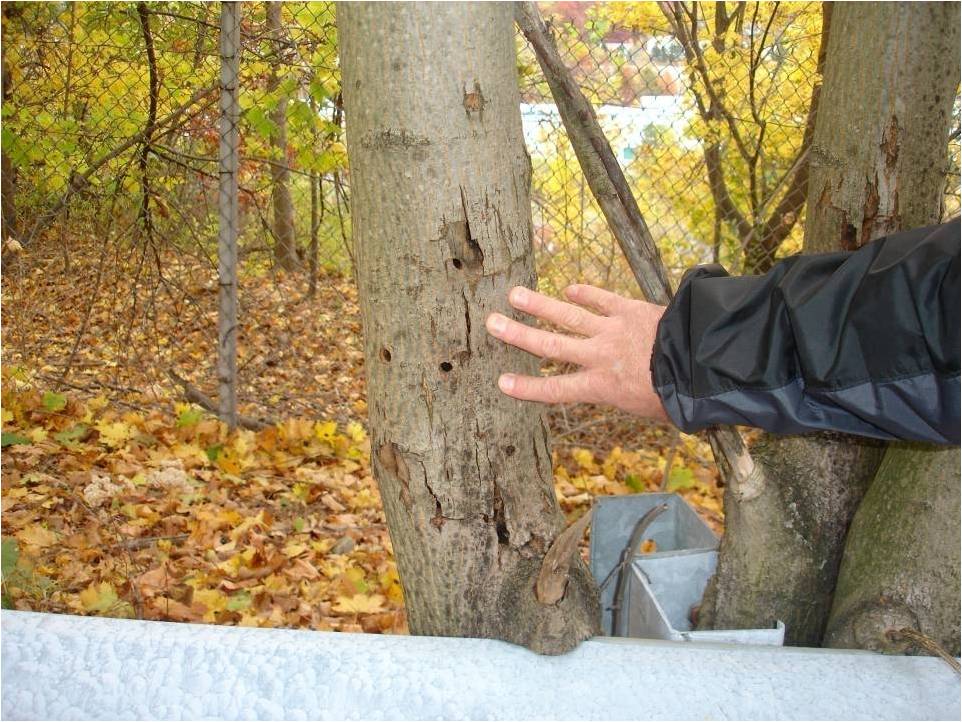
ALB Exit Holes
Peter Trenchard, CAES
Exit holes: ALB exit holes are circular and ¼ to ½ inch in diameter. Exit holes may be anywhere on the tree. Inspect branches that have been pruned or fallen from the tops of trees, as that is where infestations usually begin. There are also exit hole “look-alikes”, including the exit holes of the leopard moth and the feeding marks of sapsuckers.
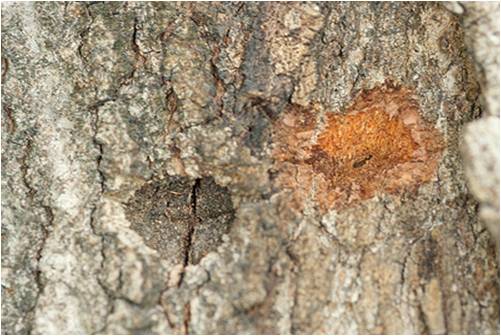
Old and New ALB Oviposition Sites
Peter Trenchard, CAES
Oviposition sites (pits): Craters chewed into the bark can be any shape, from nearly circular to a long trench. Typically, if roughly circular, they will be ½ inch or so in diameter, or about the size of a dime. As these pits are chewed by the female, the marks of her mandibles can be seen around the edges of the pit. When freshly made, the pit often stands out due to the contrast between the outer and inner bark. As the wound oxidizes and then as the tree responds, there is a loss in color contrast.
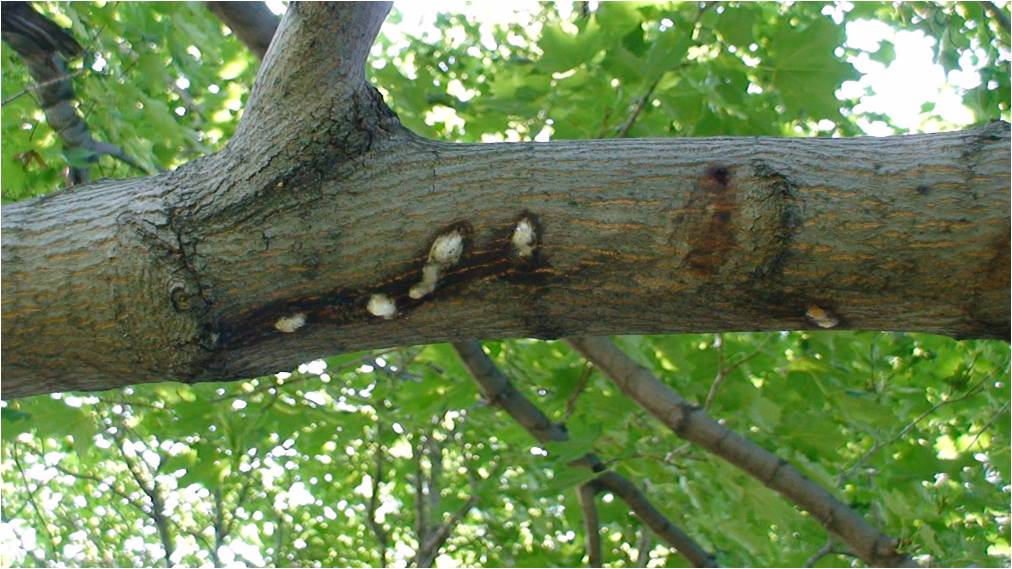
Sap Frothing from Oviposition Sites
Peter Trenchard, CAES
Frothing sap: After the adult female has chewed an oviposition pit, the tree may begin bleeding sap. In turn, this sap often begins to ferment, becoming frothy or foamy and attracting other insects that feed on the sap.
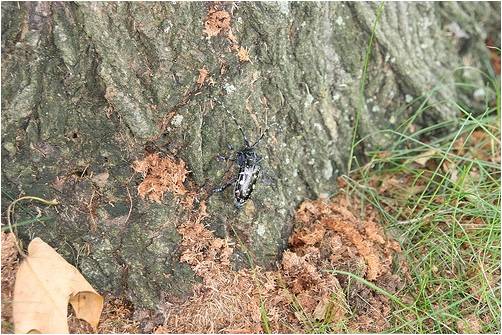
Frass at Base of Maple (with ALB)
Peter Trenchard, CAES
Frass: As the larva feeds, the solid fecal matter it generates is mixed with wood shavings that result from its feeding. This mixture is known as frass. As the larva feeds, it pushes frass back out of its tunnel. The frass from the ALB is relatively large and coarse compared to that from other insects, such as carpenter ants.
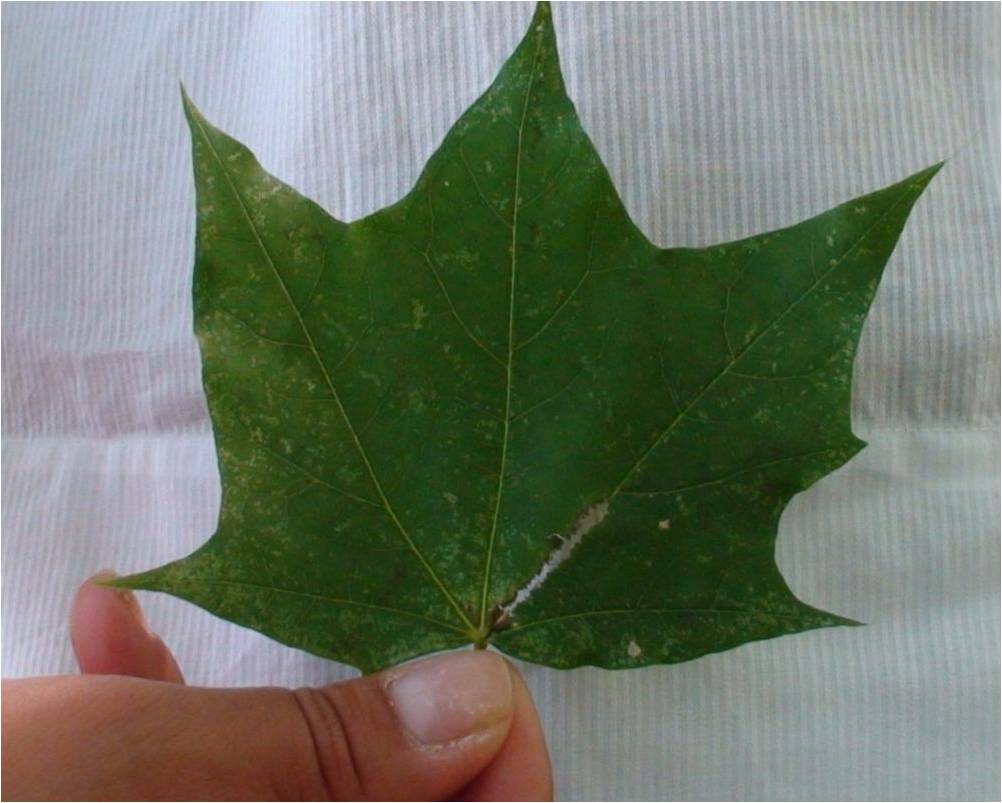
Midrib Feeding from Adult ALB
Peter Trenchard, CAES
Characteristic feeding pattern: The adult female feeds on the main and secondary veins of leaves and occasionally strips off the surface layer from the petiole and from the twigs of these same trees. As this feeding pattern is not commonly observed with other insects, it can be considered a good indicator of the presence of the ALB.
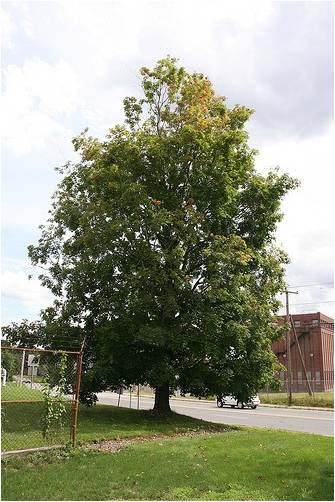
Worcester Tree, heavily infested; likely one of the first trees infested.
Peter Trenchard, CAES
Tree condition: Indicators such as those listed above may give readily visible evidence but are usually difficult to spot. In the early stages, an ALB-infested tree does not look different from an uninfested tree. However, as the infestation progresses, it can cause dieback throughout the crown of the tree. The tunneling within the wood of the tree also structurally weakens branches and trunks, increasing the likelihood that the tree will lose branches.
Life cycle and behavior
The ALB is a poor flyer that continually re-infests the same tree. Populations on an infested tree tend to expand considerably before the beetle moves on to adjacent, susceptible trees.
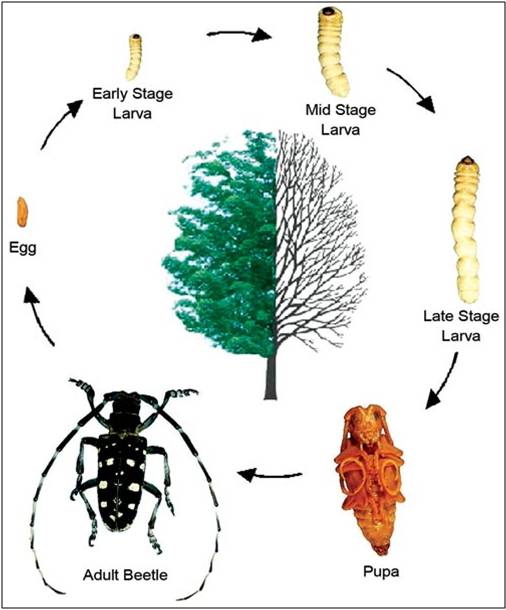
ALB Life Cycle
Diagram by Michael Bohne, Bugwood.org; Published by the University of Vermont (2001)
The ALB undergoes complete metamorphosis. Its life cycle consists of four stages: egg, larva, pupa, and adult. The egg is laid by the female at the base of a crater she chews into the bark of the tree. The crater, or oviposition site, is more commonly found at the top of the tree and on branches. In a tree that is heavily infested, oviposition sites may be found anywhere on the tree.
A single female will lay single eggs at multiple sites, with one female capable of laying up to 90 eggs. When the egg hatches, the newly emerged larva feeds upon the cambial and sapwood tissues in the vicinity of the oviposition site. As it increases in size, the growing larva burrows into the heartwood of the tree. The ALB larva typically has 5 instars (growth stages) and grows up to 2 inches in length before becoming a pupa.
The ALB overwinters as a larva in the heartwood of the tree. Pupation takes about 20 days, and the adult beetles emerge in late June and early July. Emergence continues until the first hard frost of the fall.
Adult beetles are active reproductively from when they emerge until the first hard frost. Adult females feed on the midrib of leaves, leaf petioles, and the thin bark of twigs. Following mating, male beetles will mate-guard a female to protect its genetic contribution as she chews an oviposition pit and lays an egg.
Not much is known about possible causes of mortality for the ALB other than the cold weather of late fall. Specific predators, parasites, or diseases that would reduce beetle numbers have not been recorded.
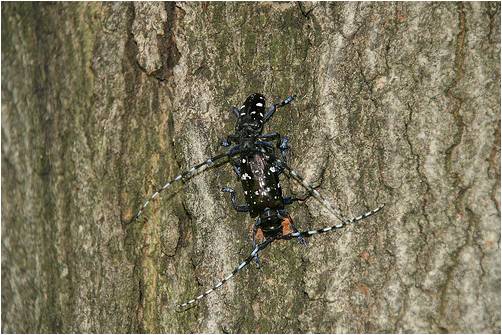
Mate Guarding (male guards female as she chews oviposition pit)
Michael Bohne, Bugwood.org
Response
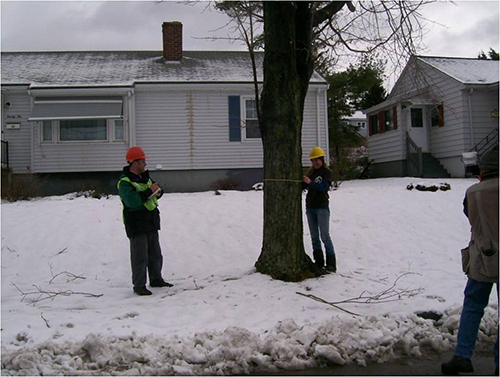
Surveying Trees in Worcester
Patty Douglas, USDA APHIS PPQ
Early detection of ALB is key. In most instances where ALB was found in the United States, the beetle was first found by a community member who noticed something unusual about their trees.
The ALB is an insect of federal regulatory concern. If ALB is found, the federal government will take direct action in partnership with various state agencies and local entities. The federal department responsible for taking action on ALB is the United States Department of Agriculture (USDA), through the Animal and Plant Health Inspection Service (APHIS) and the U.S. Forest Service (USFS). During infestations, APHIS takes the lead, with USFS and state and local entities assisting.
The primary state agency responsible for responding to ALB in Connecticut is the Connecticut Agricultural Experiment Station (CAES). Connecticut DEEP also has a critical role in the response.
The aim of the response effort is to contain the ALB so that it does not spread from the site of infestation, and to eradicate it within the infested area.
If an infestation is found, the first step in response is to locate as many of the infested trees as possible and establish a quarantine area. The purpose of the quarantine area is to ensure that no wood is moved outside of the infested area. That includes lumber, nursery stock, trunk wood, branches, stumps, roots, and all species of firewood. All who work within the quarantine area removing or treating trees receive specialized training so that this work does not then become a means for the further spread of the insect.
How to help
Actions you can take to reduce the spread of ALB include:
- Monitor your trees. Finding it early and eradicating it before it can spread further is the most effective way to limit the impact of this pest.
- Follow regulations on the movement of firewood.
If you think you may have found the ALB, do not attempt to move the insect, wood, or other potentially infested material from the site. Take photos, make a note of the location, and report the sighting by using the Connecticut Agricultural Experiment Station's reporting tool. If you have questions about ALB, contact the CAES Entomology office at CAES.StateEntomologist@ct.gov.
Resources
Asian Longhorned Beetle, APHIS
Massachusetts ALB Cooperative Eradication Program
University of Vermont ALB Page
Content last updated April 2026.