

Water
Rivers, Lakes, and Estuaries Water of Long Island Sound Warming and Rising Waters Swimming Clamming and Oystering
Drinking Water
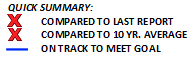
In 2025, 99.33 percent of the population served by community water systems (CWS) and 94.53 percent of all CWS demonstrated full compliance with applicable drinking water standards, based on an annual average. The percentage of the population served by CWS that met drinking water standards was less than the previous year (99.81 percent) and less than the previous ten-year annual average (98.5 percent). The percentage of CWS that met drinking water standards in 2025 was also less than the previous year (94.64 percent) and the previous ten-year annual average (94.7 percent).47 By far, the most common problem during 2025 in water systems was excessive levels of chloride.48 Source water protection is important for ensuring the safety and quantity of drinking water supplies.
In June 2022, the Connecticut Department of Public Health (DPH) updated the “Drinking Water Action Level for Per And Polyfluoroalkyl Substances (PFAS)** and renewed its recommendation to all public water systems (PWS) to test the water delivered to their customers for PFAS. The Environmental Protection Agency's (EPA) Fifth Unregulated Contaminant Monitoring Rule (UCMR 5) required PWS to sample for PFAS in their water supplies from 2024 to 2026. As of 2025, 63 PWS completed their quarterly sampling requirements, with 27 having a “running annual average” of a PFAS above EPA’s Maximum Contaminant Level (MCL).50 The EPA anticipated that approximately one-third of all systems will collect samples each year between 2023 and 2025; however, EPA may reduce the number of small systems that will be asked to perform monitoring.51
NEW! On May 14, 2025, EPA announced its intent to keep the existing National Primary Drinking Water Regulations (NPDWR) for Perfluorooctanoic acid (PFOA) and Perfluorooctanesulfonic acid (PFOS), while extending the compliance deadlines. EPA also plans to rescind the regulations and reconsider the regulatory determinations and the hazard index mixture for other PFAS chemicals.52
Goal: EPA’s goal is to ensure clean and safe drinking water by improving compliance at CWS regulated under the Safe Drinking Water Act.53
Technical Note: *The vertical axis in the chart above has been shortened, beginning at 85 percent rather than the customary zero. **PFAS are a group of man-made chemicals that are widely used in various industrial and consumer products. Exposure to certain PFAS may lead to adverse health outcomes.
—————
47 EPA, Drinking Water Performance and Results Report, Government Performance and Results Act (GPRA) tool, GPRA Summary Report and GPRA Violation Report, accessed January 22, 2026; www.epa.gov/ground-water-and-drinking-water/drinking-water-performance-and-results-report.
48 Department of Public Health (DPH), Freedom of Information Response received March 23, 2026.
49 DPH, Press Releases, Connecticut Department of Public Health Updates Drinking Water Action Level For Per And Polyfluoroalkyl Substances (PFAS), June 15, 2022; portal.ct.gov/DPH/Newsroom/Press-Releases---2022/PFAS-June-2022.
50 EPA, Fifth Unregulated Contaminant Monitoring Rule Data Finder through1/15/2026, Accessed 3/4/2026; www.epa.gov/dwucmr/fifth-unregulated-contaminant-monitoring-rule-data-finder.
51 EPA, The Fifth Unregulated Contaminant Monitoring Rule (UCMR 5) Program Overview Fact Sheet; www.epa.gov/system/files/documents/2022-02/ucmr5-factsheet.pdf.
52EPA, Per- and Polyfluoroalkyl Substances (PFAS) NPDWR Implementation; www.epa.gov/dwreginfo/pfas-rule-implementation.
53EPA, National Enforcement and Compliance Initiative: Increasing Compliance with Drinking Water Standards; www.epa.gov/enforcement/national-enforcement-and-compliance-initiative-increasing-compliance-drinking-water-0.