

Invasive Disruptors

Invasive species are species that are not native to Connecticut that exhibit an aggressive growth habit and can out-compete and displace native species. It is expected that more invasive species, both plant and animal, will arrive, become established, and flourish as a consequence of the warming climate that is making Connecticut more hospitable to species that do not tolerate cold weather. Further, climate induced stress, rising temperatures, and extreme weather in an ecosystem can facilitate invasive pathways. The adverse impacts of invasive species affect all the state’s ecosystems, including its waterways, natural lands, working lands and developed landscapes. In addition, the economic and human health costs of unchecked invasive species can be high. In 2022, the Council completed an update ("INVASIVES": PREVIOUSLY DESCRIBED and NEWLY ARRIVED) to the Council’s 2002 report, Great Infestations, that included recommendations for the control of invasive species in Connecticut. Preventing invasive species from taking over and disrupting Connecticut’s landscapes and waterways requires advanced planning, vigilance, maintenance, coordination and prioritization of the expenditure of human energy and of public funds. Some examples of invasive species are discussed below but there are many more.
Asian Tiger Mosquitoes70

Beech Leaf Disease71
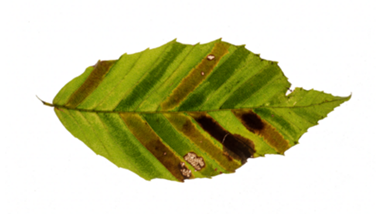
Beech leaf disease (BLD) was detected in Connecticut in 2019. The disease is caused by a nematode, Litylenchus crenatae, which is a microscopic worm that
feeds on the leaf buds of beech trees during the winter. BLD has spread quickly, partly though rain splash and in windblown aerosolized droplets. BLD causes premature leaf drop, thinner canopies, and makes trees susceptible to other pests. Symptoms of BLD include leaf banding, crinkled leaves, and dead leaf. There are three effective treatment options: (1) systemic treatment using potassium phosphite (2) application of fluopyram-containing products to target nematodes within expanded leaves, or (3) trunk injection with thiabendazole. Of these treatment options, only the phosphite-based treatment is suitable for application by homeowners. Additional information on BLD can be found on the CAES website.
——————————
Spotted Lanternfly
72Spotted Lanternfly, (Lycorma delicatul), is an invasive insect species that was first spotted in Pennsylvania in 2014. By 2025, spotted lanternfly was present in all
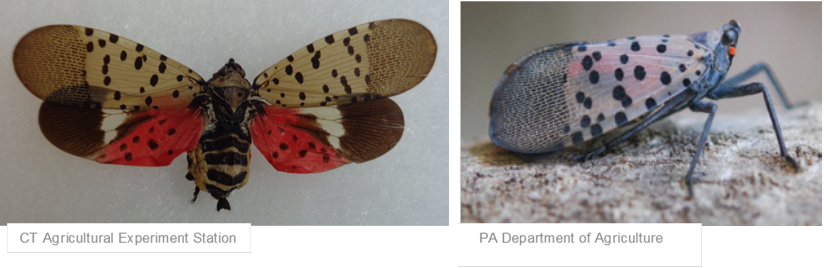 of Connecticut’s counties. Spotted lantern fly are associated with the invasive host tree-of-heaven, Ailanthus altissima, but can feed on up to 70 other plants, leaving behind residue that weakens native plant species. The CAES established a quarantine order for spotted lanternfly in December 2024. Additional information on spotted lanternfly can be found on the CAES website.
——————————
Asian Longhorned Beetle
73
The Asian longhorned beetle (ALB), Anoplophora glabripennis, is an invasive species that is native to China, Korea, and Japan. The ALBs’ primary host in North
America is maple; however, ALB have also been found to feed on birch, elm, horse chestnut, and willow trees. ALB larva feeds on the tree’s heartwood leaving the tree structurally weak, while adult ALB feeds on the veins and blades of leaves as well as on the bark of young twigs. ALB is moved to new locations primarily through the movement of larvae-infested firewood. ALB is considered a serious risk to Connecticut’s native hardwood forests, wildlife habitats, and could adversely impact the lumber, tourism, and maple syrup industries. Comprehensive survey and eradication efforts are underway in all parts of the United States where known ALB infestations exist. Additional information on ALB can be found on DEEP’s Forestry Division website.
——————————
Invasive Plants
NEW! Public Act 25-126 expanded the list of invasive plants by prohibiting the import, movement, sale, purchase, transplant, cultivatation or distribution of the following additional plant species: (A) Glossy buckthorn (Frangula alnus), (B) European buckthorn (Rhamnus cathartica), (C) reed canary grass (Phalaris arundinacea), (D) winged euonymus (Euonymus alatus), (E) European privet (Ligustrum vulgare), (F) black locust (Robinia pseudoacacia), (G) miscanthus (Miscanthus sinensis), and (H) Japanese barberry (Berberis thunbergii) on or after October 2028, and Norway maple (Acer platanoides) on or after October 2030. Additional information on Connecticut' Invasive Plants List can be found on the Connecticut Invasive Plant Working Group website, and/or refer to Connecticut General Statutes, Section 22a-381d.Hydrilla
The highly invasive aquatic plant, Hydrilla verticillata, known commonly as "hydrilla" or "water thyme" was first detected in the Connecticut River in 2016 around Glastonbury, Connecticut and has since spread into the river’s many coves, tributaries, and boat basins. Hydrilla is an aquatic plant that has earned the title “world’s worst invasive aquatic plant”. The United States Army Corps of Engineers (USACE), New England District and the Engineer Research and Development Center (ERDC) is leading a demonstration project to determine the effectiveness of registered herbicides to safely reduce and control the spread of the Connecticut River hydrilla. Research on hydrilla’s growth patterns, water exchange dynamics in the Connecticut River, and herbicide efficacy in laboratory conditions began in 2023 to guide operational scale field demonstrations of herbicide efficacy. In 2024, permitting was completed and treatments were performed at five demonstration sites on the Connecticut River. In 2025, the USACE might be monitoring treated sites and conducting assessment(s)/treatment of additional sites. In 2025, the USACE released a Draft Supplemental Environmental Assessment and a Finding of No Significant Impact for Invasive Aquatic Plant Control Demonstration and had planned to expand the number of testing sites in Connecticut.74
Technical Note: *Collection data for mosquitoes for 2016-2018 has been modified from previous reports because of the introduction of new data from a trapping site in Bridgeport. From 2010 through 2019, CAES collected mosquitoes at 92 sites statewide, and from 2020 through 2024 the number of collection sites increased to 108 statewide.
—————
70Connecticut Agricultural Experiment Station (CAES); personal communication from J. Shepard, November 15, 2024.
71 CAES, Updated Beech Leaf Disease Biology and Management, May 14, 2025; portal.ct.gov/-/media/caes/documents/publications/fact_sheets/valley_laboratory/beech-leaf-disease-management-options.pdf
72 CAES, Spotted Lanternfly, accessed September 22, 2025; portal.ct.gov/caes/caps/caps/spotted-lanternfly---slf
73 CAES, Asian Longhorned Beetle (Anoplophora glabripennis), Accessed February 11, 2026; portal.ct.gov/-/media/caes/caps/2012/factsheetasianlonghornedbeetlepdf.pdf.
74 United States Army Corps of Engineers, New England District Website, Connecticut River Hydrilla Research & Demonstration Project www.nae.usace.army.mil/Missions/Projects-Topics/Connecticut-River-Hydrilla/.