

Air Quality
Climate Changers Air Pollutants
Air Days
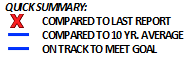

There were 341 “good air days” statewide in 2025, which was less than the previous year and the same as the previous ten-year average. A “good air day” is when every monitoring station in the state records “satisfactory air quality”, which is defined here as air that meets the health-based National Ambient Air Quality Standard (NAAQS) for the following six pollutants: sulfur dioxide, carbon monoxide, particulate matter less than 2.5 micrometers (PM2.5) in diameter and 10 micrometers (PM10) in diameter, nitrogen dioxide, and ground-level ozone.
An Air Quality Index (AQI) above 100 is considered “unhealthy for sensitive groups”, which includes people with heart or lung disease, older adults, and children. When air quality is “unhealthy”, some members of the general public may experience health effects and members of sensitive groups may experience more serious health effects.4 Outdoor activities may be restricted or advised against for all populations. In 2025, there were 22 days when the AQI for ground level ozone** exceeded 100 and three days when the AQI for PM2.5 exceeded 100. The AQI for both ozone and PM2.5 exceeded 100 on August 4, 2025.5 When compared to other New England states, Connecticut accounted for about 51 percent of the days with AQI exceedances for ozone; all other New England states had six (6) or less exceedance days
High ozone concentrations typically occur on hot summer days when winds from the southwest and west transport ozone precursors from the large metropolitan areas to the south and west, especially from the New York City area. Air emissions from mobile, industrial and commercial sources in Connecticut then enhance the production of ground-level ozone.6 
The Environmental Protection Agency (EPA) recently conducted ozone modeling for the “Good Neighbor Plan for 2015 Ozone NAAQS” to determine which states were the largest contributors to ozone at non-attainment monitors. The image (above) shows the parts per billion (ppb) of ozone that each state contributed to southwest Connecticut on the ten highest ozone days. On these days, Connecticut sources contributed less than 3 parts per billion (ppb) to ozone, while New York State contributed over 14 ppb.7
On July 25, 2024, the EPA published a final rule, granting a request from the States of New York, New Jersey, and Connecticut to reclassify the New York-Northern New Jersey-Long Island, (NY-NJ-CT) nonattainment area from ‘‘Moderate’’ to ‘‘Serious’’ for the 2015 8-hour ozone NAAQS. On July 29, 2024, EPA published a final rule reclassifying Greater Connecticut from “Moderate” to “Serious” nonattainment for the 2015 ozone NAAQS.8
Air Pollutants
There has been a long-term trend of improved air quality, in part, due to the air pollution controls that were put in place after the enactment of the 1971 Clean Air Act and Amendments. Because of these legislative actions, Americans breathe less pollution and face lower risks of premature death and other serious health effects; however, it is unclear if the improvements to air quality and public health will continue in light of the federal rollback of environmental standards and the expanded use of fossil fuels. The chart above, “Air Pollutants”, depicts that in the 1980’s, exceedances for sulfur dioxide (SO2) and nitrogen dioxide (NO2) were more common, but not so recently. Statewide exceedances of pollutants, except for ozone, are rarely seen, due to regulatory restrictions on emitters, mostly to Connecticut’s west and southwest. The relatively large amount of PM2.5 exceedances in 2025 were due, in part, to the effects of wildfires in areas to Connecticut’s north and west (August 4 and 5, 2025).
Goal: While not formally stated, the goal is for Connecticut residents to have a “good air day”, every day.
NEW! In 2025, the EPA announced it would reconsider certain requirements including, but not limited to, regulations on power plants, including Mercury and Air Toxics Standards for coal-fired power plants (MATS); mandatory Greenhouse Gas Reporting Program; and limitations, guidelines and standards (ELG) for the Steam Electric Power Generating Industry.9
—————
4 EPA, AirNow, Air Quality Index (AQI) Basics; www.airnow.gov/aqi/aqi-basics/
5 EPA, Air Data: Air Quality Data Collected at Outdoor Monitors Across the US, accessed January 22, 2026; www.epa.gov/outdoor-air-quality-data.
6 DEEP, Air Quality Trends – Ozone; portal.ct.gov/DEEP/Air/Monitoring/Trends/Ozone-Trends.
7 DEEP, Source Contribution to Connecticut’s Ozone Problem; portal.ct.gov/deep/air/planning/ozone/source-contribution-to-connecticut-ozone.
8 DEEP, Presentation by Paul Farrell “Update on ozone reclassifications of CT Nonattainment areas for the 2008 & 2015 Ozone NAAQS”, September 25, 2025.
9 EPA, “EPA Launches Biggest Deregulatory Action in U.S. History”, March 12, 2025; www.epa.gov/newsreleases/epa-launches-biggest-deregulatory-action-us-history.