History
History
In 1771, after an unfortunate incident in 1768, when a “trainband” made a farce out of the escort duty, a group of leading young men in Hartford decided it was time to organize a select company for the purpose of escorting the Governor and General Assembly at the General Elections. This company was known at this time as the Governor’s Guard.
It was not long before citizens of New Haven, its other capital, felt the need to establish a unit of Governor’s Guards composed of their own citizens. The Second Company was organized in New Haven in 1775 primarily by Benedict Arnold, who was elected the company’s captain. This caused the original unit to take the name First Company Governor’s Guard and the new organization to take the name Second Company Governor’s Guard.
The First Company Governor’s Foot Guard is the oldest American military formation in the United States with an unbroken lineage. The First Company Horse Guards was created in 1778 as the Independent Volunteer Troop of Horse Guards in Hartford and is the oldest continuously mounted cavalry unit in the United States. The Second Company Governor’s Horse Guard was created in 1808 in New Haven.
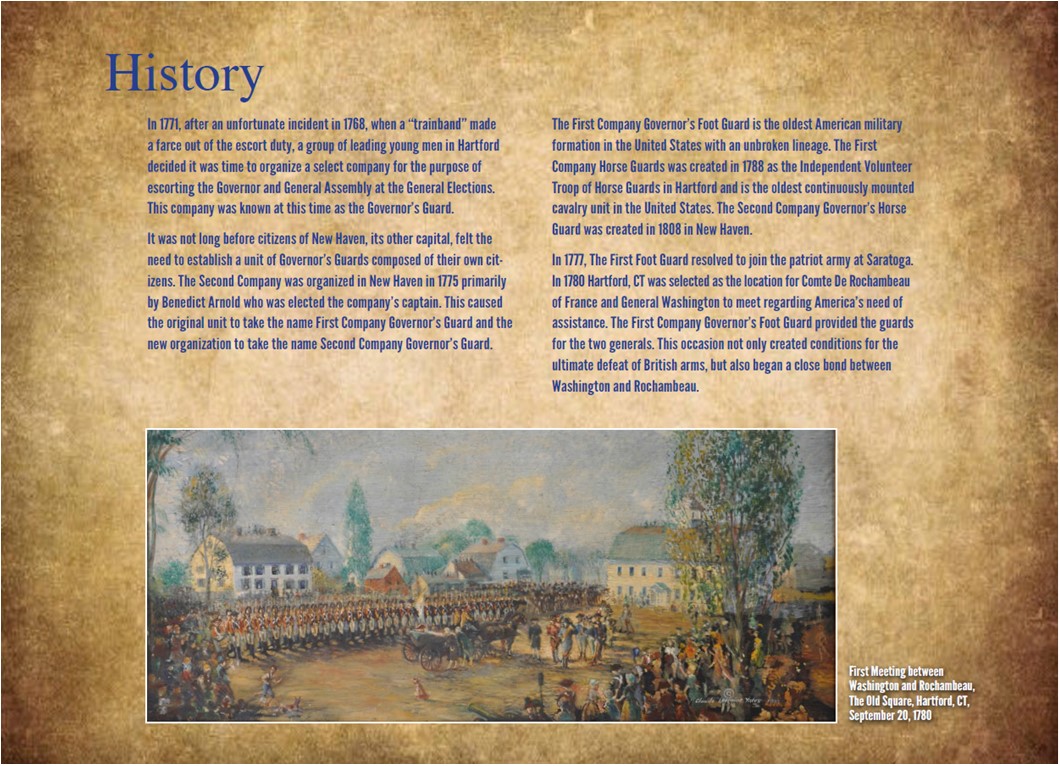
In 1777, the First Foot Guard resolved to join the patriot army at Saratoga. In 1780, Hartford, CT was selected as the location for Comte de Rochambeau of France and General Washington to meet regarding America’s need for assistance. The First Company Governor’s Foot Guard provided the guards for the two generals. This occasion not only created conditions for the ultimate defeat of British arms, but also began a close bond between Washington and Rochambeau.
First Meeting between Washington and Rochambeau, The Old Square, Hartford, CT, September 20, 1780.
History (Continued)
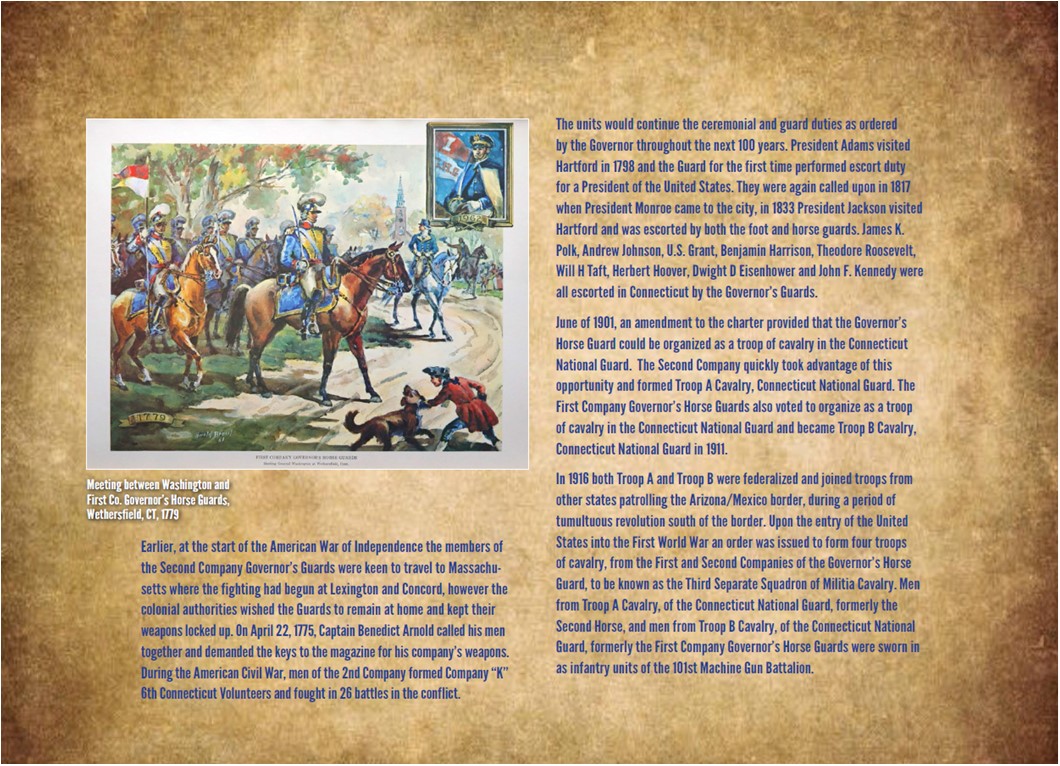
Meeting between Washington and First Company Governor’s Horse Guards, Wethersfield, CT, 1779.
Earlier, at the start of the American War of Independence, members of the Second Company Governor’s Guards wanted to travel to Massachusetts where fighting had begun at Lexington and Concord. However, colonial authorities required the Guards to remain at home and kept their weapons locked. On April 22, 1775, Captain Benedict Arnold called his men together and demanded the keys to the magazine for his company’s weapons.
During the American Civil War, men of the Second Company formed Company “K” of the 6th Connecticut Volunteers and fought in 26 battles.
19th Century Service
The units continued ceremonial and guard duties as ordered by the Governor for the next 100 years. President Adams visited Hartford in 1798, and for the first time, the Guard performed escort duty for a President of the United States.
They were again called upon in 1817 when President Monroe visited. In 1833, President Jackson was escorted by both the foot and horse guards. Later presidents escorted in Connecticut by the Governor’s Guards included James K. Polk, Andrew Johnson, Ulysses S. Grant, Benjamin Harrison, Theodore Roosevelt, William H. Taft, Herbert Hoover, Dwight D. Eisenhower, and John F. Kennedy.
20th Century Organization
In June 1901, an amendment to the charter allowed the Governor’s Horse Guard to organize as a cavalry troop in the Connecticut National Guard. The Second Company formed Troop A Cavalry, Connecticut National Guard. The First Company also reorganized and became Troop B Cavalry in 1911.
In 1916, both Troop A and Troop B were federalized and joined troops from other states patrolling the Arizona–Mexico border during a period of unrest.
When the United States entered World War I, four cavalry troops were formed from the First and Second Companies of the Governor’s Horse Guard, known as the Third Separate Squadron of Militia Cavalry. Members of Troop A and Troop B were later reassigned as infantry and served in the 101st Machine Gun Battalion.
History (Modern Era)
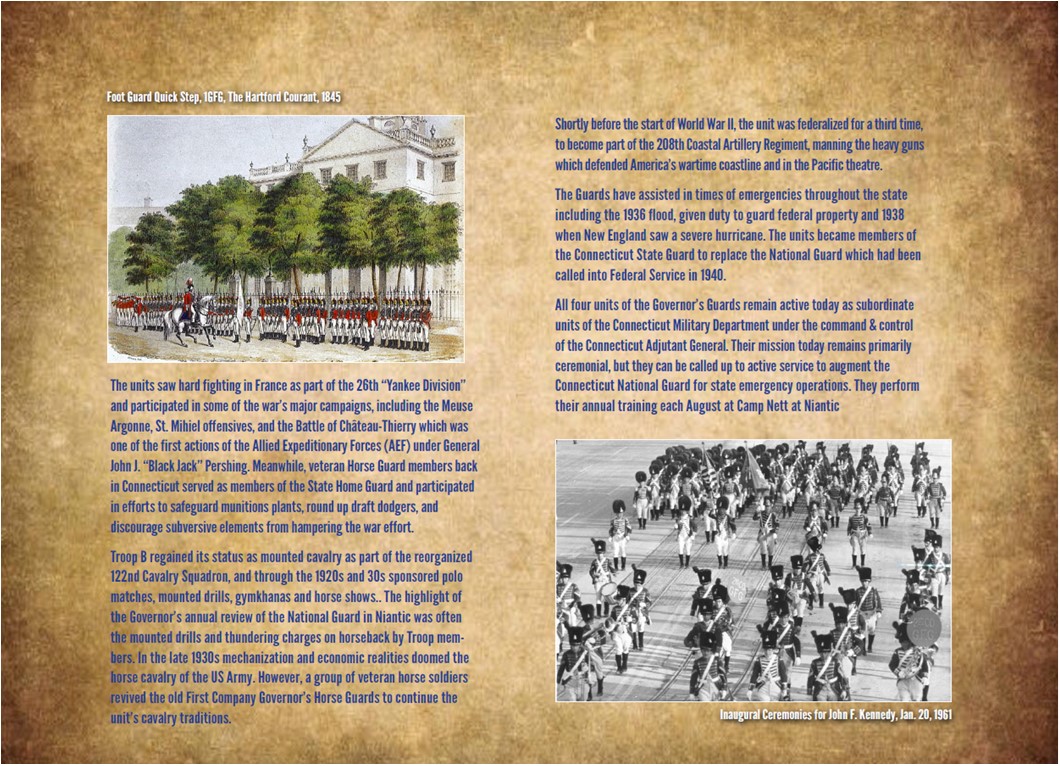
Foot Guard Quick Step, 16th Regiment, The Hartford Courant, 1845.
The units saw hard fighting in France as part of the 26th “Yankee Division” and participated in major campaigns, including the Meuse-Argonne and St. Mihiel offensives, as well as the Battle of Château-Thierry. These were among the first actions of the American Expeditionary Forces under General John J. “Black Jack” Pershing.
Meanwhile, veteran Horse Guard members in Connecticut served in the State Home Guard. They helped protect munitions plants, round up draft evaders, and prevent efforts that could disrupt the war.
Troop B returned to mounted cavalry status as part of the reorganized 122nd Cavalry Squadron. During the 1920s and 1930s, they sponsored polo matches, mounted drills, gymkhanas, and horse shows. A highlight of the Governor’s annual National Guard review in Niantic was the mounted drills and cavalry charges performed by troop members.
In the late 1930s, mechanization and economic changes led to the decline of horse cavalry in the U.S. Army. However, a group of veteran horse soldiers revived the First Company Governor’s Horse Guards to preserve cavalry traditions.
World War II and Beyond
Shortly before World War II, the unit was federalized for a third time and became part of the 208th Coastal Artillery Regiment. They operated heavy guns that defended America’s coastline during wartime, including service in the Pacific theater.
The Guards assisted the state during emergencies, including the 1936 flood and the 1938 New England hurricane. They were also assigned to guard federal property. In 1940, they became part of the Connecticut State Guard, replacing National Guard units that had been called into federal service.
Today, all four units of the Governor’s Guards remain active under the Connecticut Military Department and report to the Adjutant General. Their role is primarily ceremonial, but they may be called to active service to support the Connecticut National Guard during emergencies.
The units conduct annual training each August at Camp Nett in Niantic.
Inaugural Ceremonies for John F. Kennedy, January 20, 1961.