

The Spongy Moth: Information for Tree and Woodland Owners
- Background Information
- Advice for Individual Tree Owners
- Advice for Woodland Owners
- Additional Information
Background Information
What is the spongy moth?
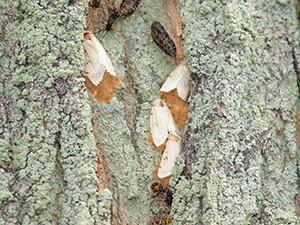
Female spongy moths laying eggs.

Adult male spongy moth.
The spongy moth (Lymantria dispar) is well-known for the damage it does to trees. The spongy moth is not native to North America. It has been in Connecticut since 1905 and is now established in the forests of southern New England.
The name "spongy moth" has been formally adopted as the new common name for the this species formerly known as the gypsy moth. The new name is based on the insect’s sponge-like egg masses. You can learn more about the name change from the Entomological Society of America.
What life stage of the spongy moth causes damage?
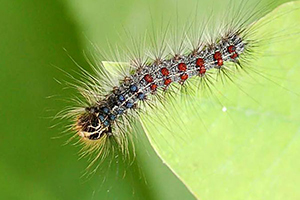
Spongy moth caterpillar
The spongy moth caterpillar causes most of the damage to trees. However, the egg masses, pupae, and fluttering adults can be nuisances.
Why should I be concerned about increased spongy moth activity?
In most years, spongy moth populations remain at a manageable level, and there is no need to treat for spongy moths. During outbreak years, damage can be severe, and it is often too late to respond once it becomes apparent. Response is best if it occurs either before the spongy moth larvae have attached or before they have become large and at their most voracious. Inspection of your property for spongy moth egg masses is the best and most proactive way to know of the potential for negative spongy moth effects.
How do spongy moths damage trees?
The spongy moth caterpillar consumes leaves to the point of defoliation. Without leaves, a tree loses most of its capability to photosynthesize. Without photosynthesis, a tree cannot produce the resources it needs to survive. Defoliation also makes trees more vulnerable to diseases and other insects. Also, stressed trees may be less resilient to environmental changes such as drought.
Can a tree survive a spongy moth infestation?
Trees defoliated by the spongy moth will normally grow back their leaves in the second half of the summer, after the spongy moth caterpillars have gone. Healthy trees can usually survive two or three successive bouts of defoliation. After that, trees are often too weakened to withstand additional pests. It is these other pests or environmental problems, such as drought, that can ultimately kill a spongy moth-weakened tree. Key among these secondary pests are the twolined chestnut borer and the honey fungus (Armillaria sp., also known as shoestring root rot).
Advice for Owners of Individual Trees and Smaller Properties
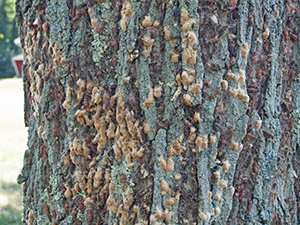
Numerous spongy moth egg masses.
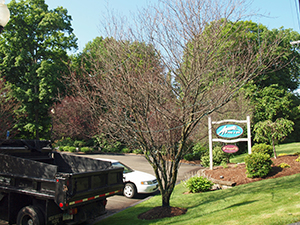
Defoliated plum tree in June.
What should a tree owner do?
- Determine if spongy moths are likely to feed on your trees. Oaks are the spongy moth caterpillar's first choice, but it will readily consume beech, birch, elm, maple, and most other hardwoods. During heavy infestations, it will also consume pine, spruce, and hemlock needles. It tends not to feed on ash and tulip poplar.
- Determine if the spongy moth has been a problem in your area. If the spongy moth population has been growing in numbers locally, it could be about to show up on your property. Good sources for this information are the Connecticut Agricultural Experiment Station Insect Inquiry Office and your town's tree warden. Feel free to ask them if the spongy moth has been active in your town.
- Look for evidence of spongy moth on your property. Look for egg masses in late summer and early spring. Egg masses are tan, cottony, and about 1 inch high by 1/2 wide. You can find them on the trunks of trees, in the crown, and on nearby structures, such as the sides of garages and houses. Egg masses are often in semi-hidden locations, such as under bark flaps or under house eaves. Scattered egg masses are probably not a problem. Numerous egg masses could be a problem.
- Contact a CT-licensed arborist for assistance if you are concerned. If action is needed, it is best taken early in the year. Once defoliation is underway, it can be difficult to keep up with the damage the caterpillars are doing.
- Learn more about tree planting and care in the Connecticut Tree Owners Manual and information about Yard Trees.
The Spongy Moth Fact Sheet, produced by the Connecticut Agricultural Experiment Station, is an excellent summary of what a tree owner needs to know in deciding what to do about spongy moth.
What are some control measures that can help individual trees?
There are various options for tree owners who want to protect individual trees from spongy moth defoliation.
During the off-season, use a spray bottle to soak the egg masses with agricultural soap or horticultural oil. These applications are relatively easy to apply and are unlikely to cause any environmental harm. Because egg masses tend to be hidden under bark flaps and in other hard-to-spot locations, such as higher up in trees, the effectiveness of these sprays is limited. However, treatment will help reduce the number of caterpillars next year.
Egg masses can be scraped off surfaces. In this case, be careful to catch and destroy the eggs. Otherwise, they can still hatch and cause problems.
Use burlap refuge bands or sticky bands around a tree to catch these caterpillars during their active season. If using sticky bands, be careful not to apply any sticky material directly onto the tree’s bark. These materials can damage the bark and, in some cases, severely harm the tree. Place a protective barrier around the tree first. Regular servicing of these bands is critical. Otherwise, the number of caterpillars trapped will build up, and the bands will lose their effectiveness.
Can insecticides be used to treat spongy moths?
A summary of the insecticides that an arborist might consider in treating for the spongy moth can be found in the Spongy Moth Fact Sheet. Homeowners are cautioned against the use of chemical treatments on their own, for two reasons:
- Several of the listed chemicals are not intended for use by non-professionals. In particular, those labeled as "restricted use" are to be sold only to those professionals who are licensed as pesticide supervisors.
- Many of the chemicals need to be sprayed onto the entire tree, including the crown. This requires equipment not normally available to a homeowner.
Are there other means of controlling spongy moths?
Biological options do exist for the spongy moth. Besides the Entomophaga maimaiga fungus and the NPV virus, a bacterial-based treatment often called BTK (Bacillus thuringiensis var. kurstaki) can be applied in the same manner as a chemical treatment. This may be the preferred treatment in areas near watercourses or other sensitive natural areas.
Should I hire an arborist?
An arborist can be an essential support for maintaining tree health. Arborists are licensed tree professionals who can diagnose tree problems and recommend solutions. Certified arborists are licensed and have extensive knowledge of safety and environmental concerns related to tree care and the use of insecticides.
A list of current licensed arborists can be found at the Connecticut Tree Protective Association (CTPA) and the CT e-Licensing portal. Note that not all licensed arborists in Connecticut are members of the CTPA.
Advice for Woodland Owners
What can a woodland owner do about spongy moth?
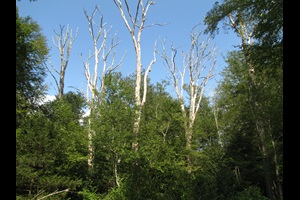
Oak trees killed by the spongy moth.
- Determine whether there is a spongy moth outbreak in your area. To do this, you can walk your woods in late spring or early summer to look for spongy moth caterpillars. They may be on the leaves, bark, or hanging from silky webs. Look for spongy moth egg masses on the trunks of trees during the off-season (from mid-summer to late April). If there are lots of egg masses, a large number of caterpillars can be expected to hatch the following spring.
- Contact a Connecticut Certified Forester if heavy defoliation has already occurred or is anticipated. Certified foresters are trained to assess for spongy moth risk factors and provide silvicultural treatment options. The State of Connecticut also provides a Service Forestry Program for woodland owners with 10 or more acres. A Connecticut Certified Forester can visit private woodlands at no cost to the landowner. This serves as a first step to learning about the health of their woodland.
I own several acres of woodland. Are the treatment recommendations different for me?
It is not practical for woodland owners to use direct control methods, such as sticky bands or pesticides. Because forests are dynamic systems, preserving overall forest health is the most important thing a woodland owner can do.
Some of my trees appear to be dying. Can the wood be salvaged?
In extreme cases, the combination of spongy moth defoliation and secondary effects, such as drought, can kill a tree. If significant tree mortality occurs in your woods, a salvage timber harvest may be appropriate.
Before taking this step, it is strongly advised that a woodland owner contact a Connecticut Certified Forester. The certified forester protects the woodland owners’ interests, and is qualified to determine the need for a salvage harvest and the potential value from such a harvest. A certified forester also has the legal authority to act as the landowner's agent in a sale of timber at the landowner’s request.
If a salvage harvest is warranted, it is best to harvest the dead and dying timber early, as the value of the wood degrades rapidly once a tree dies.
What other harmful effects might the spongy moth have on my woods?
Defoliated forests can be at increased risk of wildfire, especially under drought conditions. When trees are defoliated, more light reaches the forest floor, drying the leaf litter and woody debris. Woodland owners are encouraged to know the daily risk of wildfire through DEEP's Daily Forest Fire Danger Report webpage.
Can I take any steps to protect my woodland from spongy moth damage?
The most important thing you can do is maintain the health of your woodland. Healthy trees will have a greater ability to withstand the effects of repeated spongy moth defoliations, drought, diseases, and insects. Working with a Connecticut Certified Forester, a management plan can be developed that establishes an effective path towards maintaining the health of your woodland.
Connecticut woodland owners may also be able to receive technical assistance from their Service Forester, and financial assistance through the USDA Natural Resources Conservation Service if they are dealing with a woodland affected by spongy moth.
Should I Report Spongy Moth Sightings?
Because the insect is widespread throughout Connecticut, reporting spongy moth sightings is not necessary. However, you can still ask questions and learn about current outbreaks by contacting the CAES State Entomologist: CAES.StateEntomologist@ct.gov.
Additional Information
Content last updated May 2026.