

Twolined Chestnut Borer
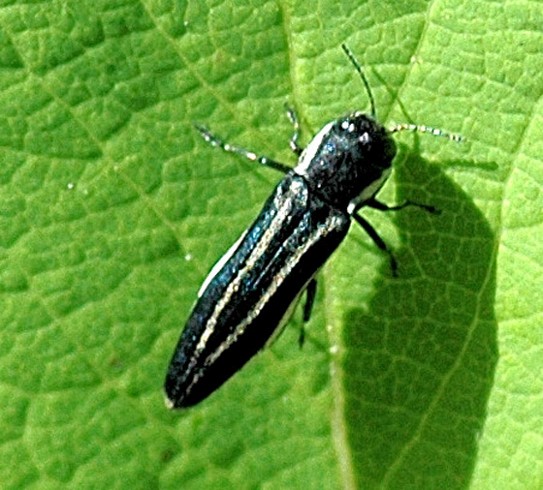
Adult twolined chestnut borer.
The twolined chestnut borer is a native insect that threatens already-stressed trees in Connecticut. The common name of this insect is given in various ways, including as the two lined chestnut borer, twolined chestnut borer, two-lined chestnut borer, or TLCB. This beetle is a close relative of the emerald ash borer (Agrilus planipennis), with a similar biology. The key difference, however, is that the TLCB is a native insect, while the EAB is not.
Trees at risk
The twolined chestnut borer was first named because it was a principal pest on native chestnut trees. Oaks, and occasionally beech and hornbeam, are also hosts to this insect. Healthy oak and other native trees are usually able to resist this insect. In most years, the twolined chestnut borer is not a problem in the forest. However, if trees are already stressed, the twolined chestnut borer can cause mortality.
Identification
Trees that are stressed by the twolined chestnut borer usually show browning of leaves near the top of the tree during summer. This is a sign that the larvae are feeding under the bark of branches in the upper crown. As summer moves on, symptoms start to show further down the tree as the beetles begin laying their eggs on branches in the middle and then lower crown.
When a TLCB attack is in full swing, it is not unusual to see trees whose tops are full of brown, dead leaves; whose middle crown shows leaves turning red and yellow as they wilt; and whose lower crown has green leaves.
Spread and response
The pattern of twolined chestnut borer outbreaks is well known in Connecticut and has corresponded with spongy moth outbreaks. TLCB outbreaks tend follow peak years of spongy moth mortality. For example, many oak trees that survived the spongy moth infestations and the drought over the years of 2015 to 2017 were weakened and subsequently killed by the twolined chestnut borer through the summer of 2019.
It should be noted that other harmful organisms also take advantage of compromised oak trees. Various pathogens, most notably the armillaria fungus, as well as insects like the red oak borer, may also be attacking weakened trees, often alongside the twolined chestnut borer.
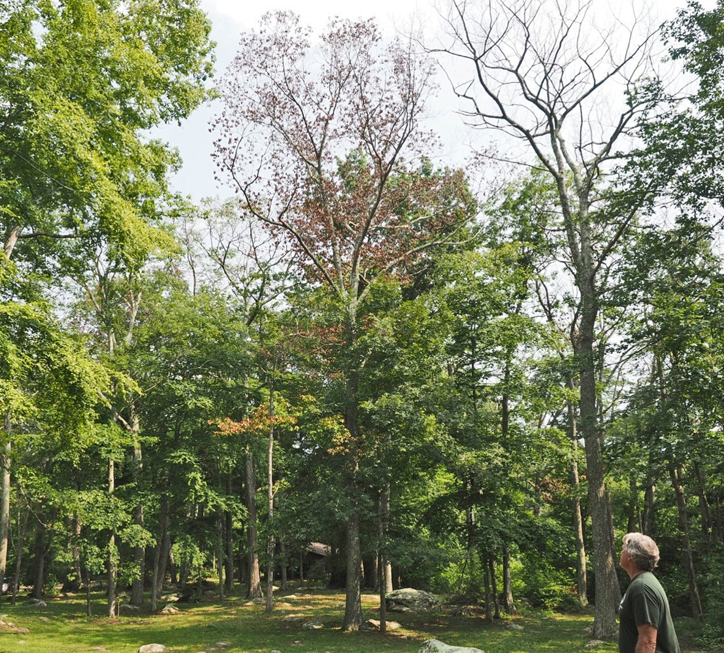
Oak infested with twolined chestnut borer (center). Oak to the right was previously killed by spongy moths.
The Connecticut Agricultural Experiment Station provides information on the treatment of oak trees that have been affected by TLCB.
How to help
- If the oak trees on your property are already stressed by spongy moth, drought, or another issue, monitor your trees for twolined chestnut borer.
- For forests, the best defense against pests like twolined chestnut borer is forest management that supports diverse species, age classes, and forest composition. For more information about the overall health of your forested land, contact your Service Forester or consult a private Connecticut Certified Forester.
- If you own or manage urban or landscape trees, contact a Licensed Arborist who can answer your questions.
- Because the twolined chestnut borer is a native insect that is widespread in Connecticut, it is not necessary to report sightings. You can still ask questions by contacting the CAES State Entomologist: CAES.StateEntomologist@ct.gov.
Resources
US Department of Agriculture Fact Sheet on TLCB
Content last updated May 2026.