

Bureau of Special Education Update, October 2025
In This Issue
From the Director’s Desk
October 2025 Newsletter Update from Bryan Klimkiewicz, Division Director, Bureau of Special Education

With the season of fall upon us, our schools are alive with the energy of learning, collaboration, and possibility. The changing season reminds us of growth, reflection, and resilience, the same qualities that define the work happening in classrooms and communities every day on behalf of children and students with disabilities.
Each fall, we are reminded that progress is not always immediate, but it is always meaningful. It is built through the steady commitment of educators, families, and leaders who believe in the potential of every learner. Your dedication often in the face of uncertainty and competing demands continues to shape brighter outcomes and stronger futures for the students we serve.
Despite the recent federal government shutdown and the reported federal reduction in force, the rights of children and students with disabilities and the responsibilities of states and districts under IDEA remain firmly in place. There has been no impact on Connecticut’s IDEA grant allocation or special education activities and programs in our state. The CSDE is actively monitoring developments and collaborating with national partners to stay informed and responsive.
Our commitment is to continue to provide timely information, technical assistance, and support to help maintain stability and compliance during this time as we strive to improve educational outcomes for students with disabilities. We deeply appreciate the dedication of Connecticut’s early intervention and special education leaders and staff, whose care, consistency, and professionalism continue to make a difference for children, students, and families every day.
In this edition of the BSE Newsletter, you’ll find updates on upcoming training and professional learning opportunities, new guidance and resources to support implementation, highlights from local programs that are making a difference, and important reminders related to general supervision and policy. As we continue through this season of change and reflection, we encourage you to stay engaged, share your successes, and reach out when support is needed. Together, we remain committed to ensuring that every child and student with a disability in Connecticut experiences meaningful progress and opportunity.
In partnership,

Bryan Klimkiewicz
Division Director, Bureau of Special Education
Connecticut State Department of Education

Bureau Updates
2025 IDEA LEA Determinations
The Connecticut State Department of Education (CSDE) is required to report annually to the public on the performance of each school district in relation to the targets in the State Performance Plan/Annual Performance Report (SPP/APR) under the Individuals with Disabilities Education Act 2004 (IDEA) Section 616(b)(2)(C)(ii)(1). Upon review of that data, all states must determine the assignment of each Local Education Agency (LEA) to one of four categories, consistent with IDEA requirements: Meets Requirements; Needs Assistance (Levels 1 and 2); Needs Intervention (Levels 1 and 2); or Needs Substantial Intervention. The 2025 LEA APR aligns with the 2023-24 data reported to the federal Office of Special Education Programs on February 3, 2025. The CSDE has released the LEA APR Determinations on Edsight.
General Supervision: Integrated Monitoring
As a condition of receiving Individuals with Disabilities Education Act (IDEA) funds, the state education agency (SEA) under IDEA Part B Sections 611 and 619 must have a general supervision system (See graphic below for 8 components of general monitoring and supervision). This system includes multiple components including integrated monitoring to — (1) improve educational results and functional outcomes for infants and toddlers with disabilities and their families, and children with disabilities; and (2) ensure that local education agencies (LEAs) meet the requirements under IDEA, 20 U.S.C. §§ 1412(a)(11), 1416(a), 1435(a)(10) and 1442; 34 C.F.R. §§ 300.149, 300.600–300.604, 300.608, 303.120, and 303.700–303.708.
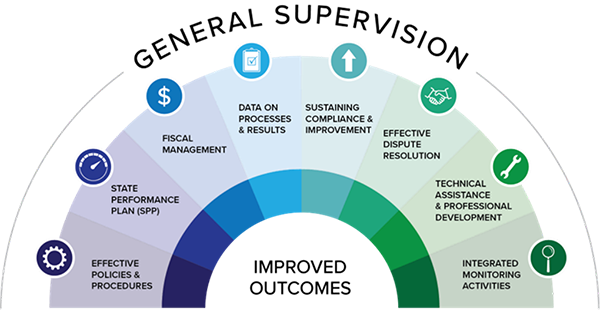
The Connecticut State Department of Education’s Bureau of Special Education (BSE) engages in a multifaceted, systematic approach to integrated monitoring, which includes Universal and cohort based Cyclical Monitoring activities. Each cohort contains approximately 1/3rd of the LEAs across the state. The 2025-2026 school year is a Cohort B year. There are several integrated monitoring activities that the BSE engages in relative to the cohort. One activity that is a part of our cyclical monitoring process and in alignment with Public Act 23-137 is Random, Unannounced Onsite Monitoring Visits. The CSDE has randomly selected and notified 12 LEAs from Cohort B for our Site-Visits for this year. The visits include a review of student individualized education program (IEP) documents, unannounced site visits to observe classroom practice, and interviews with teachers and staff who provide special education services. Our team will observe classrooms and conduct service verification activities. The process also includes holding interviews with parents/guardians of children receiving special education services. As such, the BSE has partnered with the Connecticut Parent Advocacy Center (CPAC), the State’s federally funded parent training and information center to conduct these interviews. Districts in Cohort B will be involved in other general supervision activities throughout the year. More information to come in the weeks ahead. Please do not hesitate to contact the Bureau of special education if you have any questions.

Fiscal Matters
Public Act 25-67 § 7 Special Education and Expansion Grant (SEED)
In accordance with Public Act (PA) 25-67 § 7, the Special Education Expansion and Development (SEED) grant provides boards of education with additional funds to be used for special education purposes. A frequently asked questions (FAQ) Document was developed based on initial inquiries that the CSDE has received from our school districts. Additional information has been posted on our website: Special Education Fiscal RFPs and Grants. A SEED grant application is currently being built in our electronic grants management system (eGMS). The CSDE will post additional information and related resources on this site in the near future.
New Grant Update: Public Act 25-93 Sec. 26
The Department Education is in the process of establishing a grant program to support local and regional boards of education in providing support services for students who require special education and have experienced trauma or have behavioral health needs. $500,000 has been allocated to this grant for Fiscal Year 2026 and Fiscal Year 2027. A description of the grant program and the application process are being developed and will be posted soon to Special Education Fiscal RFPs and Grants.

Policy and Guidance Reminders
Autism Eligibility Worksheet
Purpose of the CSDE Autism Eligibility Worksheet
The purpose of the CSDE Autism Eligibility Worksheet is to provide a tool to assist PPTs in the process of determining special education eligibility under the category of Autism.
Summary of the Revision Process
The original report of the Connecticut Task Force on Issues for the Education of Children with Autism (Task Force Report) was published in 1996 and was written with an emphasis on strong collaboration between home and school in the education of children with Autism. The Task Force Report was revised in 1998 and in 2005. Each revision incorporated changes in relevant Federal and State legislation, as well as additional changes in research findings related to Autism Spectrum Disorders.
In an effort to keep current with additional changes in legislation, research, and best practice, the CSDE began the process of a revision to the Guidelines for Identification and Education of Children and Youth with Autism in 2024. The process resulted in an updated draft worksheet for determining special education eligibility under the classification of Autism and accompany guidelines providing supporting information to complete the worksheet which will supersede the previous version once published.
The process of revision occurred in two (2) phases: a needs assessment phase and a revision phase.
Needs assessment: A comprehensive multi-method, multi-informant needs assessment was conducted in order to learn from as many perspectives as possible. The needs assessment included:
- A comprehensive literature review: focusing on updated research relevant to Autism special education eligibility and assessment, as well as a review of Autism eligibility guidelines from other states.
- Focus Groups: Before the worksheet and guidelines were revised, a series of focus groups were conducted in order to gain more insights around what participants like about the current worksheet and guidelines, what they want addressed, and what questions they have. The focus groups included attorneys, school psychologists, directors of special education, program directors, PPT chairs, and a member of CPAC.
- Survey of School Professionals: A widely spread virtual survey was completed by over 100 staff members who work in schools and intersect with Autism eligibility. The survey asked questions about what participants like about the current worksheet and guidelines, what they want addressed, and what questions they have.
- Survey of Families: Families who have been through the eligibility process were also asked to complete a survey to gain insights from the parent perspective of what they like about the current worksheet and guidelines, what they want addressed, and what questions they have.
Revision: The results of the needs assessment were combined and analyzed to create a checklist of revisions. The checklist was used to revise the worksheet and accompanying guidelines. The focus groups then came together again to review and provide feedback on the updated worksheet and guidelines. The document was posted for public comment to gain additional feedback. The additional feedback was then incorporated.
Goals of the CSDE Autism Eligibility Worksheet
The following goals were identified through focus group discussions and survey results:
- Align the updated worksheet to keep current with research, and state and federal mandates.
- Provide consistent state-wide guidance to PPTs regarding determining eligibility for special education under the disability category of Autism in a way that is current with the research, and state and federal mandates.
- Provide a decision making framework that facilitates conversations between all members of the PPT.
- Break down the legislation on special education eligibility in terms that are accessible to all members of the PPT.
- Provide clarity around a) best practices in evaluation of Autism, b) determining educational impact, c) ensure documents have accessible language, enough illustrative examples, and functional definitions of key terms.
This document will be posted on the Bureau of Special Education website in the near future solely for review/feedback purposes and is not to be used until it is formally published by the Connecticut State Department of Education. We will be gathering input through a brief survey to ensure this document is clear, accurate, and ready to be disseminated.
Connecticut School Climate Guidance
The Connecticut State Department released the Connecticut School Climate Guidance document in April 2025 to outline the new legislative requirements pursuant to Public Act 23-167, and to provide resources to districts to support their implementation of building welcoming and supportive school environments. For more information, contact Amanda Pickett, CSDE Consultant, Amanda.pickett@ct.gov. The legislation outlines several critical components essential to its implementation, including the following:
- Comprehensive School Climate Policy
- School Climate Improvement Plans
- Tiered Challenging Behavior Response framework
- Administration of a School Climate Survey
- Establishment of Safe School Climate Committees
- Defined Staffing Requirements, appointment of a District School Climate Coordinator and School Climate Specialist
- Training/Professional Learning Requirements
- The Adoption of a Restorative Practices Response Policy

Early Childhood Special Education
Early Childhood Special Education Professional Learning Opportunities
The CT State Department of Education (CSDE) is preparing for the statewide transition to CT DOTS as the Early Childhood Outcomes (ECO) data collection tool beginning in the 2026–2027 school year. To support early childhood special education teachers, related service providers, and administrators in building familiarity and confidence with the CT Early Learning and Development Standards (CT ELDS) and the CT Documentation and Observation for Teaching System (CT DOTS), a series of virtual professional learning opportunities are being offered. Whether you are new to these tools or looking to strengthen your practice, these sessions are designed to deepen your understanding, provide practical strategies to begin to prepare you for implementation of CT DOTS for ECO data collection.
| Session Title | Format | Description |
|---|---|---|
| Introduction to CT Early Learning and Development Standards (CT ELDS) | 90-minute virtual session |
In this introductory session, participants will:
Who should attend: Early childhood special education teachers and related service providers who are new to CT ELDS or want a refresher. |
| Introduction to CT Documentation and Observation for Teaching System (CT DOTS) | 90-minute virtual session |
In this session, participants will:
Who should attend: Early childhood special education teachers and related service providers who are new to CT DOTS or want a refresher. |
| Connecting Practice to Purpose: Using CT ELDS and CT DOTS to Inform Standards-Aligned IEPs | Two 90-minute virtual sessions |
These sessions invite early childhood evaluators, special education teachers, related service providers, and administrators to:
Why attend: Building familiarity with CT ELDS and CT DOTS into your current practice, will make the transition to using CT DOTS for ECO data collection in 2026–2027 smoother and more effective. |
Please Note: In late spring, implementing CT DOTS for ECO training sessions will be offered in person at each of the RESCs and virtually. More information will be shared soon.

Abilities in Action
Commissioner Russell-Tucker Announces Vanessa Taylor as Connecticut’s 2026 Anne Marie Murphy Paraeducator of the Year
Education Commissioner Charlene M. Russell-Tucker announced that Vanessa Taylor, a kindergarten paraeducator at Putnam Elementary School, has been named Connecticut’s 2026 Anne Marie Murphy Paraeducator of the Year. Read the press release.
321 Insight Users: Nominate a Para for The 321 Insight Paraeducator Spotlight Award
Do you have a paraeducator whose work you’d like to spotlight? 321 Insight would like to hear about it. Introducing the 321 Insight Paraeducator Spotlight Award! This award highlights paraeducators who are truly making a difference every day, going above and beyond in supporting students, educators, and school communities.
- Supporting student academic and behavior success
- Dedication and growth
- Team collaboration
- Building positive student relationships
Complete the nomination form and include a brief description (500 words max) explaining why the para should be recognized.
Winners will receive a 321 Insight gift bag and will be featured in the 321 Insight quarterly newsletter, website, and on social media sites.
Highlighting the Spire School
The Spire School runs a career exploration program called Pathways where professionals from a wide variety of experience visit the school to discuss their career pathway - from college to career changes - to starting over after being fired. These monthly talks have been an invaluable way for Spire to introduce students to professions they may not have heard of and to give students some real-life perspective on how to survive and thrive in the working world. Presenters have brought topics such as building EF workplace skills, going back to school, work/life balance to their discussions with students.

Training & Professional Development Highlights
CT-Dyslexia Awareness Collaborative
A heartfelt thank-you to everyone who attended the Connecticut Dyslexia Awareness Collaborative Kick-Off Event at UConn Waterbury! Your energy, passion, and commitment helped make the evening a powerful celebration of awareness, collaboration, and action.
If you didn’t have a chance to visit during the event—or would like to revisit the inspiring stories shared—explore the Voices of Dyslexia StoryCorps collection, where students, families, and educators share their experiences and journeys.
Stay connected with the Collaborative and be the first to know about upcoming events and initiatives by:
- Reading our monthly ODRD Newsletter – The Monthly Decode, and
- Signing up for our ODRD Listserv to receive updates directly in your inbox.
Together, we’re turning awareness into action—and changing the story for students with dyslexia across Connecticut.
- Read about the Voices of Dyslexia/Story Corps Project
- View the ODRD Newsletter - The Monthly Decode
- Stay Informed
Effective Engagement with Your Board of Education
Sponsored by Connecticut Parent Advocacy Center (CPAC)
 Families, community members, and Boards of Education (BOEs) all want the same thing, student success. But how do BOEs make the decisions that shape every child’s education? From setting policies and priorities to balancing budgets and staffing challenges, their choices have a direct impact on classrooms across Connecticut.
- Date and time: November 12, 2025, 6 p.m.
- Register: Reserve your spot: Effective Engagement
Not Just a Reading Disorder: Dyslexia’s Deeper Impact
Dyslexia affects far more than reading and writing. It can shape self-esteem, confidence, and social experiences in ways that are often overlooked. Join us as we explore the social-emotional impact of dyslexia, hear personal stories, and discuss strategies to support the whole student academically and emotionally. This panel will be facilitated by Alissa Heizler-Mendoza, Parent Engagement Coordinator at Decoding Dyslexia CT.
- Date and time: October 29, 2025, at 6 p.m.
- Register: Reserve your spot: Dyslexia’s Deeper Impact

CT-SEDS Highlights
Gifted &/or Talented Module in CT-SEDS
As you are aware, the new Gifted and/or Talented Module in CT-SEDS is live in CT-SEDS as of 9/12/25. Thank you to those who have attended the PCG led trainings on the Module and Import process. Trainings will continue with multiple sessions scheduled through November. The CSDE encourages you to access the training and information related to this module throughout the year to better understand the capabilities and components of the module.
See below information about this statewide rollout.
- The CSDE designed this module, with input from LEAs for LEAs to report Gifted and Talented eligibility data and for processing individual referrals through a Planning and Placement Process separate from the IEP Module.
- GT reporting of eligibility must continue to be submitted in PSIS for this school year and the following school year.
- CSDE is exploring pre-population of current Service Level Codes & Eligibility/Non-Eligibility Date from existing June 2025 PSIS data.
- The Module process itself can be used to document individual referrals and eligibility in CT-SEDS moving forward. If this process is used for individual referral, then the student’s eligibility information is automatically entered in the system at that time. If districts have their own process for individual referrals outside of the system, then that eligibility data for those students still needs to be entered in the system using the import process by the end of the school year.
- Each LEA must also utilize the batch import in CT-SEDS by the end of the 2025-26 school year to capture current GT eligibility (ex. Eligibility/non eligibility after Grade 3 SBAC scores)
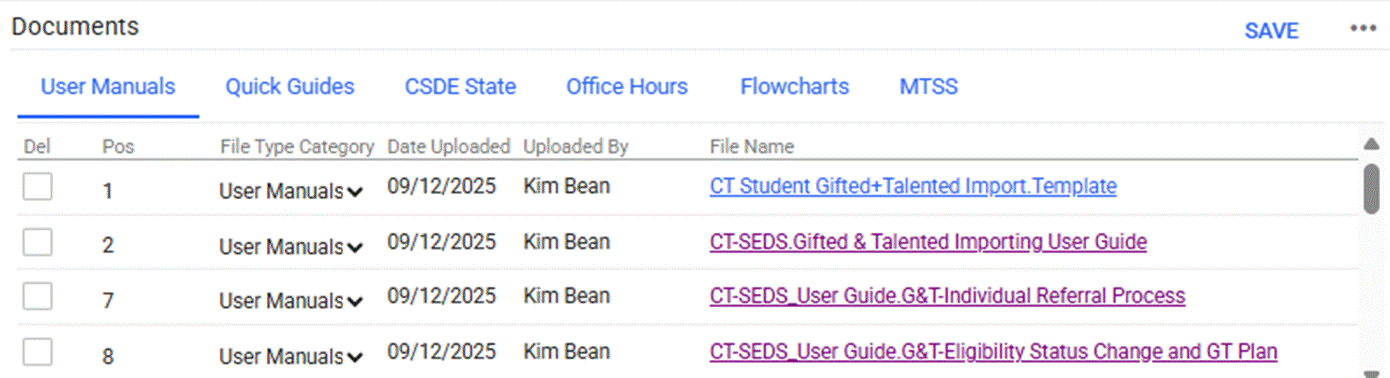
- Gifted and/or Talented User Guides are posted under the Manuals tab of the Documents Widget inside of CT-SEDS:
CT-SEDS/BSE Reminders
If a student with a disability returns to general education (Parent Revocation, Non-eligibility) and then is referred again for Special Education the following are required:
- A new Consent for Initial Evaluation
- If eligible, a NEW Consent for Initial Provision of Services
- REMINDER: you cannot finalize an IEP/ISP/PPPSS without obtaining parental consent for Provision of Services
- The IEP is required to be sent to the parent within 5 days of the IEP. If the team has not received POS within 5 days of the PPT meeting, a draft of the IEP must be provided to the parent. Please note, that DRAFT documents are NOT automatically sent through the parent portal.
Summary of PPT Meeting Document is an optional document for PPT Teams to utilize. If districts choose to complete the Summary of PPT Meeting Document through Create/View Documents, this will be sent to the Parent Portal upon finalization.

Office of Dyslexia and Reading Disabilities Updates
Connecticut Educator Competencies for Structured Literacy and Dyslexia
On May 7, 2025, the Connecticut State Board of Education (SBE) adopted the Connecticut Educator Competencies for Structured Literacy and Dyslexia, as prescribed in Connecticut General Statutes (C.G.S.) 10-14z(d). The published Educator Competencies are available on the CSDE Office of Dyslexia and Reading Disabilities website. This comprehensive set of teacher competencies provides clear and differentiated expectations for the knowledge and instructional practices educators must demonstrate. These expectations ensure effective, evidence-aligned instruction for all students, particularly those with or at risk for dyslexia, a reading disability, or a reading difficulty.
The competencies reflect the latest research on reading development, dyslexia, and effective instructional practices to support all learners. They are differentiated by certification and endorsement area and are aligned with current state initiatives, certification regulations, and nationally recognized standards (e.g., IDA Knowledge and Practice Standards).
The competencies apply to the following endorsements:
- Any teacher in a program of study leading to certification K-12
- Elementary Education (#305)
- Comprehensive Special Education (#165)
- Remedial Reading and Remedial Language Arts (#102).
Key features of the competencies include:
- Early identification, prevention, and intervention strategies for students at risk of dyslexia and related reading disabilities or difficulties
- Emphasis on explicit, systematic, cumulative, and diagnostic instruction
- Integration of oral language, foundational reading skills, vocabulary, comprehension, and written expression
- Promotion of cultural and linguistic responsiveness, especially for multilingual learners and students with co-occurring disabilities
Collaboration among general and special educators to create enhanced learning environments that address the varied needs of students with dyslexia and related reading disabilities
These expectations provide a clear roadmap for special educators to receive instruction in structured literacy and evidence-based interventions in their pre-service programs. Additionally, they offer districts a clear pathway to develop high-quality professional learning that supports teachers' continuous growth. In practical terms, these competencies equip teachers with the knowledge and skills necessary to support the literacy development of all students while ensuring that students with dyslexia and related reading disabilities receive the access and support they need, whether in prevention, intervention, or remediation.
To learn more, visit the CSDE Office of Dyslexia and Reading Disabilities website or contact Lisa Gianni, Associate Education Consultant, at lisa.gianni@ct.gov.
- View Chapter 163c - Education Evaluation and Remedial Assistance
- Read about Educator Literacy Competencies
New! Padlet of Competency-Mapped Instructional Routines
We are excited to announce the availability of the Competency-Aligned Instructional Routines Padlet, now accessible through the Office of Dyslexia and Reading Disabilities' webpage. This open-source resource contains a growing collection of evidence-aligned instructional routines, curated from the Florida Center for Reading Research (FCRR) and Reading Universe (RU). Each routine is carefully aligned with the Connecticut Educator Competencies for Structured Literacy and Dyslexia, focusing on three foundational domains: Phonological Awareness (with an emphasis on Phonemic Awareness), Decoding and Encoding, and Reading Fluency. These domains are essential for supporting students with dyslexia, students at risk for dyslexia, and those experiencing other reading difficulties.
The Padlet is designed as a practical tool for faculty and practitioners, and it will be updated regularly as new routines become available. We are also in the process of curating additional routines for vocabulary, listening, and reading comprehension. Stay tuned for updates!
We encourage you to explore this valuable resource and incorporate these routines into your instructional planning. For questions or additional information, please contact Associate Education Consultant Lisa Gianni in the Office of Dyslexia and Reading Disabilities at lisa.gianni@ct.gov.

State Agencies and State Partnership Updates
Change in DSS Requirements for Prior Authorization of HUSKY PT, OT, & S/L Therapies
The Department of Social Services (DSS) recently published a Provider Bulletin with changes to the preauthorization of medical OT, PT, and Speech/Language services through HUSKY. As a result of the new HUSKY preauthorization requirements, families may be asked to provide their medical provider with a copy of their child’s IEP.
This bulletin does not pertain to school-based services.
Employment & Transition Services for Students with Disabilities
The Employment and Transition Services program, offered through the Connecticut Department of Developmental Services (DDS), provides critical resources to help students with disabilities prepare for life after high school. Services include job training, career exploration, and community-based work experiences to support a seamless transition to adulthood.
- Transition Planning: Supports IEP teams in meeting postsecondary goals (employment, education, independent living).
- Bridge school to work gaps and offers real-world skill development for students aged 14–21.
- Family-Centered, connecting families with state-funded transition supports beyond the classroom.