

What is MTSS and what makes it effective?
Multi-tiered systems of support (MTSS) offer students targeted, personalized instruction to meet their academic, behavioral, and social-emotional needs. The tiers contained within the systems are vital to student success. They increase in intensity (e.g., frequency, duration, group size) along with the needs of the student.
Generally, there are three tiers of instruction. Tier One refers to the high-quality, evidence-aligned instruction that all students are entitled to receive. Lessons are differentiated to meet the diverse needs of the students in the class, but the learning targets are the same for all. Strong Tier One instruction is the foundation of a robust MTSS strategy.
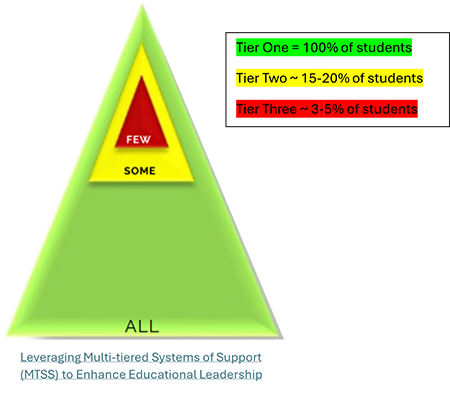
Tier Two instruction refers to the extra focused support some students may receive to help them master specific benchmarks. For English/Language Arts (ELA), data teams use CT-approved universal screening reading assessments and other diagnostic measures to determine which students would benefit from Tier Two support. For each of these students, the team creates an individual literacy plan, which includes a learning goal and growth target, the evidence-aligned materials and routines that will be used for instruction, a schedule for implementation, and consistent progress monitoring. The plan is shared with the students’ families, along with practice activities for home. The team reflects upon the students’ progress, often every 6-8 weeks, to see if each student is projected to meet their learning goal and growth target, or whether the instruction needs to be adjusted.
Tier Three instruction is the most intensive. Students may meet more frequently or for longer periods than in Tier Two; additionally, the group size is smaller or perhaps even one-on-one. These students are progress-monitored more frequently than in Tier Two to ensure that their learning goals and growth targets are met. Like in Tier Two, students receive literacy plans that are shared with their families, and the data team meets consistently to review and reflect on their growth.
When data teams meet consistently throughout the school year, students benefit from the data-based decisions they make to inform instruction. Once fall, winter, or spring benchmarks have been administered, teams use the data from universal screeners and diagnostic measures to reflect on each student’s progress. Teams may adjust one student’s current intervention, and they may move another student to a different tier of support. Another student might have met their learning goal and no longer require additional support. Still another might not be making adequate growth despite several adjustments to their Tier Three intervention, and the team might decide to call together a Planning and Placement Team (PPT) with the student’s caregivers. Between benchmarking periods, teams use progress-monitoring data to adjust instructional strategies within the intervention. Students do not have to wait until the end of the school year to see whether their learning goals have been achieved; instead, successful MTSS ensure that interventions are fluid based on student progress, that teams meet consistently throughout the school year to adjust instruction as needed, and that the decisions informing them are based on multiple measures of data.
All these systems working together, with a secure family-school partnership, is part of what makes MTSS effective. What is also part of MTSS is ongoing professional learning for effective implementation of interventions. The systems are carefully coordinated to support each student’s academic, behavioral, and social-emotional needs both in and out of the classroom.