


FEMA Public Assistance
Public Assistance Process
Following a disaster, DEMHS coordinates closely with federal, state, and local partners to initiate the formal disaster declaration process.
The following sections provide a high-level overview of how an incident progresses from the initial damage assessment to a Presidential declaration. For comprehensive programmatic rule and regulations, please refer to the PA Program and Policy Guide version 5.
Terms
- Applicant - your organization (state, territory, tribe, local government, or certain private nonprofit organizations)
- Recipient - DESPP/DEMHS
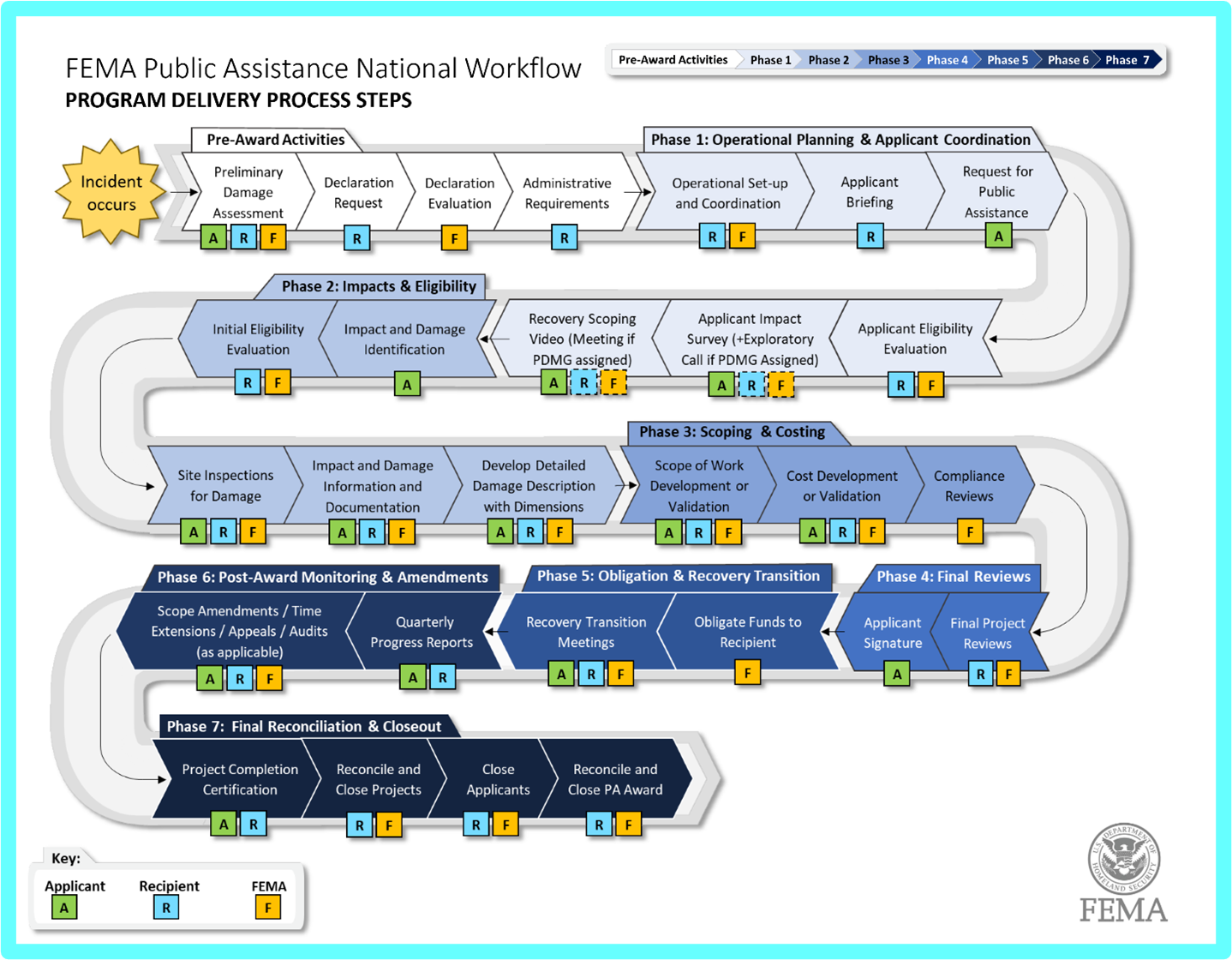
Pre-Declaration Grant Process
Incident Occurs
- Emergency Declaration - Issued by the President to provide supplemental assistance to save lives, protect property, and avert the threat of a catastrophe. EMs are typically limited in scope and funding (often capped at $5 million) and generally only cover Emergency Protective Measures (Category B), such as sheltering or emergency pumping.
- Major Disaster - Issued by the President following a natural catastrophe that severely exceeds state and local capabilities. DRs unlock a much broader range of federal assistance, typically funding both Emergency Work (debris removal and life safety) and Permanent Work (repairing or replacing roads, bridges, and public facilities).
Initial Damage Assessment (IDA)
- DEMHS works with Applicants to assess the extent of local damage. We usually conduct IDAs via surveys distributed through Regional Coordinators, the DEMHS website, and social media. If the data shows we might meet the required thresholds, DEMHS requests a joint preliminary damage assessment with FEMA.
- IDAs must meet Per Capita Indicators to be further considered for the PA Process. For more information about these indicators, refer to the Per Capita Impact Indicator and Project Thresholds | FEMA.gov
Preliminary Damage Assessment (PDA)
- FEMA uses the IDA information to verify and evaluate the total damage. This phase often involves on-the-ground site visits and cost estimates
- Review the FEMA Preliminary Damage Assessment Guide for more information about the IDA and PDA processes including what information/documentation can be collected.
Governor Requests Declaration
- The Governor must request a declaration or extension from the President within 30 days of the incident.
President Declares Major Disaster
- FEMA can only provide public assistance if the President declares that an incident is an Emergency Declaration or a Major Disaster.
Post-Declaration Grant Process
Applicant Briefing
- DEMHS hosts a meeting (usually virtual) to discuss the specific details of the Presidential declaration and how to apply. We notify Applicants of the schedule via Regional Coordinators, our website, and social media
Request for Public Assistance (RPA)
- When DESPP/DEMHS submits requests to FEMA for public assistance on the Applicant’s behalf. FEMA accepts RPAs up to 30 days from the date the Applicant was included in the Presidential declaration. FEMA may offer extensions in certain situations


