

College and University Recycling

"Enthusiasm is the mother of effort, and without it, nothing great was ever achieved"
~ Ralph Waldo Emerson
Recycling Initiative Counts!
Because of their educational mission, large student populations, high community visibility, and active involvement in research, development, and new technology, Connecticut's universities and colleges have the potential to become waste reduction and recycling models for other institutional waste generators in the state.
Related Topics
- Mattress Recycling
- Climate Change & Waste
- Pollution Prevention
- How to Dispose of Prescription Medicines
- Universal Waste Rule
- Electronic Waste
- Product Stewardship
- Construction and Demolition Materials Management
General Information
Recycling is mandatory for everyone in Connecticut - even for colleges and universities. Recycling activities should be integrated into a comprehensive solid waste management plan for the campus. Connecticut follows a solid waste management hierarchy as outlined in the State Solid Waste Management Plan, amended 2006.
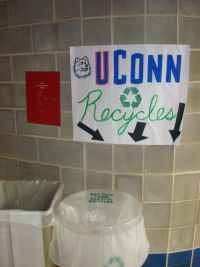
Recycling strategies should be implemented anywhere waste is generated: in administrative offices, classrooms, libraries, dormitories, dining halls, etc. Each area may focus on the collection of different recyclable materials (e.g., office and computer paper in offices; beverage containers, magazines and newspapers in dorms; glass and metal containers in food prep areas, etc.), involve different collection approaches, and require different recycling behavior on the part of program participants.
Developing a comprehensive campus waste prevention program is a challenge; the program doesn't implement itself. Pulling together an effective program will involve many people in many areas of the campus. The main steps include:
- Gaining cooperation of administration, staff, faculty, and students.
- Establishing a baseline of purchasing practices, materials use patterns, and waste generation trends on campus from which to measure progress.
- Creating an action plan.
- Publicizing and promoting waste prevention on campus.
- Monitoring and evaluating the progress of waste prevention programs.
Don't forget to plan for recycling during:
- Office cleanouts and file purges;
- Residence halls "move out" days; and
- Special events
New and Rehabbed Campus Buildings Should Be Designed to Accommodate Recycling!
As recycling programs come on line and are improved, campuses have to work to make containers and collection systems "fit" wherever possible. Often the result is makeshift solutions based on whatever physical setup happens to exist. The best remedy is to consciously incorporate recycling facility design into the planning and construction of new and rehabilitated buildings and facilities.
Composting & Organics Recycling
Leaves are a mandatory recyclable item, and as such, schools should be making arrangements for their collection and recycling. Whether on-campus or off, a leaf and yard waste composting site can be educational while supplying material for landscape maintenance needs.

Although not mandatory, cafeteria food scraps and kitchen prep waste are recyclable through composting and/or collection for animal feed. They are wet, heavy portions of the waste stream and diverting them for re-use can result in reduced garbage tipping fees and useable end products. Agricultural schools may opt for an on-site food scrap composting facility linked with animal manure composting.
For more information please visit DEEP's Composting & Organics Recycling webpage web page, or call the DEEP Recycling Program at (860) 424-3366.
College & University Composting Programs
- Iowa State University, Ames, IA
- Colby College Composting Waterville, ME
- Dartmouth College Dartmouth, NH, Dartmouth, NH
- Middlebury College Composting Middlebury, VT
- University of New Hampshire Composting Durham, NH
- University of British Columbia Vancouver, BC
- Ohio University Athens, OH
- Ithaca College Composting Ithaca, NY
- University of Connecticut Storrs, CT Storrs, CT (manure composting facility)
- Connecticut CollegeNew London, CT, New London, CT
End of Semester Move-Out Days
According to Dump and Run, Inc., the average college student produces 640 pounds of solid waste each year, including 500 disposable cups and 320 pounds of paper. Colleges witness significant spikes in their solid waste at the end of the school year. In 1993, Tufts University registered as much as 50 tons more waste than the average 180 tons throughout the year. As a result, campuses across the country organize and coordinate programs and events in an effort to recover materials – from clothing to food to furniture and household furnishings – for reuse!
 |
 |
| Storage of donated items collected during move-out days at UConn | UConn's Give & Go Logo |
There are different models to organize for the collection of materials from student housing at the end of the school year. They range from a private enterprise collecting materials and then reselling them for profit or charitable organization, to a totally student-driven effort. Colleges may organize their own collection efforts and distribute the materials to local community non-profit organizations. Learn more about how different universities recover valuable resources for reuse – and start one this year at your school!
Resources for Coordinating End-of-Semester Waste Recovery Events
- Treasure From Trash: Toolkit for Move-Out Reuse Projects (MA DEP)
- Planning for Move-Out (CURC) Webinar
- Residence Life Move Out (University of Arizona) Power Point presentation
- Ohio University Move Out (Ohio University)
- No Stuff Left Behind (North Carolina State University) Online article and podcast
- UNH-RENU Recycled Everything New/Used (University of New Hampshire)
- Spring Salvage (Yale University) Donates all material collected at the end-of-the-semester to local non-profit organizations
- Give & Go (UCONN)
- Dump & Run Non-profit that provides consulting and other waste minimization services
- JunkLuggers Provides consulting, transport and other services
- CT Reuse Centers and Material Exchanges
Campus Recycling Programs in Connecticut
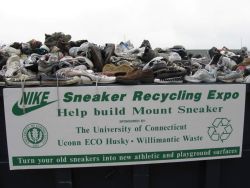
- Connecticut College Campus Recycling Programs
- Sacred Heart University
- Southern Connecticut State University
- Trinity College
- University of Connecticut Campus Recycling Programs
- UCONN Waste Reduction & Recycling Workgroup (part of Environmental Policy Council)
- University of Hartford Student-Led Recycling Program for Dorms
- Wesleyan University
- Yale University
Do you represent a college, university or boarding school in CT with an outstanding recycling program and don't see yourself on this list? Let us know by emailing the web address for your program to Sherill Baldwin.
Campus Recycling Programs in Other States
- Harvard University
- Humboldt State University
- Rice University
- Tufts University
- Middlebury College
- University of Colorado at Boulder
- University of Massachusetts - Amherst
- University of New Hampshire
- University of Oregon
- University of Wisconsin-Madison Surplus With A Purpose (SWAP)
Additional Recycling Resources
- Recycling Publications
- Helpful Organizations in CT
- Helpful Organizations Nation-wide
- RECYC-L - College and University Recycling Coordinator Listserv (hosted by Brown University - Follow screen instructions to join and log-in)
- Green Schools Listserv (hosted by Brown University) To join, Email: GRNSCH-L@LISTSERV.BROWN.EDU
- Recycling and Beyond: A College Campus Primer (Univ of Oregon, and Medical University of South Carolina) A very good comprehensive guide
- College and University Recycling Coalition (CURC)
- Recyclemania! An annual recycling competition for colleges and universities
- Campus Ecology (National Wildlife Federation)
- Association for the Advancement of Sustainability in Higher Education
- Greener by Degrees A Grist special series on college eco-activism (Grist)
- Trash Tracking Project Website (MIT) Article (MIT News)
- Starting a Campus Recycling Program (University of Missouri Outreach & Extension, Office of Waste Management)
- Green Teams at Harvard (Harvard Office of Sustainability)
- The Institution Recycling Network For smaller schools that may not generate a lot, but generate a lot of different things.
- Generation E: Students Leading for a Sustainable, Clean Energy Future A report detailing 35 ways students are creating a sustainable future at U.S. colleges and universities. (NWF Campus Ecology)
- Zero Waste Campus Toolkit (University of Oregon)
- Campus Zero Waste (GrassRoots Recycling Network) Links to many campus recycling and waste reduction Web resources.
- Reduce/Reuse/Recycle
Disclaimer: The Connecticut Department of Energy and Environmental Protection (DEEP) maintains the content on this web site to enhance public access to information and facilitate understanding of waste reduction, reuse and recycling. The DEEP is not recommending these resources over any others and recognizes these represent only a partial listing of resources on this subject.
Content Last Updated February 2020