

Press Releases

08/12/2026
DEEP Urges Residents to Take Steps to Prevent Conflicts with Black Bears
Black Bears Have Entered Homes More Than 50 Times in 2026
(HARTFORD)—The Connecticut Department of Energy and Environmental Protection (DEEP) strongly urges residents to follow best practices and “Be BearWise” to reduce the likelihood of conflicts with black bears and avoid home entries.
Human-bear conflicts continue to increase in Connecticut, and residents have reported bear sightings in all 169 cities and towns. The growing number of bears entering homes provides one of the clearest indicators of the increasing public safety risk resulting from human-bear conflicts. So far in 2026, DEEP has documented over 50 bear home entries across nearly two dozen municipalities, surpassing the total number of home entries that occurred in all of 2025. While these numbers vary from year to year, this year's data continue to show a concerning long-term pattern: bear home entries have risen significantly over the past seven years and remain far higher than those reported in neighboring states. Given this trend, it’s critical that Connecticut residents take steps to protect themselves, their families and their properties.
Black bears attempt to enter homes because they have consumed human-associated food (e.g., birdseed, trash, pet food) on a regular basis in residential areas. These bears become “habituated” (comfortable around people) and “food-conditioned” (associate humans with food). Food-conditioned and habituated bears in particular pose a risk to themselves as well as to public safety and may cause property damage to houses and cars or may be involved in conflicts with pets and livestock.
“When bears find an easy meal in our trash or at birdfeeders, they lose their natural fear of people and spend more time in our yards and urban areas, rather than in the woods, placing families and pets at risk,” said Acting DEEP Commissioner Emma Cimino. “Every resident has a role to play in protecting our communities by securing food sources which will help keep bears wild and neighborhoods safe.”
Preventing Home Break-ins:
If you leave the doors and windows of your home open and unlocked, bears can easily gain entry to your home causing safety risks and property damage to food storage areas, furniture, and other household items. Having a bear drop in unexpectedly can be scary. It only takes a few minutes to lock up; it takes a lot longer to clean up after a bear visit. Learn more about the two-second solution from BearWise that keeps stuff safe and bears wild.
- Don’t leave anything with an odor inside a screened-in porch, on or under the deck, or near the garage doors and windows. Remember, bears have a much better sense of smell than we do!
- Make sure kitchen trashcans have a lid to decrease odors from permeating.
- If your garage has an insubstantial panel door, it is best not to store food sources with odors inside, including freezers and refrigerators.
- If you live in or are visiting an area with a lot of bear activity, close and lock ground-floor windows and doors when possible, but especially prior to leaving the house. Be mindful of locking upper-level windows and doors that might be accessible for bears climbing stairs, ladders, and wooden porch posts. Locking screen doors isn’t enough–a curious and hungry bear can easily break through a screen.
- Lock vehicles and do not leave food in vehicles.
How to Avoid Human/Bear Conflicts
- NEVER feed bears. Intentionally feeding bears is illegal in Connecticut.
- Invest in a bear-resistant trash can. Properly designed bear-resistant containers are a proven method for breaking the habituation cycle by preventing bears from easily accessing human food. Discuss options for bear-resistant trash receptacles with your local trash hauler, since bear-resistant trash cans can be compatible with trash collection trucks.
- Never toss leftover food outside “for the animals to clean up,” as that can be a source of food for bears.
- Avoid putting out birdfeeders (including hummingbird and suet feeders.) Birdfeeders are an attractant to bears any time of day and year. Empty feeders left hanging serve as a visual attractant, have residual seed odor, and will still attract bears to houses. Instead, support birds by planting ecologically valuable native plants and adding water features which provide food and shelter year-round and benefit far more species than seed or sugar-water.
- Store garbage in secure, air-tight containers inside a garage or storage area. Garbage for pickup should be put outside the morning of collection and not the night before. Periodically clean garbage cans with ammonia to reduce residual odors.
- Do not store leftover bird seed, suet cakes, or recyclables in a porch or screened sunroom as bears can smell these items and will break through screens to get to them.
- Keep barbecue grills clean. Store grills inside a garage or shed and remove any fuel source before storing.
- Always supervise dogs when outside. Keep dogs on a short leash when walking and hiking. An off-leash dog might be perceived as a threat to a bear or its cubs.
- Do not leave pet food outdoors or feed pets outside.
- Use electric fencing to protect beehives, agricultural crops, berry bushes, chickens, and other livestock.
- Avoid placing meat scraps or sweet foods, such as fruit and fruit peels, in compost piles.
DEEP recommends several best practices for reducing the likelihood of an encounter with a bear, which can be found online on DEEP’s Living with Black Bears section of the website. DEEP also has created a video incorporating many of these best practices. The Be BearWise Checklist helps residents learn how to avoid attracting bears and how to keep bears way from homes and property.
In the rare instance when a bear appears to be aggressive toward people, residents should immediately contact DEEP’s 24-hour Emergency Dispatch Center at 860-424-3333.
Bear Reporting:
Bear sightings reported by the public provide valuable information to assist DEEP in monitoring changes in the black bear population. Anyone who observes a black bear in Connecticut is encouraged to report sightings online or send an email to the Wildlife Division at DEEP.Wildlife@ct.gov. Information on the presence or absence of ear tags, including tag color and numbers, and radio collars is particularly valuable.
Some of the information in this press release was provided by BearWise®, a program created by bear biologists and supported by state wildlife agencies.
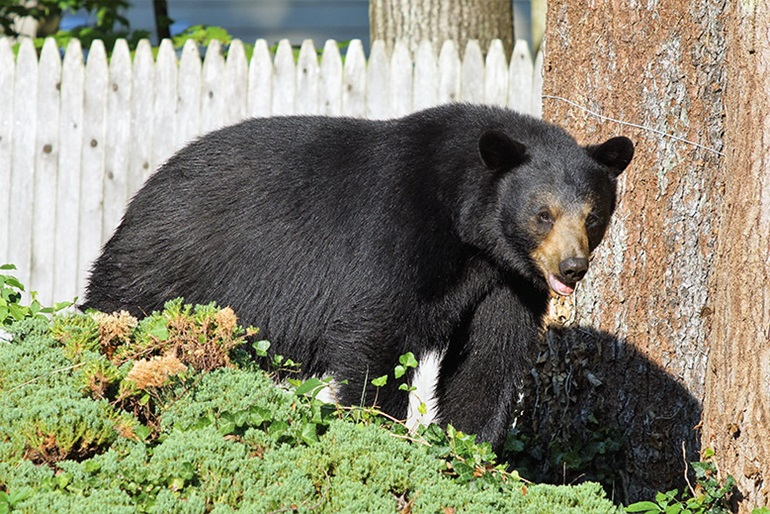
Black Bear in Yard – Photo credit: K. Testerman/CT DEEP-Wildlife Division
Access to bird seed, trash, and other human-sourced food trains bears to look for food in our communities and even our homes. This learned behavior is passed down to offspring, making it critical for us to learn to be BearWise to help keep bears and people safe.
- Twitter: @CTDEEPNews
- Facebook: DEEP on Facebook
Contact
DEEP Communications
DEEP.Communications@ct.gov
860-424-4100