

Press Releases

05/12/2026
DEEP Urges Drivers to Use Caution to Avoid Turtles in Roads During Nesting Season
Assisting Turtles in a Proper Manner Helps Ensure Their Survival
(HARTFORD) — The Connecticut Department of Energy and Environmental Protection (DEEP) reminds residents to be on the lookout for turtles crossing roads from May through July, which is nesting season for many turtle species. During this time, egg-bearing females travel across land, often crossing roads, in search of suitable locations to dig nests and lay eggs. Aquatic turtles also leave the water to find nesting sites on land.
“Connecticut is home to a number of turtle species, including the endangered bog turtle. Habitat fragmentation continues to threaten these populations, making conservation efforts critical to their survival,” said DEEP Commissioner Katie Dykes. “Protecting turtles and their habitats helps ensure that these species persist for future generations.”
Safely Lend Turtles a Helping Hand
When you encounter a turtle crossing a road, always keep it pointed in the direction it is traveling. If you turn it around, it will likely attempt to cross again. Do not move the turtle to a different location or “better spot.” Leave the turtle in the same general area once it has safely crossed the road. Turtles maintain a home range, and females often return to the same area to lay their eggs.
Snapping turtles can be large, heavy, and defensive. If you are unable to guide one across the road, carefully pick it up by the back of its shell above the legs and tail — never by the tail — to avoid injury or a bite. Be aware that snapping turtles can reach their heads far back. Consider using a stick or whatever else you may have on hand (shovel, car mat, etc.) to carefully move them across the road. Only assist a turtle when it is safe to do so and never attempt to stop traffic.
Turtles live long lives, take many years to reach maturity, and have low survival rates when young. Because of this, populations cannot easily recover from the loss of adult turtles. High adult survival — especially among females — is critical to maintaining stable populations. This challenge is even greater today as many turtle populations become increasingly fragmented and isolated.
“Research has shown that turtle populations across the United States often have disproportionately high numbers of males because so many female turtles are killed on roadways during nesting season,” said Jenny Dickson, DEEP Wildlife Division Director. “If you encounter a turtle in the road, remember: ‘Give turtles a brake’ and help them cross if it is safe.”
If you notice a location where turtles frequently cross, please report it to the Wildlife Division by emailing deep.ctwildlife@ct.gov with location details.
Keep Wild Turtles Wild
Do not collect native turtles or keep them as pets. Turtles should remain in the wild. Removing turtles from the wild, even hatchlings, can have a significant impact on local populations. Every individual plays an important role in maintaining population stability. Captive turtles should never be released as they rarely survive, may introduce diseases to wild populations, and in the case of non-native species, can harm native wildlife.
The best way to enjoy turtles is to watch them in their native habitat. Help keep wild turtles wild and leave them where you find them. Instead of collecting turtles, take photographs instead. Those interested in learning about Connecticut’s turtles can visit DEEP’s Turtles of Connecticut webpage.
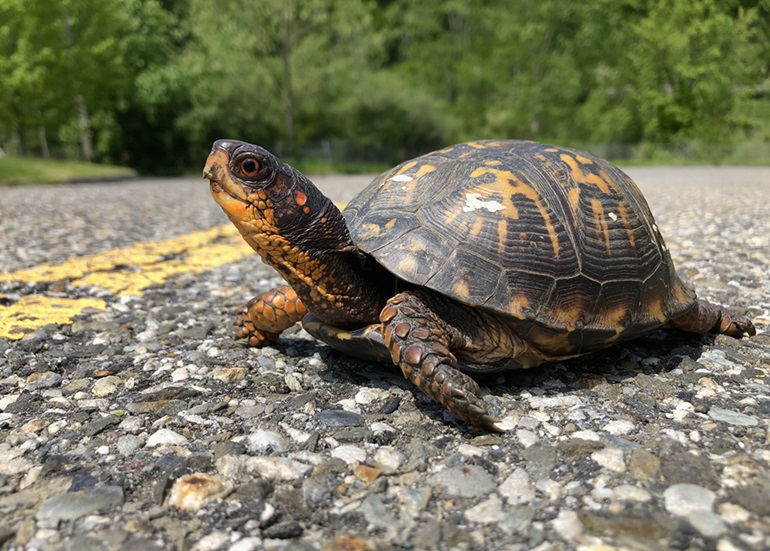
As you drive, watch out for turtles, like this eastern box turtle, crossing the road. Turtles crossing roads in May through July are often pregnant females, and they should be helped on their way and not collected. Without creating a traffic hazard or compromising safety, drivers are encouraged to avoid running over turtles that are crossing roads. Keeping safety precautions in mind, you may elect to pick up turtles from the road and move them onto the side they are headed. Never relocate a turtle to another area that is far from where it was found.
Photo credit: Paul Benjunas/DEEP Wildlife Division.
- Twitter: @CTDEEPNews
- Facebook: DEEP on Facebook
Contact
DEEP Communications
DEEP.Communications@ct.gov
860-424-3110