

General Urban Forestry Information
General Urban and Community Forestry Information and Contacts
What is urban forestry?
Connecticut is a highly urbanized state – it is the fourth most densely populated, and about 40% of its land is classified as urban – but it also ranks among the most highly forested states. This combination means that Connecticut has a large area of urban forests. Urban forests are the trees that we encounter in our daily lives. The urban forest is made up of street trees and trees on private or residential property, managed park spaces, and natural areas. These trees provide a wide range of physical, mental, and economic benefits to communities by improving air quality, controlling flooding, providing shade and cooling, improving physical and mental health, and many other benefits.

Different types of canopy in the urban forest, depicted by the Natural Areas Conservancy in New York City.
What is community forestry?
While Connecticut is both highly urbanized and heavily forested, many of its communities are small towns and rural areas. In these places, there may be more total forest cover than in cities, but the trees that shape daily life are often those found in shared community spaces. Community forestry focuses on the care and stewardship of trees and forests that are collectively valued and managed by residents, local governments, and volunteers. This may include trees on town greens, in town forests, along main streets, around municipal buildings, in school yards, and in parks and recreation areas.
Smart management of these spaces helps support the goals of public safety and emergency readiness. Community tree management also delivers a wide range of benefits for people and wildlife, provides for the common good, and improves the cost-effectiveness of future management.
Whether in densely developed cities or small rural towns, trees are a vital part of daily life in Connecticut. To read more about the benefits of healthy, well-managed trees and forests where we live and work, visit the Vibrant Cities Lab.
DEEP's Urban and Community Forestry Program
DEEP’s Urban and Community Forestry (UCF) Program is funded by the U.S.D.A. Forest Service and supports communities as they grow and manage their urban and community forests. The UCF Program is guided by the actions proposed in the 2020 Connecticut Forest Action Plan and the Governor’s Council on Climate Change, which include:
- Increasing tree cover, particularly in areas where existing canopy cover is low.
- Improving the condition of existing trees.
- Ensuring a healthy and resilient future urban forest.
- Connecting residents to their urban and community forests.
The UCF Program accomplishes its mission by providing financial assistance and technical assistance to municipalities, non-profits, and community groups across the state. In addition to directly supporting managers, the program works in partnership with organizations, such as the Arbor Day Foundation and Sustainable CT, to help municipalities and universities receive formal recognition for their urban and community forestry work. The UCF Program regularly collaborates with other partner organizations who are focused on urban forestry and responsible tree care in Connecticut.
Check out our Urban Forestry Grant Accomplishments page for examples of urban forestry work happening across the state.

For everyone
The UCF program has prepared a directory of contacts and information for tree issues and a guide about yard trees. Individuals interested in learning more about urban forestry are also invited to explore the UCF Program’s resource library.
For municipalities, community groups, and other managers
Building local stakeholders’ capacity to manage and steward sustainable and successful community forestry programs is a core goal of the UCF Program. If planning an urban forestry program or project is new to you, see our Urban Forest Management at Scale page. There is individualized support available through the Technical Assistance Program and there may be Financial Assistance through grants for qualifying organizations and projects. See our list of partner organizations as well; many of them offer support.
For tree care professionals
Arborists, nursery growers, and other professionals are essential to urban and community forestry. The Connecticut Tree Protective Association hosts twice-yearly preparatory courses for the Connecticut Arborist Exam and organizes other professional development opportunities for the tree care industry. The Connecticut Nursery and Landscape Association provides the Connecticut Certified Horticulturalist Program and offers educational resources and trade shows for those involved in the nursery and landscaping industries. The Tree Wardens’ Association of Connecticut provides networking and professional development opportunities for tree wardens.
Urban and Community Forestry Contacts
Danica Doroski, Urban Forestry Coordinator
Department of Energy and Environmental Protection
79 Elm St. Hartford, CT 06106
860-424-3814 Danica.Doroski@ct.gov
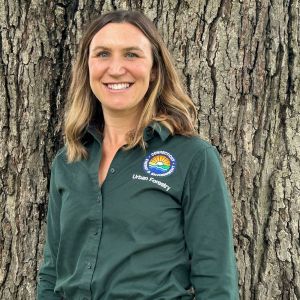
Danica Doroski joined DEEP as the Urban Forestry Coordinator in 2021. A forest ecologist by training, Danica also brings experience in horticulture, community engagement, and education from her time at the Morris Arboretum in Philadelphia, PA, the New York Restoration Project, and the New York City Department of Parks and Recreation. Throughout these various roles, her favorite part of urban forestry continues to be getting to learn from local land managers and community groups about the urban forests in their neighborhoods. Danica holds a BA from Bates College and both an MFS and PhD from the Yale School of the Environment.
Les Welker, Partnership Coordinator, Urban and Community Forestry
Department of Energy and Environmental Protection
79 Elm St, Hartford, CT 06106
860-424-3534 Les.Welker@ct.gov
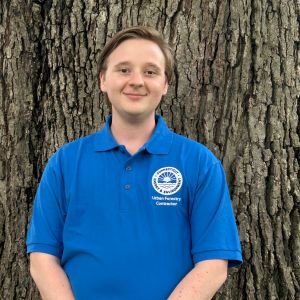
Les Welker joined DEEP as the Urban and Community Forestry Partnership Coordinator in 2025. Les most recently worked as a contractor with the Wildlife Management Institute, supporting DEEP’s Urban and Community Forestry programs. He brings valuable experience in grant administration and a strong technical background in urban forestry, including community engagement, geospatial analysis, street tree planting, and urban canopy assessment. Les developed these skills while working at the Urban Resources Initiative in New Haven and earning his Master’s in Environmental Science from the Yale School of the Environment. He’s passionate about helping communities care for the forests closest to home.
Erin Alvey, Project Manager (Grant Assistance), Urban and Community Forestry
Wildlife Management Institute on behalf of CT Department of Energy and Environmental Protection
79 Elm St, Hartford, CT 06106
860-424-3992 DEEP.UCF.Grants@ct.gov
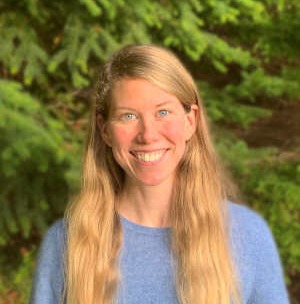
Erin Alvey works in partnership with Wildlife Management Institute and CT DEEP to serve as the Grant Program Specialist for DEEP's Urban and Community Forestry program. Erin is a forest ecologist with a professional background in forestry, ecological restoration, and horticulture. She is also experienced in project management, grant administration, and capacity-building in natural resources management. Erin enjoys collaborating with a diverse array of stakeholders to implement multi-objective forest management projects, incorporating cultural values or traditional knowledge, and cultivating resilient communities.
Back to the Urban Forestry Program
Content last updated April 2026.