

Hemlock Woolly Adelgid
Hemlock woolly adelgid, Adelges tsugae Annand (HWA), is a non-native insect that feeds on hemlock species. In Connecticut, HWA was first reported to the Connecticut Agricultural Experiment Station in New Haven in 1985. By 1997, it was found throughout the state.
Mortality from HWA attack can occur within four years, often in conjunction with other serious pests, such as the non-native elongate hemlock scale, Fiorinia externa Ferris (EHS). EHS spread from New York to Connecticut in the 1970s and has now spread widely through our state. Trees affected by EHS will show reduced new growth, yellowish-green needles, and grayish, thin crowns.
Trees weakened by HWA and EHS may then die when overwhelmed by the native hemlock borer, Phaenops (formerly Melanophila) fulvoguttata. However, with the help of control measures and weather-related impacts, some hemlock trees have survived the infestation.
Trees at risk
Hemlock woolly adelgid feeds on hemlock species, specifically eastern hemlock (Tsuga canadensis) and Carolina hemlock (Tsuga caroliniana).
Identification
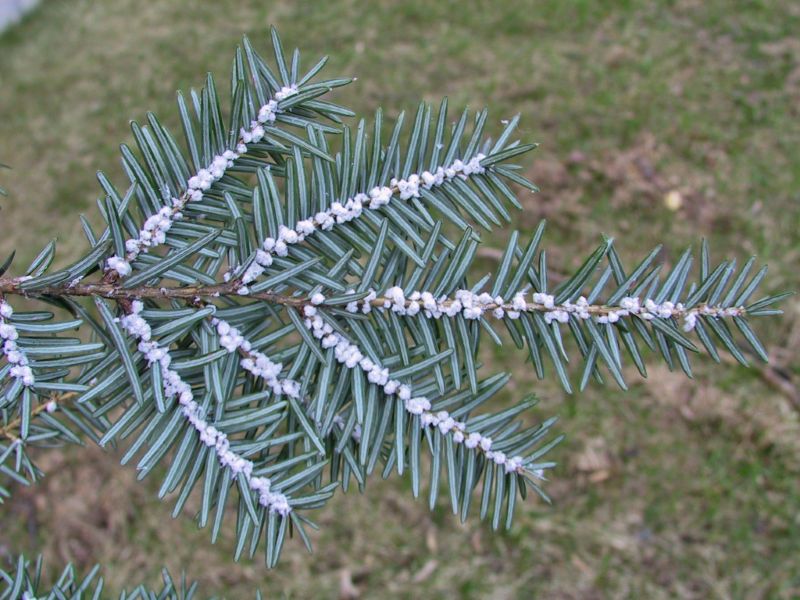
Clusters of white wool on the underside of hemlock needles indicate HWA infestation.
The easiest way to determine whether a hemlock tree has been affected by HWA is to look at the underside of the needles for small clusters of white waxy wool. Nymphs will also be visible at times, with or without wool. The nymphs look like tiny dark dots on the underside of new growth. Trees affected by HWA may display needle drop, twig dieback, and thin crowns.
The best time to detect active HWA infestations is March through May, when adult females produce waxy wool to protect the eggs that are laid on the underside of new growth.
Life cycle and behavior
HWA adults and nymphs feed on a stem's new growth by inserting a long feeding mouthpart called a stylet. The feeding targets the hemlock's storage cells and inhibits the tree's ability to produce new growth. Feeding by the adelgid depletes the tree's storage reserves, which can eventually result in tree death.
Hemlock woolly adelgid has two all-female generations a year, and each female develops and lays eggs under a ball of protective waxy wool, most visible on the underside of the newest hemlock growth. Nymphs (crawlers) emerge from the eggs in the spring and early summer. After a pause in summer, nymphs continue to develop in the fall and then develop into adults.

HWA crawlers emerging from eggs.
Spread and response
HWA is spread by wind, birds and other wildlife, humans, and the movement of infested plant materials.
HWA-infested hemlocks can survive if regularly treated, especially in the garden landscape. Horticultural oil or insecticidal soap applications, once or twice annually in May and late June, depending on the level of HWA infestations, are the preferred method of control with the least impact on non-target and beneficial species. This is generally costly and impractical for large-scale control.
Biological control is a promising way to reduce the impact of HWA. Connecticut has been managing HWA for over 34 years, implementing statewide biological control with the Japanese lady beetle predator, Sasajiscymnus tsugae. Many of the state's hemlocks have survived and persist to this day. In Connecticut, biological control of HWA has focused exclusively on laboratory rearing and mass releases of the lady beetle onto state, town, and private forests.
This tiny lady beetle, about 2mm in length, feeds on all stages of HWA. Studies have shown its ability to adapt and overwinter in Connecticut. It is the only HWA predator that is reared commercially. It is now available to the public from Tree-Savers, a Pennsylvania-based company.
Climate also influences HWA population levels. Long-term research at the Connecticut Agricultural Experiment Station has shown that severe cold events can limit HWA growth, allowing hemlock trees to rebound the following spring. Drought also has a significant effect, weakening hemlock trees and making them more susceptible to HWA damage. At the same time, drought can reduce HWA survival.
The hemlock woolly adelgid continues to invade and threaten Connecticut's hemlocks after warmer winters. In addition, the elongate hemlock scale has spread throughout much of Connecticut's hemlock forests in recent years and is affecting full recovery in some sites.
How to help
Monitor your hemlock trees regularly for signs of HWA.
For forests, the best defense against pests like HWA is forest management that supports diverse species, age classes, and forest composition. For more information about the overall health of your forested land, contact your Service Forester or consult a private Connecticut Certified Forester.
If you own or manage urban or landscape trees affected by the HWA, contact a Licensed Arborist who can answer your questions.
Because HWA is widespread in Connecticut, it is not necessary to report HWA sightings. You can still ask questions by contacting the CAES State Entomologist: CAES.StateEntomologist@ct.gov.
Resources
- Hemlock Woolly Adelgid, CAES
- HWA Winter Mortality in Connecticut and Implications for Management and Control, 2016
- Hemlock Woolly Adelgid Factsheet, Dec 2018
- Collaborative Biological Control in Connecticut with Sasajiscymnus tsugae, Introduced Predator of Hemlock Woolly Adelgid, 2021
- Hemlock Wooly Adelgid, USDA
- Tree-Savers
Content last updated May 2026.