

Beech Leaf Disease in Connecticut
Trees at risk
Identification
Life cycle and behavior
Spread and response
How to help
Resources
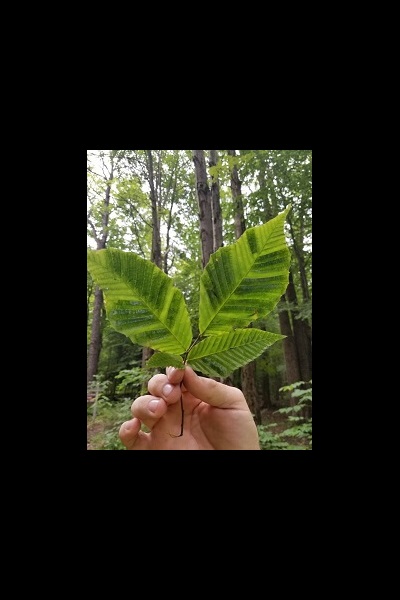
Leaves from an American beech tree infected with beech leaf disease.
Beech leaf disease (BLD) is an emerging and serious threat to Connecticut’s trees and forests. In the United States, it was first identified in Ohio in 2012, and has since spread to multiple states. It was first detected in Connecticut in 2019, and is now widespread in the state. BLD affects both native and ornamental beech species. Symptoms of BLD include leaf damage, canopy thinning, and tree decline.
Beech leaf disease is caused by a non-native nematode (Litylenchus crenatae mccannii). A nematode is a microscopic roundworm. The disease affects the leaves and buds of beech trees, leading to reduced photosynthesis, weakened trees, and, in severe cases, tree death.
Trees at risk
Beech leaf disease affects the American beech (Fagus grandifolia) in North America. Symptoms of BLD have also been observed in European (Fagus sylvatica), Oriental (Fagus orientalis), and Chinese (Fagus engleriana) beech species, which are commonly planted as ornamentals in Connecticut.
Both mature beech trees and saplings are susceptible to the disease, but younger trees often show symptoms earlier and may decline more rapidly.
Beech trees in Connecticut face additional threats to their health – specifically, beech bark disease, introduced to the United States in the late 1800s and well established in Connecticut. This disease complex causes damage to the bark and vascular tissue. There are two steps to infection. First, the beech scale insect (Cryptococcus fagisuga) creates wounds in the tree. Then, the wounds become infected with several fungal species (Neonectria faginata, Neonectria ditissima, and Bionectria ochroleuca). Beech leaf disease adds additional stress to trees already impacted by beech bark disease, worsening the impact. In 2024, an annual survey of about 2,400 beech trees affected by BLD showed that annual growth decreased by 75%.
Infected trees may survive for several years, but repeated defoliation leads to decline and mortality.
Identification
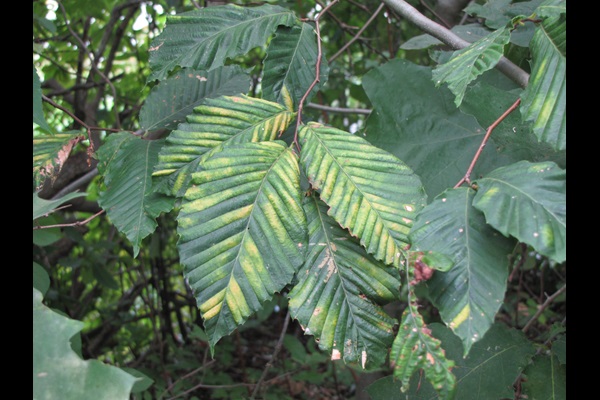
An American beech tree affected by beech leaf disease.
Early symptoms of BLD include dark stripes or bands between the lateral veins of leaves that are visible immediately upon bud break in the spring. Affected leaves may be unevenly distributed in the lower canopy. Leaves with severe symptoms are heavily banded, shrunken, and crinkled with a thickened leathery texture. Affected trees will also show premature leaf drop and bud failure.
Symptoms appear in late spring at leaf-out and worsen throughout the growing season. Infected beech trees often produce two sets of leaves per year – a heavily damaged, symptomatic "first flush" in spring, followed by a healthier "second flush" in late May or June. These second flush leaves form in new buds and appear pale and thin compared to normal leaves. These new leaves lack the Litylenchus crenatae mccannii nematode, and show no symptoms of BLD. While the second flush offers temporary relief, the disease will progress.
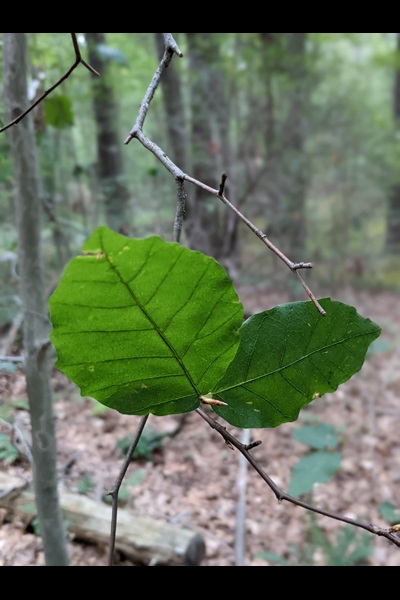
The second flush of leaves on a beech tree affected by beech leaf disease.
Life cycle and behavior
The nematode responsible for BLD lives and reproduces within the leaf and bud tissue of beech trees. It is believed to overwinter in dormant buds and re-emerge in spring as leaves develop. The exact mechanisms of its spread and reproduction are still under investigation, but the nematode’s presence in buds suggests it can persist year to year within the same tree.
Tree mortality can occur within 1 to 5 years for saplings and 6 to 10 years for mature trees. Mortality rates can exceed 90% for young trees in affected areas, with no known cure, making BLD a severe threat to forest health.
Thickets of American beech saplings will often be seen adjacent to mature American beech trees as a result of an adaptive process called root suckering. When facing a threat such as BLD, American beech trees respond by sending up new growth from the roots of the diseased tree. These root sprouts (or suckers) are genetically identical to the parent tree and can develop their own root systems. The mature diseased tree will continue to send up root sprouts, eventually forming a dense thicket of beech saplings around it. Because the root sprouts are genetically identical to the source tree, they will also succumb to whatever diseases the parent is affected by, including BLD. Mortality in the root sprouts is often seen before the mortality of the original, mature beech tree.
Spread and response
BLD has spread rapidly across Connecticut and in neighboring states. Methods of spread include:
- Rain splash
- Wind dispersal
- Movement of infected plant material, such as nursery stock or firewood
- Animal activity
The Connecticut Agricultural Experiment Station (CAES) is actively monitoring the spread of BLD and collaborating with researchers and the DEEP Forestry Division to better understand the disease and develop management strategies.
At this time, there is no known cure for BLD. However, small-scale use of phosphite-based treatments has been shown to protect individual trees. For more information on BLD treatment for yard and community trees, contact a Certified Arborist.
How to help
Residents, landowners, and forestry professionals can support efforts to manage BLD:
- Avoid moving beech material, such as firewood and saplings.
- Monitor trees on your property annually for signs of BLD and document changes.
- For forests, the best defense against beech leaf disease is resilient forest management that supports diverse species, age classes, and forest composition. For more information about the overall health of your forested land, contact your Service Forester.
- Community trees can be effectively treated for BLD on a small scale using a phosphite-based treatment. Contact a Certified Arborist for advice on treating your beech trees.
Reporting BLD-infected trees is no longer requested because the disease is now widespread in Connecticut. If you have questions about the beech trees in your community, you can contact the CAES Plant Disease Information Office.
Resources
USFS Pest Alert: Beech Leaf Disease
CAES: Beech Leaf Disease Biology and Management
Content last updated August 2026.