

Beech Bark Disease in Connecticut
Trees at risk
Identification
Life cycle and behavior
Spread and response
How to help
Resources
Beech bark disease (BBD) is a long-established threat to American beech trees in Connecticut and across the northeastern United States. This disease results from a complex interaction between an invasive insect and a fungal pathogen.
Beech bark disease is caused by the combined effects of the beech scale insect (Cryptococcus fagisuga), which feeds on the bark of beech trees and creates the opportunity for fungal pathogens in the genus Neonectria (primarily Neonectria faginata and Neonectria ditissima) to infect the wounds created by the scale insect. BBD weakens and eventually kills beech trees.
This disease complex is native to Europe and was originally brought to North America in the late 1800s. A new disease affecting American beech, beech leaf disease, is caused by a non-native nematode and was first found in Connecticut in August 2019. Beech leaf disease is a separate, additional stressor for beech trees that have been already affected by BBD.
Trees at risk
The primary species affected by BBD in Connecticut is American beech (Fagus grandifolia). European beech (Fagus sylvatica) may also be susceptible, particularly in ornamental plantings, but the disease is most devastating to American beech populations.
Identification
Symptoms of beech bark disease include:
- White, woolly patches on the bark caused by colonies of beech scale insects.
- Small, sunken cankers on the bark, often reddish or brown in color.
- Cracked bark, especially in advanced stages.
- Crown dieback, reduced leaf production, and eventual tree death.
- Infected trees may also exhibit “beech snap”, where weakened trunks break off during storms or high winds.
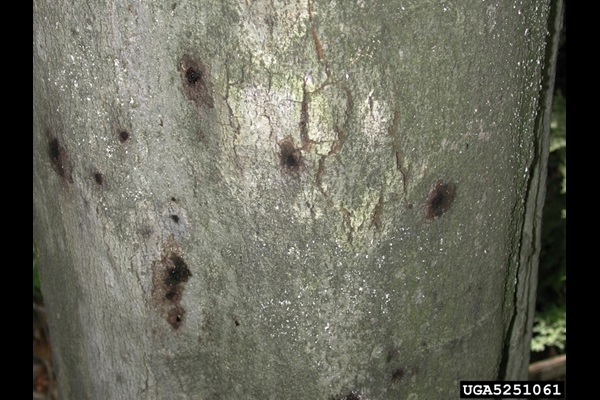
Cankers, cracks, and white fungal patches on an American beech tree caused by beech bark disease.
When beech trees are infected by BBD, they mount a defensive response, sending up shoots from their roots. These young beech shoots grow in clusters around the original diseased tree, creating dense thickets of young stems. While these sprouts keep the tree’s genetics alive, they become infected with the disease and rarely grow into healthy, mature trees.
Life cycle and behavior
The disease progresses in two main stages:
- Insect Infestation: The beech scale insect, introduced from Europe in the late 1800s, feeds on the bark by inserting its stylet into the tree’s tissues. This feeding creates wounds and stress in the tree.
- Fungal Infection: The wounds created by the scale insect allow Neonectria fungi to enter the tree. These fungi form cankers that girdle the tree, disrupting nutrient flow and leading to decline.
The scale insect reproduces asexually and overwinters on the bark, making it difficult to control once established.
Spread and response
Beech bark disease has spread throughout Connecticut and much of the northeastern U.S. since its arrival in North America over a century ago. It spreads through:
- Wind-dispersed scale insects.
- Movement of infested firewood or nursery stock.
- Natural expansion of infected tree populations.
There is currently no cure for BBD, but forest managers and researchers are working to identify resistant trees and promote natural regeneration. Some American beech trees show partial resistance to the scale insect and may survive in affected areas.
How to help
You can support efforts to manage beech bark disease:
- Monitor beech trees on your property or in local forests for signs of scale and cankers.
- Avoid moving firewood from infested areas to prevent the spread of the insect.
- Preserve resistant trees when managing forests or woodlots, as these may help future generations of beech trees survive.
For forests, the best defense against diseases like BBD is resilient forest management that supports diverse species, age classes, and forest composition. For more information about the overall health of your forested land, contact your Service Forester.
Resources
USFS Beech Bark Disease Leaflet 1983
Content last updated April 2026.