


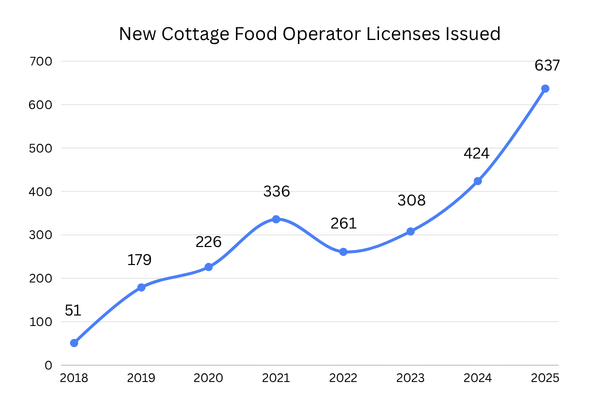
HARTFORD — The Department of Consumer Protection (DCP) Food and Standards Division is reminding businesses and consumers of food safety tips ahead of farmers market season.
In Connecticut, an individual who intends to sell cottage food products directly to consumers, must obtain a Cottage Food Operator (CFO) license through DCP. Cottage food products must be made in a home kitchen and are low-risk for food-related injury or illness. Common cottage food products include loaves of bread, cake pops, candies, and popcorn.
Cottage food businesses are not allowed to sell potentially hazardous foods, which are items that require time and temperature control to prohibit bacteria growth. This includes eggs, meat, poultry, and dairy.
“Connecticut has seen tremendous growth in cottage food businesses across the state,” said DCP Commissioner Bryan T. Cafferelli. “The Cottage Food Program creates opportunities for individuals to start a small business with less overhead costs. Many of these cottage food operations grow to become thriving small businesses in their communities. This summer, if you plan to buy or sell cottage food products at a farmers market, we have a few safety tips to keep in mind as you shop local.”
“Farmers’ markets are one of the best examples of how strong our agricultural community is here in Connecticut. They bring together the farmers who grow our food and the cottage food producers who often rely on local farms for their ingredients driving dollars back into our local economy,” said Connecticut Agriculture Commissioner Bryan P. Hurlburt. “Working alongside our partners at the Department of Consumer Protection, we’re committed to ensuring that the products available to families are safe, responsibly made, and rooted in our state’s agricultural tradition. When you shop at a farmers’ market, you’re supporting the people who grow it and strengthening the connection between our communities and the land.”
For businesses:
- Allergen labeling requirements: If your product contains one of the 9 major allergens (milk, eggs, fish, shellfish, tree nuts, peanuts, wheat, soybeans, or sesame) you must follow the federal labeling requirements. Cottage food operators can either include the allergen in the ingredient list or add a “Contains” statement with the allergens, placed directly after the ingredients.
- Create a detailed ingredient list: You must list all ingredients in descending order by weight, with the heaviest ingredient first. If you use a prepared item, you must list all sub ingredients. For example, “soy sauce” is not acceptable, but “soy sauce (wheat, soybeans, salt)” is acceptable.
- Provide a clear label: You are required to label your cottage food product. Labels must include your business name and address, ingredients, net weight or volume, and the following statement: “Made in Cottage Food Operation That is Not Subject to Routine Government Food Safety Inspection.”
For consumers:
- Read the label closely: Be sure to read the label closely. Review the ingredient list and if the product contains any allergens.
- Ask questions: If you are unsure about the ingredient list or how it is made, feel free to ask the seller questions. They can help explain the process, which can better determine if you would like to purchase the item or not.
- Look at display: Display tables should be under a tent or located in a shady area to prevent direct sunlight.
Frequently asked questions by cottage food businesses:
Can I sell cooked vegetable products, like salsas, tomato or spaghetti sauces?
No, you cannot sell salsas, tomato or spaghetti sauces, or focaccia bread with roasted vegetables. Cooked vegetables, fresh or canned, are often made with low acid and acidified food, which is considered potentially hazardous. View list of prohibited cottage food products
Can a farmers market require a food license for a cottage food business?
Yes, farmers markets or other direct marketing venues may require vendors to have a food establishment license or meet additional requirements. A food establishment license is different from a Cottage Food Operator (CFO) license.
Can I sell my cottage food products online?
You may advertise and take orders for your product online (i.e. social media). However, all transactions must be a person-to-person transaction within Connecticut. Products cannot be mailed or delivered through a third-party delivery service or a mobile food ordering company.
Learn more:
To obtain a Cottage Food Operator license, applicants must receive local zoning approval, complete a food safety course and water supply test, and submit their desired food type, and label to DCP for review. Learn more information about application requirements and how to apply.
To read more about requirements and frequently asked questions about the program, visit Cottage Food in Connecticut webpage.
Those with questions about the Cottage Food Program in Connecticut may contact DCP’s Food and Standards Division at (860) 713-6161, or by emailing dcp.foodandstandards@ct.gov.