


What's New

What’s New
--Updates, Alerts, and News from the PDIO--
August 2017
Disease Alert: Downy Mildew of Impatiens

Above: Lower surface of impatiens leaf with sporulation of the downy mildew pathogen.
The destructive disease impatiens downy mildew has been confirmed on residential plants in CT this summer. The disease is caused by Plasmopara obducens, a fungus-like organism (also called a water mold or oomycete). All cultivars of the common garden impatiens, Impatiens walleriana, are susceptible. However, New Guinea impatiens appear to be tolerant to downy mildew. The downy mildew pathogen is spread by infected plants, water/rain, and wind. Early symptoms of downy mildew begin as light-green yellowing, mottling, or stippling and often go unnoticed. Advanced symptoms include stunting of whole plants, leaves, and flower buds, downward curling of leaves, wilting, plant collapse, and severe defoliation that results in bare, leafless stems. Plants suspected of having this disease should be sent or brought to the PDIO for analysis. If downy mildew is diagnosed on your plants, all infected plants should be dug up (roots included) and placed into municipal trash, when acceptable. Infected plants should not be composted. For more information, please see our fact sheet Downy Mildew of Impatiens by Dr. Yonghao Li.
Disease Alert: Late Blight
Reported in MA- Scout for Late Blight of Tomato and Potato

Late Blight has been confirmed in Hampshire County, MA on cherry tomatoes. It is very important for commercial growers and home gardeners to be on the lookout for late blight of tomato and potato in their fields and community or backyard gardens. The recent weather has been very favorable for the development of this disease, so it is important examine plants for symptoms. Information on this important disease can be found in the fact sheet Late Blight of Tomato and Potato in Connecticut--2012 by Dr. Sharon Douglas.
Any suspicious tomato or potato samples should be sent or brought to The Plant Disease Information Office for examination and diagnosis as soon as possible.
April 2017
Disease Alert: Cedar-Apple Rust
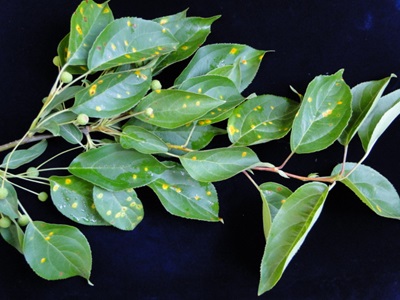
Cedar-Apple Rust was the subject of our What's New update in May 2016 and with all the rainy weather we've been having lately, you may be noticing the interesting orange galls adorning your Juniperus trees and shrubs again. The photo below on the left shows a cedar-apple rust gall on a cedar tree producing spores. These spores may be carried by the wind and infect apple and crabapple trees, which are just beginning to leaf out. Now is the time to begin treating apple and crabapple trees with fungicides to protect them from cedar-apple rust leaf spots (photo below right) and defoliation on heavily infected trees. For more information on this pathogen, please see our fact sheet; Cedar-Apple Rust by Dr. Sharon Douglas.

Disease Alert: Volutella Blight of Pachysandra
Volutella Blight was the subject of our What's New update in March 2016 and it looks like we will be having another spring with conditions favorable for the growth and spread of this pathogen. It is typical for pachysandra to appear yellowish in color following the winter, but if your beds are looking sparse you should examine the plants for signs of Volutella Blight. Brown spots on leaves and black shriveled stems are characteristic of this disease. If you notice any of these symptoms in your pachysandra, please feel free to contact us for confirmation. Cultural control and fungicide applications can help manage this disease.
January 2017
Disease Alert: Oak Wilt
Oak wilt is an aggressive fungal disease which kills thousands of trees annually in the Midwest and Eastern United States. The disease is transmitted to healthy trees by nitidulid beetles which carry the fungal spores on them from infected trees. The disease can also be transmitted from a sick tree to a healthy tree via root systems that have grafted together. So far, oak wilt has not been detected in Connecticut, but the neighboring state of New York has found infected trees in four counties. Here is a link to the Department of Environmental Conservation's article on the recent findings: Deadly Oak Wilt Disease Found in Brooklyn and Several Towns in Suffolk County. The symptoms of oak wilt are most noticeable during the summer when leaf discoloration begins to occur. In red oaks, leaf death and defoliation occur rapidly whereas white oaks tend to die branch by branch over a longer period of time. For more information on this disease and what symptoms to look for, please read the USDA Forest Service brochure: How to Identify, Prevent, and Control Oak Wilt. If oak wilt is suspected on a tree here in Connecticut, branch samples with leaves displaying wilt can be submitted to the PDIO for analysis.