

Small Birds in Distress
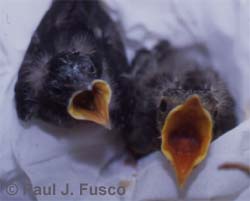
A young bird fell from its nest. What can I do? Birds will not abandon their chicks if you touch them - they have a poor sense of smell. If possible, put the bird back in its nest. If the nest is destroyed or you cannot reach it, place the bird in a wicker or woven stick basket with good drainage and place it in the highest branch near the original nest. If the adult birds do not return in 24 hours or more, then assume the young birds are orphaned and contact one of the volunteers listed below.
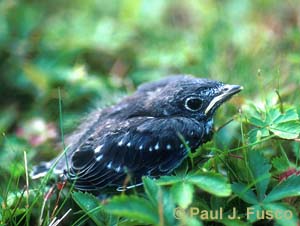
There is a bird outside that cannot fly. Is it an orphan? If the bird is almost full sized and fully feathered, but has a short tail or fleshy gape, it may be a fledgling. Birds leave the nest before they are able to fly. While they are on the ground, the adult birds will continue to feed and look after their young. During this time, keep pets indoors and leave the young bird there!
How can I tell if a bird needs help?
- It is unable to stand or perch with both legs.
- A wing appears to be constantly hanging down or is being held out to the side of its body.
- The bird was attacked by a cat and there is a noticeable puncture wound.
What else can I do? Listed below are volunteers who are authorized to care for sick, injured, or orphaned wild birds with the intent of returning them back to the wild. Most birds are protected by federal and state law, and these volunteers have both the state and federal permits authorizing them to handle protected birds.
Non-native or game bird species: Some bird species do not require a federal permit. House sparrows, starlings, rock pigeons, and mute swans (all non-native) and game birds, such as wild turkeys, ring-necked pheasant, chukar, ruffed grouse, and bobwhite quail, can be cared for by rehabilitators in the list below.
Additional permits are needed for persons to handle and care for hawks, owls, ducks, and geese. If you need assistance with one of these birds, contact a rehabilitator who specializes in Hawks and Owls or Ducks and Geese.
Persons authorized to handle and care for small native birds
Canton
- Roaring Brook Nature Center
- 860-693-0263
Sharon
- Sharon Audubon Center
- 860-364-0520; Ext 106
- Mackenzie.Hunter@audubon.org
- ONLY rehabbing small birds, hawks, owls
Stonington
- Denison Pequotsepos Nature Center
- 860-980-3731
- ledwards@dpnc.org
- Only rehabbing birds of prey and adult songbirds/perching birds
- NO waterfowl; NO baby birds
Waterford
- Waterford Country School, Ben Turner/Tina Cote
- 860-442-9454; dial ext. 4290
- bturner@waterfordcs.org or tcote@waterfordcs.org
- Only rehabbing adult migratory birds (NO baby birds)
Weston
- Wildlife in Crisis
- 203-544-9913
- NO ducks or geese
Rehabilitators who can handle a limited list of bird species
European starlings, house sparrows, rock pigeons (also known as rock doves), and mute swans, which are non-native species in Connecticut, and game birds, such as wild turkeys, ring-necked pheasant, chukar, ruffed grouse, and bobwhite quail, can be cared for by rehabilitators who are not required to have a federal permit to handle these birds. Consult the list below or above to find a rehabilitator near you who can provide assistance for species on this list.
Branford
- Karen L. Hannon
- 203-623-0809
- klhannon2020@outlook.com
Granby
- Margaret Adamec
- 860-653-2671
- megarobs@cox.net
New Fairfield
- Karin Leili Bauer
- 203-994-1015
- kbcattleco@aol.com
Salisbury
- Johanna Walton
- 860-318-6990
- Jojowalt007@yahoo.com
West Hartford
- Mona Cavallero
- 860-280-8418
- mcavallero1@comcast.net
- ONLY transport/advice for small birds, hawks, or owls in Hartford County
Return to Dealing with Distressed Wildlife
Content last updated on October 7, 2026.