

Swimming - CT State Parks and Forests
Swimming
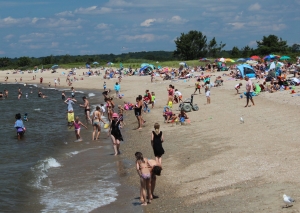
Connecticut State Parks offer many beautiful places to go swimming, from lakes and ponds to the shoreline beaches. Whether you enjoy splashing in cool clear water or sunbathing on warm sparkling sand, our State beaches offer the perfect way to spend a hot summer day.
Where can I swim?
Connecticut offers 21 designated swimming areas. Lifeguard coverage is available at 8 of these designated swim areas. The remaining 13 designated swim areas are not lifeguarded.
Our State Park Lifeguard Squads typically work from 10am-6pm during the summer months of June, July and through mid-August. They are scheduled off two days per week. Training schedules and staffing levels may change scheduled hours, and lifeguard coverage is dependent on season, time of day, and staffing levels.
Our 21 designated swimming area locations are listed below. Areas that typically employ lifeguards are noted with a red + symbol.
- Black Rock State Park, Watertown +
- Burr Pond State Park, Torrington +
- Chatfield Hollow State Park, Killingworth
- Cockaponset State Forest (Pattaconk Recreation Area), Haddam/Chester
- Day Pond State Park, Colchester
- Gardner Lake State Park, Salem
- Gay City State Park, Hebron
- Hammonasset Beach State Park, Madison +
- Hopeville Pond State Park, Griswold
- Indian Well State Park, Shelton +
- Lake Waramaug State Park, Kent
- Mount Tom State Park, Litchfield
- Pachaug State Forest, Voluntown
- Rocky Neck State Park, Niantic +
- Quaddick State Park, Thompson
- Sherwood Island State Park, Westport +
- Silver Sands State Park, Milford +
- Stratton Brook State Park, Simsbury
- Squantz Pond State Park, New Fairfield +
- Wadsworth Falls State Park, Middlefield/Middletown
- Wharton Brook State Park, Wallingford/North Haven
Before you swim:
-
Check the Swimming Area Water Quality Report. It is updated weekly from Memorial Day through Labor Day.
- If the water looks murky, it might be a blue-green algae bloom. View information on algae blooms and what to do if you see one.
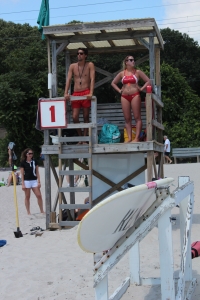
How to Stay Safe
-
Drink Responsibly
Excessive alcohol consumption impairs judgment and reaction ability. Even prescription drugs may impair judgment. -
Parents - Watch your Children
It only takes seconds for a child to drown, and this can occur silently. Please ALWAYS watch your children; if you are more than an arm’s length away, you’re too far! -
Be Aware of Underwater Hazards
Natural swimming areas can have sudden drop-offs, inshore holes, large rocks or tree roots that can’t be easily seen from the surface. Diving and jumping into these waters can be hazardous. Please be careful of these unseen dangers. - Swim only in the designated areas, and stay where the lifeguards can see you!
-
Take a Swimming Lesson
Increasing your water safety knowledge and swimming skills can help save your life. People of all ages should consider signing up for a swimming class offered at your local YMCA branch, American Red Cross Chapter, or municipal parks & recreation department.
-
Follow the Beach Rules:
- No alcoholic beverages, glass, pets, or nudity.
- No flotation devices, only approved lifejackets.
- No snorkels.
- No rough play.
- No sand or rock throwing.
- No "throw-catch" activities.
- No soap or shampoo.
- No fishing.
- Keep the beach area around the lifeguard chair clear.
- Swimmers must stay off buoys and lines.
- Water and the beach will be cleared when lightning is visible or thunder is heard.
Special Access
- Beach Wheelchairs are available at several locations.
- These are specially designed for access over the sand, and can be borrowed for the day. Just be careful - they are NOT designed to be taken into the water.
Remember...
- Water and alcohol DON’T mix! Never swim under the influence.
- Parents - watch your children! Drowning is silent, and can occur in seconds.
- Be careful of underwater hazards, and don’t dive in.
- Never swim alone.
- Always swim in designated areas.
Content updated August 2025