

Winter Moth in Connecticut
Trees at risk
Identification
Life cycle and behavior
Response
How to help
Resources
The winter moth (Operophtera brumata) is a non-native invasive defoliating insect. It was introduced to North America in the 1950s in Nova Scotia. Since the late 1990s, it has spread through New England, infesting forests and agricultural landscapes. It was officially found in Connecticut in 2005.
Winter moth larvae cause extensive damage to hardwood trees and shrubs, potentially leading to tree decline and death. The larvae damage developing leaf buds and foliage, especially in oaks and maples, leading to reduced growth and potential tree mortality. It causes early defoliation in warmer, coastal areas in Connecticut. Winter moth outbreaks occurred in Connecticut in 2015 and 2016.
Trees at risk
Winter moth larvae feed on a diverse range of deciduous tree species. Their primary hosts are oak, maple, birch, ash, linden, and elm trees. They also feed on fruit and ornamental trees, such as apple, cherry, and crabapple, and herbaceous plants like blueberry and viburnum.
Identification
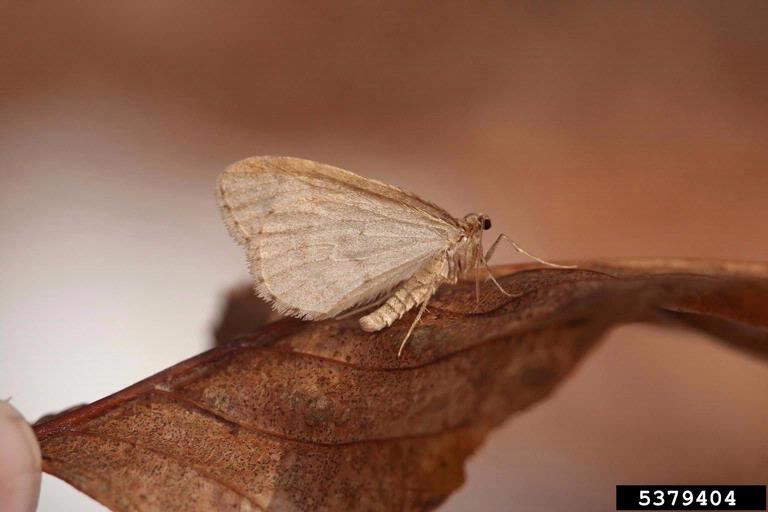
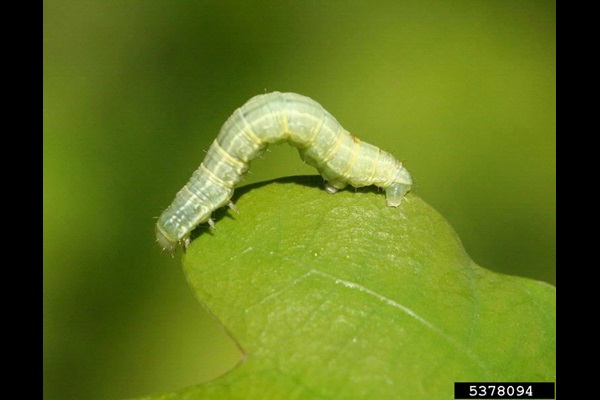
Winter moth caterpillars are pale green with a distinctive white stripe on each side. They are about 1 inch long. Adult males are small (20 to 25 mm), light brown to tan, with fringed hindwing edges. Females are wingless (brachypterous), gray, and climb vertical surfaces to mate and lay eggs.
Winter moths can be mistaken for lookalikes, including the Bruce spanworm (Operopthera bruceata) or fall cankerworm (Alsophila pometaria). Distinguishing the two can be challenging and typically requires expert analysis. Winter moth and Bruce spanworm are able to mate and produce offspring, which makes identification more challenging.
In addition to visual sightings of males flying, caterpillars on buds, and “ballooning” on silken strings, symptoms of a winter moth infestation include a thin tree canopy, bud failure, and small holes in the leaves.
Life cycle and behavior
In early summer (May to June), larvae drop from the tree to the ground and pupate in the soil. Newly-developed adults emerge from the soil in November to December. Wingless females climb tree trunks and emit pheromones that attract large groups of flying males.
In early spring, females lay egg clusters on twigs and bark and then die. In spring, around the time when buds are opening and temperatures average 55° F, newly-hatched caterpillars wriggle into the buds and begin feeding. These larvae feed voraciously on multiple buds.
Larvae produce a strand of silk and float, or “balloon”, off the tree to feed on the plants below. Although females are flightless, they can easily spread from tree to tree by the ballooning of larvae.
Infestations can defoliate a tree within weeks. Repeated annual defoliation can cause branch dieback and eventually tree death. Male winter moths are strongly attracted to light and can be spotted flying around outdoor lights at night.
Response
Since 2006, the parasitoid fly Cyzenis albicans has been released across sites from coastal Maine to southeastern Connecticut. These parasitoid flies were specifically released in New London County. By 2016, larval densities had dropped significantly. By 2022, no significant damage due to winter moth was observed. This is an example of effective biological control of a forest pest.
In addition to regional biological control, additional monitoring and management also occur in Connecticut. Although winter moth activity has decreased from its peak in the mid-2010s, the Connecticut Agricultural Experiment Station (CAES) continues to monitor the insect and investigate emerging forest health issues. High-risk sites, such as sites with oak trees that were weakened by spongy moths, are monitored to look for eggs and larvae feeding on buds and leaves.
In addition to biological control, the best form of response is to encourage a healthy and diverse forest stand. This maintains the tree vigor and biodiversity needed for resilient forests. If you manage a forest, promote forest health by maintaining biodiversity, supporting native plants, and do not introduce infested soil or plants.
Insecticides, including pre-blossom sprays, can be used with some effectiveness in urban and community forests and agricultural areas. An early-spring treatment of the organic pesticide Bt (Bacillus thuringiensis) can control winter moths as they begin to burrow into tree buds. For individual trees, a method called “tree banding” can act as a barrier for climbing caterpillars and adult females in late fall to early winter. However, research does not support the effectiveness of this method for high winter moth population levels.
How to help
Although winter moth populations have been kept in check due to the parasitoid wasp, you can still share sightings and ask questions by contacting the CAES State Entomologist: CAES.StateEntomologist@ct.gov.
When reporting a sighting, include specific details to help the experts at CAES:
- Your location: Provide the address or a general location where you spotted the moth or damage.
- Evidence of damage: The caterpillars can cause severe defoliation of trees and shrubs, including maples, oaks, and fruit trees.
- Photos: Include clear photos of the adult moths, caterpillars, or the damage they have caused.
- Date of sighting: Note when you first observed the insects or damage.
For forest trees, the best defense against pests like the winter moth is the management of resilient forests through the support of diverse species, age classes, and forest composition. For more information about the overall health of your forested land, contact your Service Forester.
Resources
UConn Integrated Pest Management: A Pest Concern in New England: Winter Moth
UMass Extension: Winter Moth Identification and Management
USDA: Biology, spread and biological control of winter moth in the eastern United States
USFS: Contributions of Classical Biological Control
URI Biocontrol Lab: Winter Moth
Content last updated April 2026.