

Verticillium Wilt in Connecticut
Trees at risk
Identification
Life cycle and biology
Response
How to help
Resources
Verticillium wilt is a soilborne fungal disease caused by Verticillium dahliae and Verticillium albo-atrum. These fungi invade tree roots and colonize their water-conducting vessels, interfering with normal water movement. The result is wilting, leaf scorch, dieback, and in severe cases, death of the tree. Although most commonly observed in ornamental and landscape plantings, Verticillium wilt can also affect hardwoods in Connecticut’s forests, creating long-term concerns for forest health. Because the fungus can persist in soil for many years, it is very difficult to manage once a site becomes infested.
Trees at risk
A wide range of woody plants are vulnerable to Verticillium wilt. In Connecticut, the most susceptible include maples, particularly Norway and sugar maple, as well as elms, redbud, and catalpa. Other hardwoods such as birch, ash, and locust may also be affected. Conifers appear to be resistant. The greatest concern for Connecticut’s forests is for native maples, which are highly important for both ecological function and forest composition.
Identification
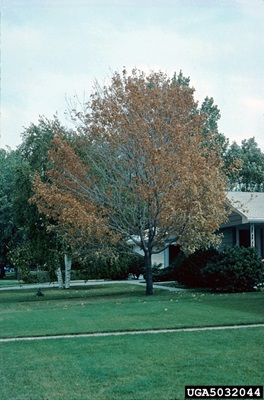
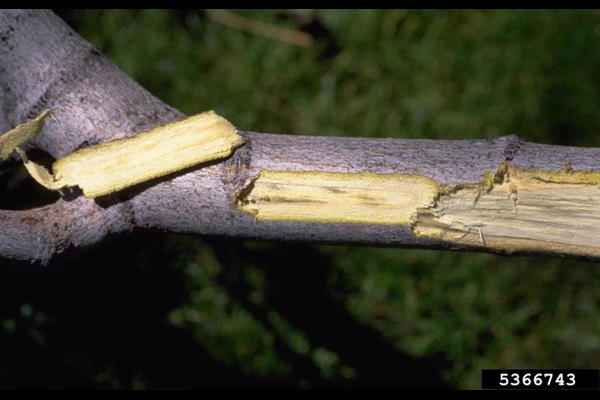
Symptoms of Verticillium wilt can vary considerably. Some trees decline slowly over several years, while others show sudden wilt. Common signs include wilting or “flagging”, where one side or branch of a tree wilts while the rest of the canopy remains green. Leaves may show marginal browning, curling, or early fall coloration, and over time, branches may die back, leaving a thin canopy. When bark is peeled away, olive green to brown streaks in the sapwood can often be seen. These vascular streaks are a useful indicator, but not unique to Verticillium. Because other stressors can mimic the same decline symptoms, laboratory confirmation is necessary, and the Connecticut Agricultural Experiment Station can culture samples to verify infection.
Life cycle and biology
The fungus survives in soil as tiny, dark resting structures called microsclerotia. These structures are long-lived and may persist for more than a decade. When tree roots grow nearby, the microsclerotia germinate and invade fine roots, eventually spreading into the tree’s vascular system. Inside the xylem, the fungus moves upward with the sap stream, blocking vessels directly and triggering host defenses that further interfere with water transport. Symptoms typically become most obvious in mid- to late summer, particularly when hot, dry weather places additional stress on trees. Once present in the soil, Verticillium is very difficult to eradicate, and replanting susceptible trees in the same location often leads to reinfection.
Response
No chemical treatment currently cures Verticillium wilt. Management instead depends on limiting the spread and supporting the health of trees that remain. Severely affected trees should be removed and disposed of properly to reduce inoculum. Fresh chips from diseased trees should not be used as mulch around susceptible species, though they may be composted for at least a year before reuse. Pruning tools should be disinfected with bleach or alcohol after use on infected wood. For trees that remain, efforts should focus on reducing stress, including watering during drought, avoiding soil compaction or root injury, and applying mulch correctly rather than creating harmful mulch “volcanoes”.
How to help
Forest landowners and managers can take proactive steps to reduce the impact of Verticillium wilt. Planting resistant species in known infested sites is an important strategy since many conifers and certain hardwoods show resistance to the disease. Maintaining species diversity in forests and plantings also reduces the likelihood that one disease will cause widespread loss. Promoting soil health through the addition of organic matter may also improve resilience. Regular monitoring for wilt, scorch, or unusual decline in susceptible trees can allow early detection, and suspected cases should be confirmed through laboratory diagnostics before management decisions are made.
The CAES Plant Disease Information Office accepts diagnostic samples from landowners, arborists, and municipalities.
For forest trees, the best defense against fungal pathogens like Verticillium is the management of resilient forests through the support of diverse species, age classes, and forest composition. For more information about the overall health of your forested land, contact your Service Forester.
Resources
CAES Verticillium Wilt of Trees and Shrubs
Content last updated April 2026.