

Oak Wilt in Connecticut
Trees at Risk
Identification
Life cycle and spread
Response
How to help
Resources
Oak wilt is a deadly fungal disease caused by Bretziella fagacearum that blocks the vascular system of oak trees, leading to wilting, browning leaves, and rapid decline. It was introduced to North America, but its exact origin is unknown. It was first detected in North America in Wisconsin in 1942. As of 2026, it has not yet been confirmed in Connecticut, but it has been found in several states, including New York. It has killed tens of thousands of trees throughout eastern North America. Because oaks are a dominant component of Connecticut’s forested landscape, the potential arrival of this disease poses a serious threat. If established, oak wilt could diminish timber value, disrupt wildlife habitat, and present new challenges for forest health.
Trees at risk
Oaks are the host tree for this disease. Not all oak species respond to oak wilt in the same way. Members of the red oak group, such as northern red oak, black oak, and pin oak, are highly susceptible and can die within weeks of infection. White oak is more tolerant but often declines slowly over several years. In Connecticut, where oaks are common across both forest and urban settings, the risk is broad. Trees growing in clusters are especially vulnerable because the disease can spread through interconnected root systems.
Identification
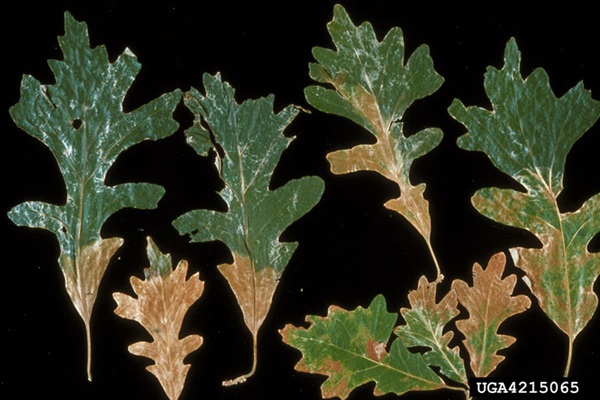
Oak leaves affected by oak wilt disease.
The first signs of oak wilt are often wilting and discoloration in the upper crown or outer branches of the tree. Leaves may brown from the edges inward, sometimes dropping prematurely while still partly green. In red oaks, decline is particularly fast, and trees can die within a single season. Examination of infected branches may reveal dark streaking in the sapwood, and in dead or dying trees, the fungus can form spore-producing mats beneath the bark. These mats sometimes crack the bark and give off a sweet, fermenting odor that attracts insects.
Because similar symptoms can result from drought, bacterial leaf scorch, or other stresses, diagnosis can be difficult. However, oak wilt often causes a more rapid and uniform decline across the crown, with foliage dropping while still green. To confirm the disease, twig samples should be sent to a diagnostic laboratory, such as the Connecticut Agricultural Experiment Station (CAES). Early reporting and testing are essential because oak wilt has not yet been detected in the state.
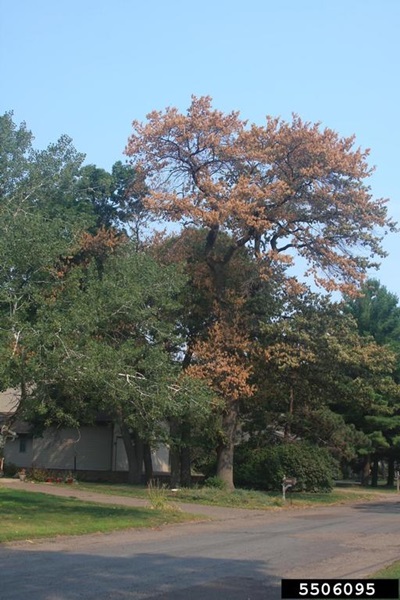
Crown discoloration from oak wilt.
Life Cycle and spread
Oak wilt spreads in several ways. Underground, it can move through root grafts that connect neighboring oaks, allowing the fungus to pass directly from tree to tree. Above ground, sap-feeding beetles are drawn to fungal mats under the bark of infected trees. These beetles pick up spores and can carry them to fresh wounds on other oaks, where the fungus gains entry. Humans also contribute to the spread by moving infected firewood or logs, which can transport the fungus over long distances.
Once established in a tree, the fungus colonizes the xylem, blocking the flow of water and nutrients and causing drought-like symptoms. In red oaks, this process often leads to death within weeks or months. White oaks may survive longer but suffer a gradual decline. Warm, moist conditions promote fungal growth and beetle activity, making spring and summer the riskiest times. Pruning wounds made during these months are especially vulnerable to infection.
Response
Since oak wilt has not yet been detected in Connecticut, the current response centers on prevention and monitoring. The Connecticut Agricultural Experiment Station and the Department of Energy and Environmental Protection track forest health, test suspect samples, and raise awareness among arborists, landowners, and tree wardens. If the disease is confirmed, containment would involve restricting the movement of oak wood, removing and properly disposing of infected trees, and cutting trenches to sever root connections between healthy and diseased trees. Timing and technique are important; wound sealing and pruning avoidance during insect-active months can greatly reduce the risk of spread. Because there is no statewide sampling program, public vigilance and quick reporting remain essential.
How to help
Residents and land managers can take simple steps to protect Connecticut’s oaks.
- Avoid pruning or wounding oak trees during spring and summer, when beetles are most active. If cuts are unavoidable, seal them immediately.
- Do not transport oak firewood or logs, especially from areas where oak wilt is known to occur. Keep trees healthy through good management practices, minimize stress, and use certified arborists who follow best practices.
- Report any sudden or unusual oak decline to the Connecticut Agricultural Experiment Station Plant Disease Information Office so that samples can be tested promptly.
For forest trees, the best defense against fungal pathogens like oak wilt is resilient forest management that supports diverse species, age classes, and forest composition. For more information about the overall health of your forested land, contact your Service Forester.
Resources
USFS Oak Wilt in the Northeastern and Midwestern States
Content last updated July 2026.