

Jumping Worms in Connecticut
Trees at risk
Identification
Life cycle and behavior
Spread and response
How to help
Resources
Asian jumping worms (Amynthas and Metaphire species) are invasive earthworms from East Asia that have become established in Connecticut. Unlike the more familiar European earthworms, these worms are aggressive soil invaders that rapidly consume leaf litter and alter the topsoil. Their presence threatens the health of Connecticut’s forests by changing soil structure, reducing plant regeneration, and disrupting the organisms that depend on a stable forest floor.
Trees at risk
Connecticut’s forests evolved without earthworms. European earthworms were introduced in the 1600s and forests have adapted to their presence. The soil layer known as the “O horizon” — a top layer of rich leaf litter and decomposing organic material — is vital for tree health and regeneration. Jumping worms consume this layer quickly, leaving behind coarse, granular soil that holds less water and nutrients than the typical O horizon. This process occurs more rapidly and on a larger scale than the decomposition effects of European earthworms. Tree seedlings, including sugar maple, oak, and other hardwoods, often struggle to germinate and survive in these altered soils.
Identification
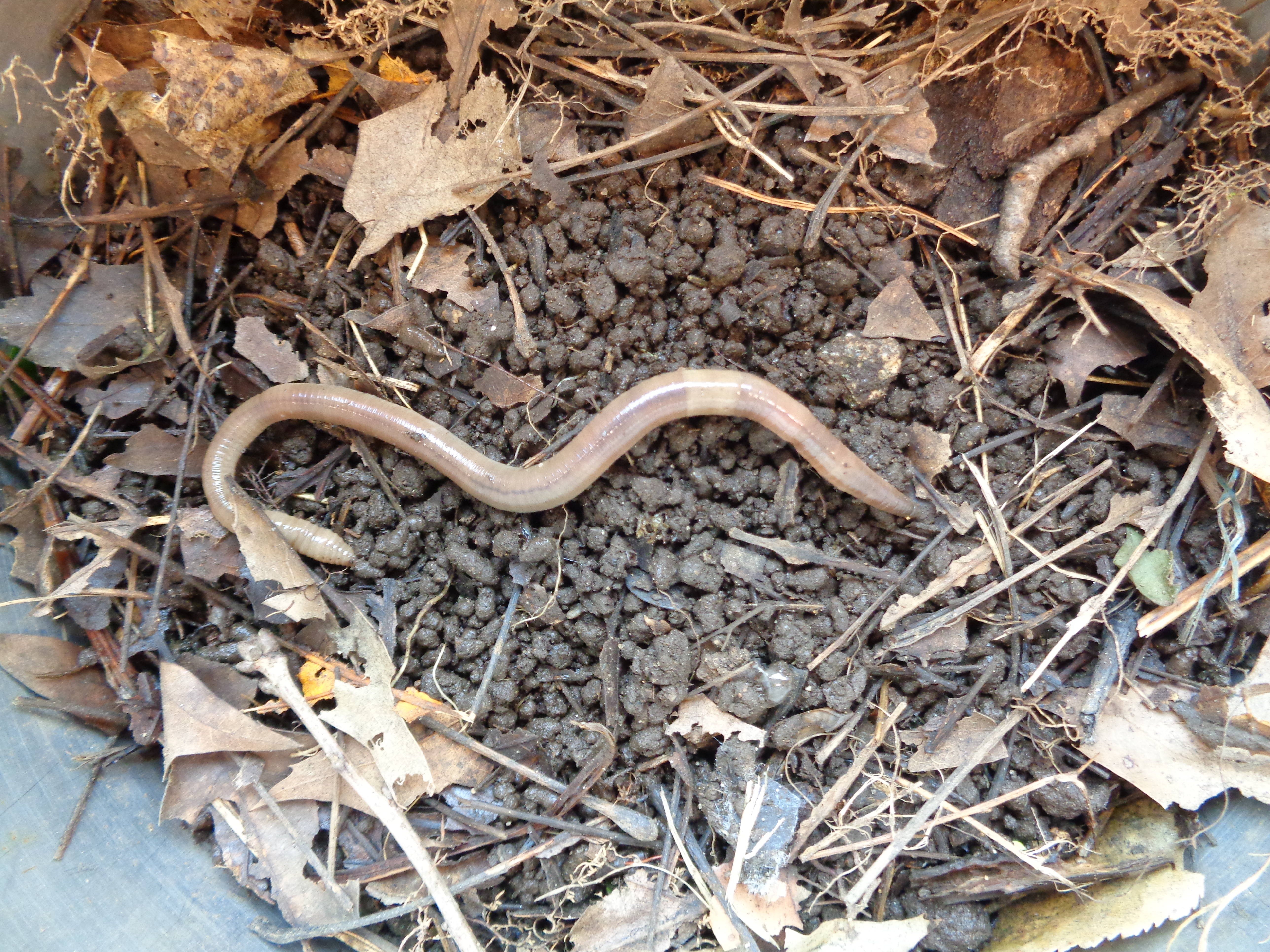
A jumping worm on top of its castings.
Jumping worms can be distinguished from other earthworms by several traits:
- Appearance: Generally larger than European earthworms, adults are 1.5 to 8 inches long with a smooth, light-colored, fully encircling clitellum (collar) close to the head. Unlike European earthworms, this band is not raised.
- Behavior: When disturbed, they thrash wildly, sometimes resembling a snake in motion.
- Soil evidence: Infested soils appear covered in loose castings that look like coffee grounds or Grape-Nuts cereal.
- Habitat: They live and feed near the soil surface, especially in leaf litter, mulch, and compost.
Life cycle and behavior
Jumping worms are annual species. Adults die after the first frost, but tiny, resilient cocoons remain in the soil through winter. These cocoons hatch in spring, producing juveniles that grow rapidly. By mid- to late summer, adults are active at the soil surface. Many species reproduce asexually (without mating), meaning even a single worm can establish a new population. Their constant feeding and burrowing homogenize the soil, stripping away the leaf litter layer that is critical to forest health.
Spread and response
Jumping worms spread primarily through human activity. Their cocoons and juveniles are easily transported in potted plants, mulch, compost, and soil, as well as on tools, shoes, and vehicles. Purchasing bare-root plants can reduce the spread of Asian jumping worms.
Because no proven large-scale eradication methods exist, Connecticut’s response focuses on slowing their spread and raising awareness. Current research is exploring soil treatments and biological controls, but management remains focused on prevention.
How to help
Residents, land managers, and gardeners can play an important role in protecting forests:
- Check soil and plants before moving them to new areas. Use bare-root plants or wash soil from roots.
- Purchase heat-treated mulch or compost to ensure worms and cocoons are killed.
- Clean tools, shoes, and equipment after working in potentially infested soil.
- Do not transport soil, compost, or leaf litter from infested sites.
- Report sightings of jumping worms to iMapInvasives to help researchers develop best practices to prevent their spread.
- Dispose of collected worms responsibly by drowning them in water, or, by sealing them in a plastic bag, freezing them, and placing them in the trash.
For forests, the best defense against pests like jumping worms is the management of resilient forests through the support of diverse species, age classes, and forest composition. For more information about the overall health of your forested land, contact your Service Forester.
Resources
Connecticut Agricultural Experiment Station: Jumping Worms in Connecticut
UConn Soil Nutrient Analysis Lab: Snake or Jumping Worms in Connecticut
UConn Integrated Pest Management Program: Jumping Worms
Content last updated April 2026.