

Elm Zigzag Sawfly in Connecticut
Trees at risk
Identification
Life cycle and behavior
Spread and response
How to help
Resources
The elm zigzag sawfly (Aproceros leucopoda, EZS) is a non‑native insect pest that is relatively new to North America. It was first confirmed in North America in July 2020 in Sainte‑Martine, Québec, Canada. In the U.S., the first detection was in May 2021 in Virginia. Subsequently, it was found in Connecticut in 2024 in Litchfield county.
This insect prefers elm trees (Ulmus spp.), feeding on foliage during its larval stages. The name “zigzag” comes from the characteristic notching pattern caused by early larvae feeding at leaf margins.
While many elm trees can recover from a single defoliation event, heavy or repeated infestations may weaken trees and make them susceptible to other stresses, such as disease, drought, and secondary pests. Additionally, Connecticut’s elms may already be stressed by other pressures (e.g., Dutch elm disease), so the additional burden of an insect pest could exacerbate elm decline.
Because EZS is emerging in the U.S., scientific knowledge about its long‑term impacts in our region is limited.
Trees at risk
All elm species are potential hosts. Elm hosts that can be found in Connecticut include the American elm (Ulmus americana), Slippery elm (Ulmus rubra), and non-native elms used in landscaping. The sawfly is not known to feed on non‑elm trees.Identification
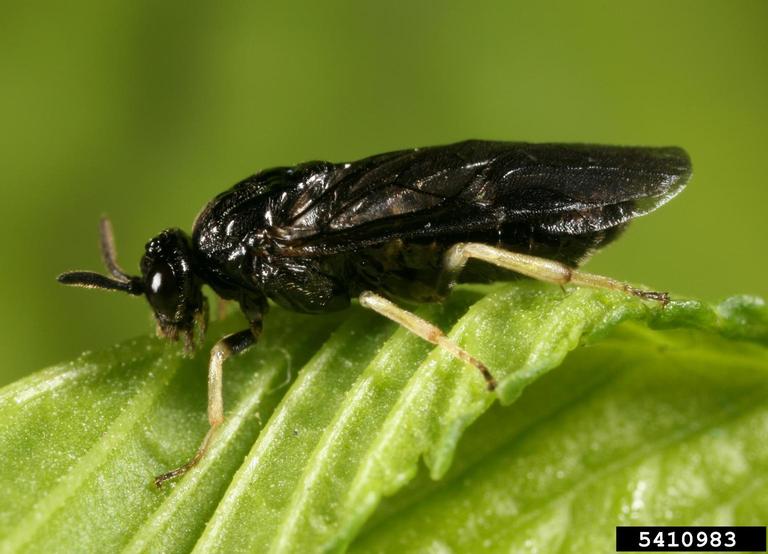
Adult elm zigzag sawfly.
Adult sawflies are wasp‑like in appearance and about 6 to 7 mm in length. They are shiny black, and have smoky brown wings and pale, yellowish legs that often have white tips. Interestingly, no adult males have been observed.
Newly-hatched larvae are grayish-white and small, around 1.8 mm. Mature larvae are green, roughly 10 to 11 mm long, with a dark band on the head capsule and T‑shaped dark markings on the second and third pairs of thoracic legs. You may also see their cocoon. In summer, it will be a loosely woven, net‑like structure attached to leaves, branches, or nearby objects. Overwintering cocoons are denser and typically found in leaf litter, soil duff, or ground debris near the base of trees.
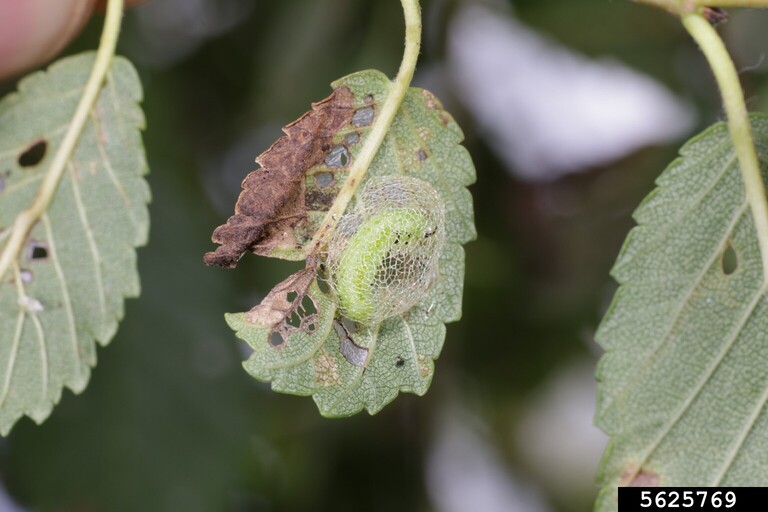
Elm zigzag sawfly cocoon.
You are likely to see evidence of the sawfly before finding the adult. Early instar larvae chew notches into the sides of elm leaves, cutting inward about 5 to 10 mm from the margin, creating a zigzag or scalloped “notch” pattern. As larvae grow, they may consume more of the leaf blade, leaving only the midrib and veins, possibly eliminating the zigzag motif.
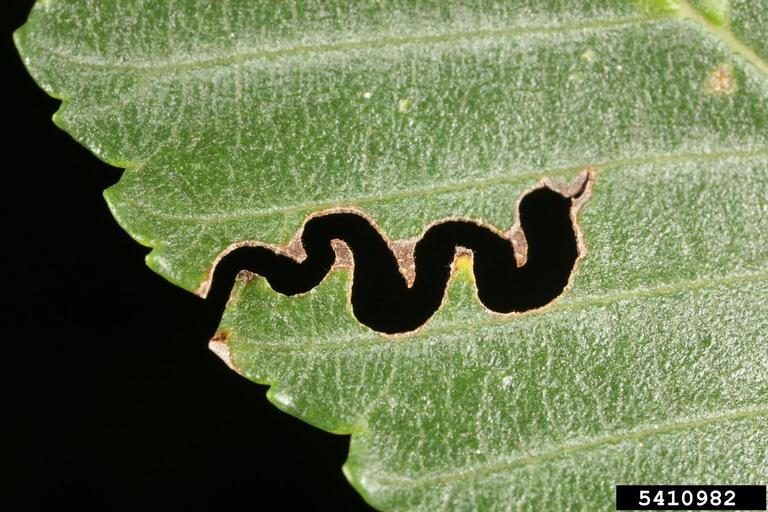
Characteristic zigzag pattern from the elm zigzag sawfly.
Due to the small size of eggs and early larval stages, early infestations may go unnoticed until damage becomes more apparent. Heavy infestations of elm zigzag sawfly may lead to partial or full defoliation of branches or entire trees.
Life cycle and behavior
The elm zigzag sawfly reproduces through parthenogenesis, meaning all individuals in introduced populations are female and reproduce without mating. Adult sawflies have a short lifespan of just 1 to 6 days and begin laying eggs shortly after emerging. Each female lays between 7 and 60 eggs along the serrated edges of elm leaves. These eggs, which measure about 0.8 to 1.0 mm, are initially bluish-green and turn black just before hatching, usually within 4 to 8 days under favorable conditions.
After hatching, larvae feed on elm leaves for approximately 15 to 18 days, progressing through six instars. Once fully developed, they spin cocoons and pupate within them for 2 to 3 days, emerging as adults 4 to 7 days later. During summer, cocoons are loosely woven and often found attached to leaves or nearby structures. For overwintering, however, the cocoons are more robust and located in soil or leaf litter.
The number of generations per year varies by climate. While two generations have been recorded in parts of the southeastern U.S., as many as 4 to 6 generations per year have been documented in Europe. This ability to rapidly reproduce allows populations to grow quickly in favorable conditions.
Spread and response
Because the EZS can complete multiple generations in favorable conditions, populations may escalate quickly.
The elm zigzag sawfly can spread both naturally and through human activity. Adults are strong fliers and may disperse up to 56 miles annually, colonizing nearby elm populations. Human-assisted movement, however, poses a greater risk for long-distance dispersal. Cocoons or pupae can cling to elm foliage, branches, firewood, nursery stock, and even vehicles or equipment.
As a result, moving infested material can inadvertently introduce the pest to new areas. Preventive steps include avoiding the movement of elm material and maintaining tree health through watering, mulching, and pruning of infested branches.
Because this pest is relatively new to North America, management approaches are still being developed. However, several practices are recommended.
- Monitoring and early detection are crucial. Residents and professionals should inspect elms for distinctive zigzag feeding patterns and report any sightings.
- Physical controls include handpicking larvae, spraying them off leaves with water, or removing cocoons.
- Research is ongoing into biological control options, including identifying natural predators or parasitoids that may help manage populations. Long-term integrated pest management strategies will likely involve collaboration among forestry agencies, researchers, extension services, and citizen scientists.
- Though no insecticides are currently labeled specifically for this pest in many jurisdictions, some broad-spectrum products effective against sawflies may be considered for high-value trees. These should be applied early, as soon as larvae emerge.
How to help
- Monitor elm trees, especially during late spring and summer, for defoliation. Examine leaf edges for zigzag damage and look for larvae or cocoons on leaves or nearby surfaces.
- Report findings: Take clear photos, note the location, and email the information to the Connecticut Agricultural Experiment Station at CAES.StateEntomologist@ct.gov. You may also be asked to submit specimens for confirmation.
- Prevent the spread of the elm zigzag sawfly: Avoid transporting elm wood, branches, or nursery stock from infested areas. Inspect vehicles, tools, and plant material before moving them. Promoting overall tree health can increase resilience against infestation. Finally, educating neighbors and professionals, volunteering with local organizations, and staying informed will strengthen early detection and response efforts.
Although the elm zigzag sawfly has not yet been confirmed in all areas of Connecticut, increased awareness and proactive management are key to limiting its spread and minimizing its impact on the state’s elm populations.
For forest trees, the best defense against insect pests like the EZS is the management of resilient forests through the support of diverse species, age classes, and forest composition. For more information about the overall health of your forested land, contact your Service Forester.
Resources
CAES Elm Zigzag Sawfly Fact Sheet
USFS Elm Zigzag Sawfly Pest Alert
UMass Amherst Extension Elm Zigzag Sawfly Fact Sheet
Invasive Species Centre (Canada) Elm Zigzag Sawfly
University of Georgia “Zigzag Sawfly: A New Invasive Pest on Elm”
Elm Zigzag Sawfly Confirmed in Massachusetts
Content last updated April 2026.