

Dutch Elm Disease in Connecticut
Trees at risk
Identification
Life cycle and spread
Response
How to help
Resources
Dutch elm disease (DED) is a devastating vascular disease of elm trees caused by two fungal pathogens, Ophiostoma novo-ulmi and O. ulmi. It remains the most destructive elm disease in North America. Since its first introduction to western Connecticut in 1933, the disease has killed millions of American elm trees across the Northeast and continues to threaten the remaining elm populations in Connecticut.
Trees at risk
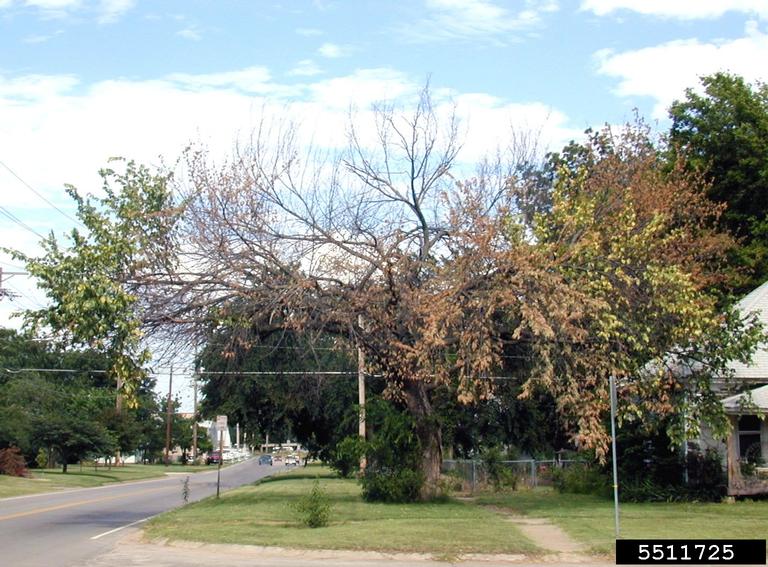
An elm tree affected by Dutch elm disease.
The American elm (Ulmus americana) is especially vulnerable to DED and has suffered the greatest losses. Other native and ornamental elms, such as slippery elm (U. rubra) and rock elm (U. thomasii), as well as European and hybrid cultivars, are also susceptible. Some Asian species, including Chinese elm (U. parvifolia), Siberian elm (U. pumila), and Japanese elm (U. japonica), along with hybrids bred for resistance, are less prone to infection. Older and stressed trees, particularly those growing along streets or in confined urban spaces, tend to be at higher risk.
Identification
DED is often recognized by wilting or “flagging” leaves on a single branch or section of a tree. These leaves may yellow, brown, and drop prematurely, while the rest of the canopy remains green. As the disease progresses, entire limbs or sections of the crown may die back. In some cases, when trees are connected through root grafts, the entire crown may decline rapidly.
Cutting into an infected branch often reveals brown streaking or discoloration in the wood beneath the bark, a hallmark sign of fungal invasion.
Life cycle and spread
Dutch elm disease is caused primarily by the Ophiostoma novo-ulmi and Ophiostoma ulmi fungi that infect the water-conducting tissues of elm trees. The fungus overwinters in the wood of infected trees and is spread primarily by elm bark beetles, including the smaller European elm bark beetle (Scolytus multistriatus) and native species. These beetles carry fungal spores on their bodies and introduce them into healthy trees while feeding on young twigs. They also lay eggs beneath the bark of weakened or dying trees, and the larvae create galleries where the fungus grows and produces more spores. Within an infected tree, the fungus colonizes the vascular system, blocking water transport and causing wilting, dieback, and ultimately death. The disease can also spread underground through root grafts and through pruning tools, allowing it to move quickly between neighboring trees.
Response
Managing DED requires a combination of practices aimed at limiting fungal spread and protecting high-value trees. Severely infected or dying trees should be removed promptly, and the wood must be destroyed or debarked to eliminate bark beetle breeding sites. In cases of limited infection, pruning back into healthy wood may save part of the tree, though tools must be disinfected between cuts to avoid spreading the fungus.
Insecticide treatments may reduce bark beetle activity, and in some cases, systemic fungicide injections are used to suppress infection in valuable specimens. Preventing root graft transmission through trenching can also be effective. For long-term solutions, planting resistant elm cultivars or hybrids is strongly recommended.
The Connecticut Agricultural Experiment Station (CAES) is the lead state institution responsible for monitoring, diagnosing, and providing management guidance for DED.
How to help
Regular monitoring of elm trees for signs of wilting, browning, or branch dieback is critical for early detection. Avoiding injuries to tree bark helps reduce opportunities for infection, while disinfecting pruning tools prevents accidental spread between trees.
If an infected elm is identified, it should be reported and removed quickly, with wood disposed of properly by chipping, debarking, or burning. Where feasible, root separation between adjacent elms can prevent disease from moving underground. Planting resistant elms is encouraged for replacement and reforestation efforts, ensuring that future generations can enjoy these iconic trees.
For forest trees, the best defense against fungal pathogens like Dutch elm disease is the management of resilient forests through the support of diverse species, age classes, and forest composition. For more information about the overall health of your forested land, contact your Service Forester.
Resources
CAES Dutch Elm Disease Fact Sheet
CAES Bulletin 1935 Dutch Elm Disease in Connecticut
Content last updated April 2026.