


Office of Forest Health
Office of Forest Health
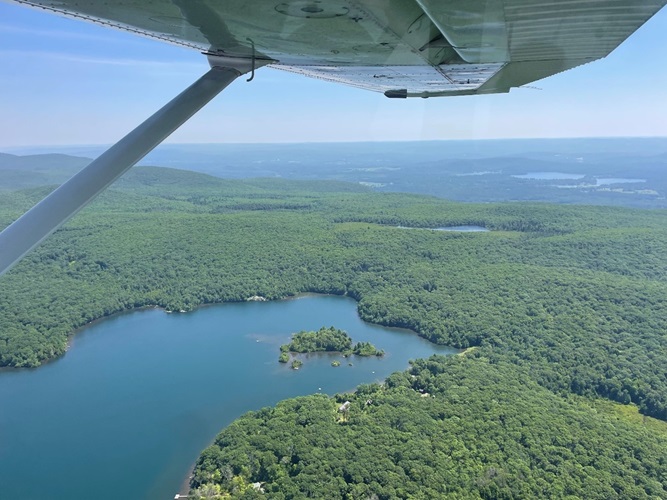
Forests in the Northeast face multiple stressors, which threaten their ability to provide important social and ecological services. These include pest, pathogen, and plant invasions; climate change; forest conversion and fragmentation; and overbrowsing by white-tailed deer. As the lead forest health agency in the state, CAES works in cooperation with the USDA Forest Service, the CT Department of Energy and Environmental Protection Division of Forestry, and other state and federal agencies to monitor and manage threats to Connecticut’s 1.78 million acres of forested land. These initiatives include an annual aerial survey to detect landscape-level changes in tree health and mortality, ground surveys to evaluate specific agents of damage, and research to investigate the impacts of changing conditions on forest ecosystem health and productivity.
| Department | Staff Member | Role |
|---|---|---|
| Environmental Science and Forestry |
Elisabeth Ward, Ph.D. | Forest Ecologist, CT Forest Health Program Coordinator |
| Scott Williams, Ph.D. | Chief Scientist and Department Head | |
| Joseph P. Barsky | Certified Forester and Research Technician | |
| Jack Hatajik | Forest Health Technician | |
| Susanna Kerio, Ph.D. | Forest Pathologist (Urban tree health, Chestnut blight) | |
| Entomology |
Claire Rutledge, Ph.D. | Forest Entomologist (Emerald ash borer, southern pine beetle) |
| Jacob Ricker | State Entomologist | |
| Tia Blevins | Nursery Inspector (Spongy moth, Elm zigzag sawfly) | |
| Raffaela Nastri | State CAPS Coordinator | |
| Plant Pathology and Ecology | Robert Marra, Ph.D. | Forest Pathologist (Beech leaf disease, Oak wilt) |
| Raquel Rocha, Ph.D. | Nematologist (Beech leaf disease) | |
| Yonghao Li, Ph.D. | Plant Disease Information Office | |
| Felicia Millet | Plant Disease Information Office | |
| Valley Laboratory | Carole Cheah, Ph.D. | Entomologist (Biocontrol of hemlock woolly adelgid) |
| Richard Cowles, Ph.D. | Plant pathologist/Entomologist | |
| Nathaniel Westrick, Ph.D. | Plant Pathologist (Oak wilt, Chestnut blight) | |
| Jatinder Aulakh, Ph.D. | Invasive Plant Biologist | |
| Jeffrey Fengler | Nursery Inspector (Spongy moth, Elm zigzag sawfly) |
Current areas of research include:
- Tree regeneration and understory plant communities in response to canopy tree mortality from pests, pathogens, and diseases to inform forest management
- Promoting forest health in New Haven parks impacted by Beech leaf disease
- Mechanisms of beech decline from beech leaf disease
- The impacts of beech leaf disease on soil carbon cycling and mycorrhizal communities
- The effectiveness of potassium phosphite bark spray treatments in mitigating beech leaf disease symptoms
- Long-term tree regeneration and forest stand dynamics in response to different disturbance regimes and management strategies
- Revisiting biocontrol options for chestnut blight with hypovirulent strains of Cryphonectria parasitica
One example of a project conducted by Jacob Ricker, Jeffrey Fengler, Tia Blevins, and Raffaela Nastri is an annual winter spongy moth (Lymantria dispar dispar) egg mass survey. Spongy moth is an invasive forest pest that can cause episodic but severe defoliation of oaks, which can cause widespread mortality after several years of repeated defoliation. Spongy moth egg mass surveys help forest practitioners and land managers track spongy moth population levels to predict when and where severe defoliation events might occur. In Connecticut, CAES has been monitoring spongy moth population levels through egg mass surveys for decades, and methods of displaying the collected data have changed over time. Approximately 103 sites and their locations are visually surveyed each year for spongy moth egg masses during the months of October to March.
Click this link to see how spongy moth egg mass numbers have changed across the state during our most recent outbreak from 2016 to 2024: Spongy Moth Winter Egg Mass Surveys
Link to our biennial newsletter: 2024 Forest Health Highlights
We also host an annual Forest Health Symposium to communicate forest health issues to practitioners in the state. Links to past agendas and presentations are available below.
Forest Health Monitoring Workshops:
- March 10, 2026
- March 11, 2025
- March 12, 2024
- March 7, 2023
- March 8, 2022
- March 4, 2021
- March 5, 2020
- March 5, 2019
- March 8, 2018
- March 7, 2017
This program is supported with funding from the USDA Forest Service. In accordance with Federal law and U.S. Department of Agriculture (USDA) civil rights regulations and policies, this organization is prohibited from discriminating on the basis of race, color, national origin, sex, age, disability, and reprisal or retaliation for prior civil rights activity. (Not all prohibited bases apply to all programs.) Persons with disabilities who require alternative means of communication for program information (e.g., Braille, large print, audiotape, American Sign Language, etc.) should contact the responsible State or local Agency that administers the program or USDA’s TARGET Center at (202) 720-2600 (voice and TTY) or contact USDA through the Federal Relay Service at (800) 877-8339. Additionally, program information is also available in languages other than English. To file a program discrimination complaint, complete the USDA Program Discrimination Complaint Form, AD3027, found online at How to File a Program Discrimination Complaint and at any USDA office or write a letter addressed to USDA and provide in the letter all of the information requested in the form. Submit your completed form or letter to USDA by: (1) mail: U.S. Department of Agriculture, Office of the Assistant Secretary for Civil Rights, 1400 Independence Avenue, SW, Washington, D.C. 20250- 9410; (2) fax: (202) 6907442; or (3) email: program.intake@usda.gov .
Last Edited: July 2, 2026